What causes asphalt cracks? Learn how water, traffic, heat, poor drainage, and weak base preparation damage pavement - and how to plan lasting repairs.
Choosing Concrete Fixings for Steel Posts
Steel posts rarely fail because the post itself was undersized. More often, the weak point is at the base – the connection into concrete. That is why choosing the right concrete fixings for steel posts matters on everything from small fence lines to structural supports, handrails, bollards, and canopy frames. Get the fixing wrong and you can end up with movement, cracking, pull-out, or a base plate that never sits properly.
On site, the right choice usually comes down to four things: the load, the concrete condition, the base plate detail, and how quickly the job needs to move. There is no one-size-fits-all anchor. A post carrying lateral impact near a driveway has a different demand than a light sign post on a residential slab. The fixing method needs to match the application, not just the hole size in the plate.
What matters when selecting concrete fixings for steel posts
The first question is whether the post is carrying structural load, impact load, or just light-duty restraint. A decorative post on a non-critical application might suit a straightforward mechanical anchor. A heavily loaded post, or one exposed to repeated side load, often calls for a higher-capacity system with proper embedment and edge distance.
Concrete strength also matters. Anchoring into sound, fully cured concrete is very different from fixing into a thin slab, older cracked concrete, or a section with unknown reinforcement congestion. If the slab is shallow or the anchor lands too close to an edge, your fixing options narrow quickly. Some anchors perform well in cracked concrete, while others lose capacity fast when conditions are less than ideal.
Then there is the base plate itself. Hole diameter, plate thickness, weld quality, and leveling requirements all affect the anchor choice. Oversized holes can make installation easier, but they can also require washers or heavier anchor hardware to transfer load correctly. If the plate needs to be packed and grouted, that changes the effective anchor behavior as well.
Mechanical vs chemical concrete fixings for steel posts
In most post base applications, the decision sits between mechanical anchors and chemical anchors. Both can work well. The better option depends on the job conditions.
Mechanical anchors
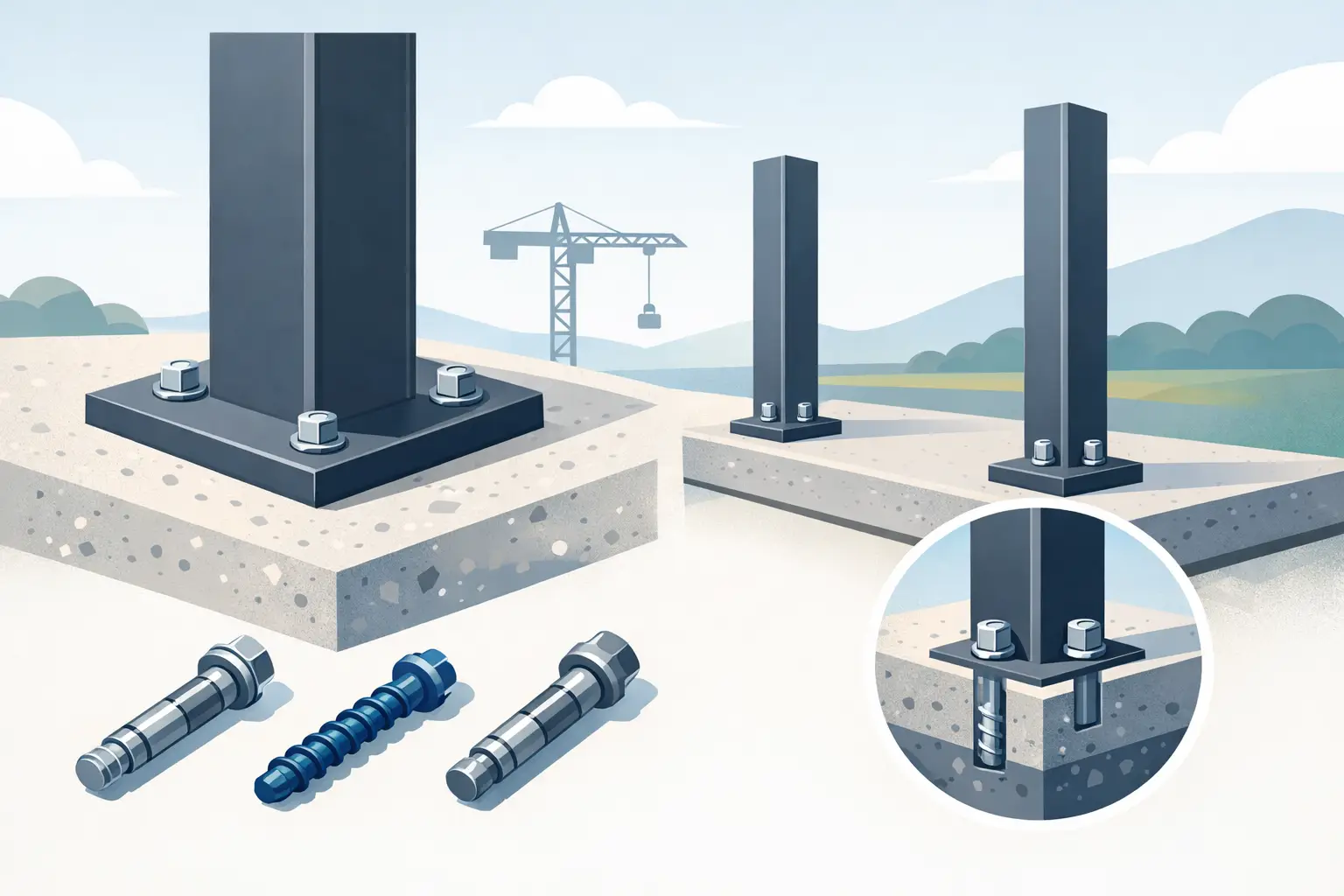
Mechanical anchors are often chosen when speed matters. Wedge anchors, sleeve anchors, and through bolts are common on jobs where the concrete is sound and access is straightforward. Installers like them because once the hole is drilled and cleaned, the fixing can be set quickly and loaded without waiting for cure times.
For steel posts, wedge anchors are widely used because they provide strong holding power in solid concrete. They are a practical choice for base plates on bollards, barriers, handrails, and many post-installed steel supports. The trade-off is that they need enough slab depth and suitable edge distance. In thin concrete or near slab edges, expansion forces can create problems.
Sleeve anchors can suit lighter-duty work and are sometimes more forgiving in certain base plate setups, but they are not the automatic answer for high-load applications. Through bolts can be useful in some cases, especially where the post and slab configuration are simple, but they still need to match the load path and substrate.
Chemical anchors
Chemical anchors come into their own when you need flexibility in embedment depth, reduced expansion stress, or higher performance in difficult conditions. A threaded rod set with approved anchoring adhesive can be a strong solution for steel posts, especially where edge distance is limited or the slab detail does not suit an expansion anchor.
They also help when hole alignment needs to be more controlled. With the right system, you can set rods accurately to suit a base plate template, which is useful on jobs where the post position is fixed by survey or fabrication detail.
The trade-off is installation discipline. Hole cleaning matters. Resin selection matters. Temperature matters. Cure time matters. If the installer rushes the process, chemical anchors can underperform badly. They are not difficult, but they do leave less room for sloppy site practice.
Base plate and load considerations
A steel post does not load every anchor equally. Base plate geometry, post height, and direction of force all influence the fixing demand. A tall post with side load creates tension on one side of the plate and compression on the other. In that case, the anchors are not just holding the plate down – they are resisting overturning.
That is why anchor spacing and embedment should never be treated as a simple hardware decision. The fixing has to work with the plate design. If the plate is too thin, it can deform and reduce how the load transfers to the anchors. If the anchors are too close together, the concrete breakout cone can overlap and cut capacity.
For impact-prone areas, such as vehicle approaches or service yards, the anchor system should be chosen with that risk in mind. A post that looks fine under static load may not be adequate once repeated knocks or sudden side force are introduced. That is where engineering input becomes more than a box-ticking exercise.
Installation details that make or break the result
The anchor type matters, but installation quality usually decides whether the fixing performs as intended. Drill diameter needs to match the manufacturer specification exactly. Overdrilled or shallow holes reduce reliability. Hole cleaning is often ignored, especially on fast-moving jobs, but dust left in the hole can compromise both mechanical grip and adhesive bond.
Torque is another common issue. Mechanical anchors need to be tightened correctly. Under-torquing can leave the fixing loose. Over-torquing can damage the anchor, crush the concrete, or distort the base plate. A calibrated approach is better than guessing with a spanner and calling it done.
Leveling also needs attention. Packers and non-shrink grout may be required under the base plate, depending on the design. If the plate is bearing unevenly, the anchors can pick up loads they were not meant to carry. That often shows up later as looseness, movement, or cracking around the fixing points.
Common mistakes with concrete fixings for steel posts
One of the most common mistakes is selecting anchors based only on diameter. A 1/2-inch fixing is not automatically equivalent to another 1/2-inch fixing if the embedment, anchor type, and concrete condition differ. Capacity comes from the full system, not just the size stamped on the box.
Another issue is ignoring slab thickness. On residential and light commercial work, the slab may not have enough depth to suit the preferred fixing. Installers sometimes drill anyway and hope for the best. That can lead to blowout on the underside, poor set, or reduced holding strength.
Edge distance is another frequent problem. Posts installed near slab ends, joints, or saw cuts need extra care. Expansion anchors placed too close to an edge can crack the concrete or lose performance under load. In those situations, a chemical anchor or a revised base detail may be the better route.
Corrosion resistance should not be overlooked either. Exterior posts, coastal jobs, and wet service areas may require galvanized or stainless hardware depending on exposure. Saving a little on anchors only to replace corroded fixings later is false economy.
Matching the fixing to the job
For light-duty posts on good-quality concrete, a mechanical anchor may be the quickest and most cost-effective choice. For higher loads, limited edge distance, or more demanding post bases, chemical anchors often give you more control and better performance. For anything carrying real structural demand, the fixing should match the engineer’s detail and the anchor manufacturer’s tested data.
That is where supply matters as much as product selection. Trade buyers do not just need a box of anchors. They need the right type, the right grade, and enough stock to keep the crew moving. Delays on small components can stall steel installation just as easily as delays on the posts themselves.
A supplier that understands reinforcement, concrete work, and site sequencing is usually easier to work with when the job changes midstream. If the slab condition is different from the drawings, or the base plate detail shifts, practical product guidance saves time. That is part of the reason contractors use specialist suppliers like Quality Steel Supplies rather than treating fixings as an afterthought.
When to slow down and check the detail
Some post installations are straightforward. Others are not. If the post supports a gate, barrier, balustrade, structural frame, or anything subject to impact or crowd load, it is worth slowing down and checking the anchor detail before drilling. The cost of rework is usually far higher than the cost of choosing the correct fixing from the start.
The best concrete fixing for a steel post is the one that suits the load case, slab condition, base plate, and exposure environment without creating installation headaches. That might be a wedge anchor on one job and a chemical anchor with threaded rod on the next. What matters is not brand loyalty or habit. It is whether the fixing will hold up once the post starts doing real work.
If you are ordering for an upcoming job, treat the post base like a critical connection, not a minor accessory. It is one of the smallest line items on the order, but it can decide whether the install stays tight, compliant, and on schedule.
Related Posts