What causes asphalt cracks? Learn how water, traffic, heat, poor drainage, and weak base preparation damage pavement - and how to plan lasting repairs.
Stirrups for Beam Reinforcement Explained
A beam rarely fails where the eye expects it. Most site teams focus on the main longitudinal bars, but stirrups for beam reinforcement are what keep those bars working as a cage and help the beam deal with shear, diagonal tension, and confinement where loads get serious. If the stirrups are wrong, spaced badly, or installed loosely, the beam can lose performance fast even when the main steel looks adequate on paper.
For builders, concrete crews, and procurement teams, this is not just a design detail. It affects fabrication accuracy, installation time, inspection outcomes, and whether the pour goes ahead without rework. Getting stirrups right means fewer site delays and less chance of finding a problem once the formwork is closed up.
What stirrups do in a reinforced concrete beam
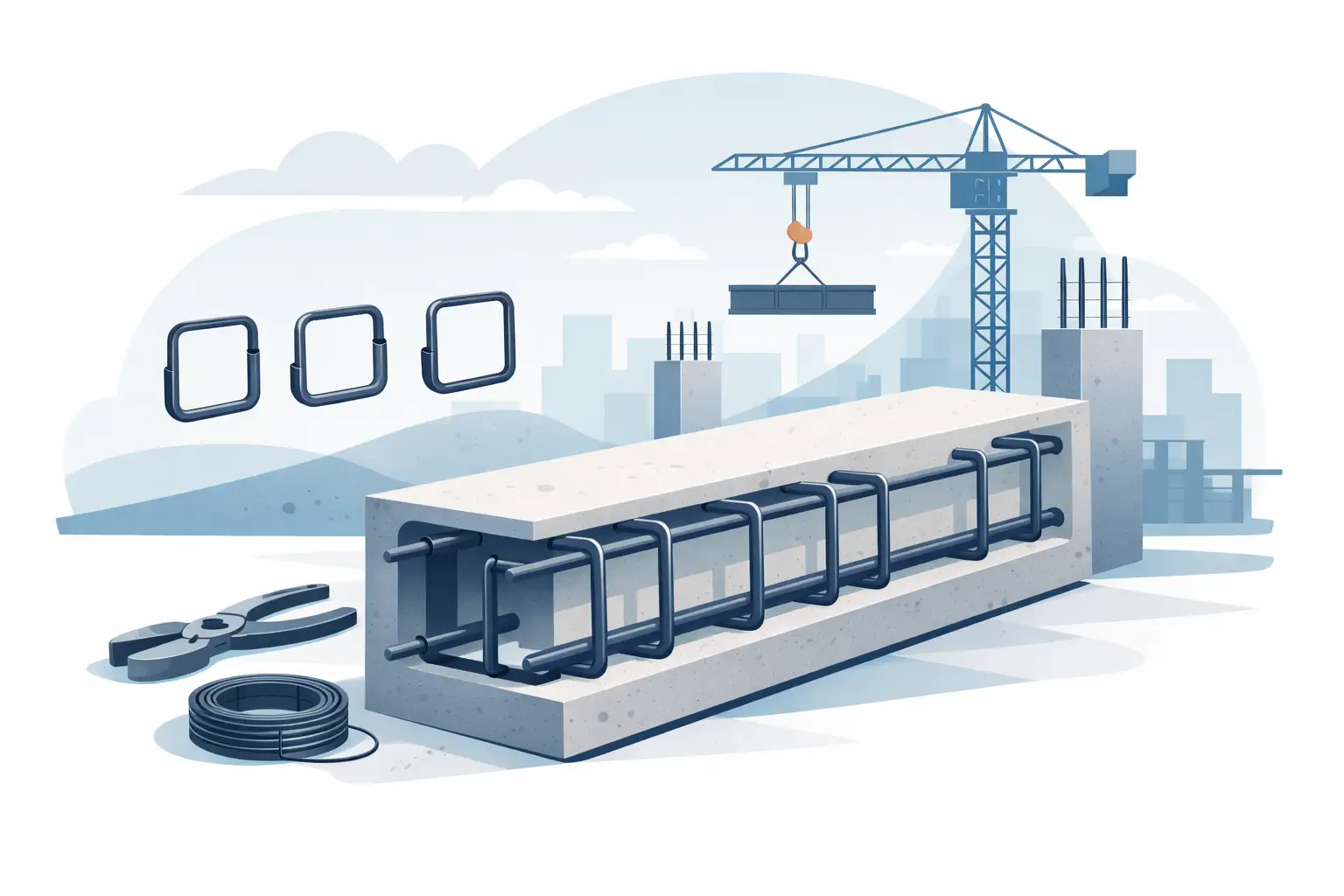
Stirrups are closed or partially closed ties placed around the main beam bars at set centers. Their first job is to resist shear forces, especially near supports and other high-stress zones where diagonal cracking is more likely. Concrete handles compression well, but it is weaker in tension. When shear loads build, stirrups act across potential crack lines and help the beam keep carrying load after cracking starts.
They also hold the longitudinal reinforcement in position. That matters more than some crews admit. During transport, placement, and concrete vibration, main bars can shift if the cage is not tied tightly and supported correctly. Stirrups maintain spacing, help preserve cover, and keep the beam cage aligned with the engineer’s intent.
There is also a confinement role. In heavily loaded beams, stirrups help restrain the core concrete and provide lateral support to compression bars. That can improve behavior under load, but the level of benefit depends on the beam geometry, loading, and reinforcement layout.
Why stirrups for beam reinforcement matter on site
On drawings, a beam cage can look straightforward. On site, there are always practical pressures – congested steel, awkward beam-column junctions, service penetrations, and a crew trying to keep the pour on schedule. That is where stirrup quality and fit-up start to matter.
If stirrups are fabricated to the wrong dimensions, cover is one of the first things to suffer. Too tight and the main bars do not sit properly. Too loose and the cage can rack out of square. If hook details are wrong, inspectors may reject the steel before concrete goes in. Even small errors multiply quickly when you have repeated beams across a slab or foundation system.
This is why experienced buyers usually look beyond just bar diameter. They want stirrups that are consistent, cleanly bent, and ready to install without site modification. Cutting and rebending steel in the field is slow, and depending on the situation, it may not be acceptable.
Common stirrup types and where they fit
The most common form is the rectangular closed stirrup used in standard concrete beams. It wraps around top and bottom longitudinal bars and is installed at specified spacing along the beam length. For many residential and light commercial applications, this is the default detail.
Square stirrups can be used where beam dimensions call for them, while more complex shapes are common in deep beams, edge beams, lintels, or congested reinforcement zones. Some applications use multi-leg stirrups when the beam is wide enough that a simple two-leg tie is not enough to control shear effectively across the full section.
Hook configuration matters as well. The engineer’s drawings typically specify the bend angle and extension length needed for compliance. That is not a cosmetic detail. Hooks are part of how the stirrup develops strength and stays engaged under load.
Choosing the right stirrups for beam reinforcement
The right choice starts with the structural drawings and specifications, not with what happens to be available on the truck. Bar diameter, internal dimensions, shape code, hook detail, steel grade, and spacing all need to match the design intent.
Beam size is the obvious first factor. A narrow beam with two top bars and two bottom bars needs a different stirrup profile than a deeper beam carrying extra bars, bundled steel, or complex anchorage near supports. Cover requirements also affect the stirrup dimensions. Buyers sometimes focus only on the outside beam width and forget that concrete cover, main bar diameter, and tolerance all reduce the real internal space quickly.
Load conditions matter too. Stirrups are often spaced closer together near supports where shear demand is highest and farther apart toward midspan where the demand drops. That means one beam may require multiple stirrup zones rather than a single spacing throughout. Ordering those correctly avoids site confusion and speeds up placement.
Then there is the practical side. On a straightforward run of beams, pre-tied or accurately fabricated stirrups can save labor and reduce mistakes. On more custom work, especially where there are one-off dimensions or changes late in the job, flexibility matters. The trade-off is simple: standardization is faster and often more cost-effective, while custom fabrication gives a better fit where the geometry is less forgiving.
Installation details that affect performance
A stirrup only works properly when it is installed where the design says it should be. That sounds obvious, but common site issues still show up – inconsistent spacing, loose tie wire, inadequate chairs or supports, and cages that lift or twist during the pour.
Spacing needs to be measured, not guessed. Tightening up spacing in high-shear areas and then drifting wider than specified elsewhere is a common problem on rushed jobs. Inspectors will notice, and even if they do not, performance can be compromised.
The stirrups must also fully enclose the required bars. If a bar sits outside the tie because of congestion or poor assembly, the cage is no longer behaving as designed. Proper tying is just as important. The cage should stay stable during handling and concrete placement without relying on luck or a careful pump operator.
Concrete cover is another point that can go wrong. If the stirrup cage is too close to the formwork or the chairs are not doing their job, the steel may end up with inadequate cover. That creates durability issues and can trigger failed inspections before the pour is approved.
Compliance, fabrication, and supply considerations
For trade buyers, compliance is not a box-ticking exercise. It affects inspection sign-off, project documentation, and liability. Stirrups should be produced from reinforcement steel that meets the required standards for the job, and the fabrication needs to match the specified dimensions and bend requirements.
This is where a specialist reinforcement supplier adds real value. When the supplier understands beam cages, bar schedules, and construction sequencing, the order process gets cleaner. You spend less time clarifying dimensions, fewer pieces arrive wrong, and the crew is not left sorting steel in the mud trying to make mismatched components work.
Lead time matters as well. Beams are often on the critical path. If stirrups are late, the formwork and concrete crew can be left waiting, and that quickly becomes an expensive problem. Fast turnaround is useful, but only if the product arriving on site is right the first time. Speed without accuracy just moves the delay from the supplier yard to the slab edge.
For that reason, many contractors prefer to source stirrups, reinforcing bar, mesh, tie wire, and chairs from one dependable supplier. It simplifies delivery coordination and reduces the chance of missing components on pour day. Quality Steel Supplies works in that practical lane – compliant reinforcing products, clear pricing, and fast delivery for jobs that cannot afford procurement drag.
When standard stirrups are enough and when custom is better
For repeat residential beams, small commercial slabs, and simple foundation work, standard stirrups often make sense. They are efficient to order, easier to handle in quantity, and usually the quickest route when the beam details are conventional.
Custom stirrups are the better option when beam dimensions are unusual, reinforcement is congested, or the engineer has called up specific shape requirements. They are also worth it when site labor is tight. A correct custom fit can save more time in assembly than it costs in fabrication.
The key is not to chase the lowest piece price without considering labor and delay risk. A cheaper stirrup that needs sorting, trimming, or workarounds on site is rarely the cheaper option by the time the beam is tied, checked, and poured.
Ordering stirrups without slowing the job
The easiest orders are the clear ones. Send the beam schedule, stirrup shape and dimensions, bar diameter, quantity, and any zoning for different centers along the beam. If there are step-downs, beam intersections, or unusual details, flag them early.
It also helps to align delivery with the installation sequence rather than ordering everything as one undifferentiated pile of steel. On active jobs, steel that arrives in the right packs for the right pour area is easier to stage, count, and install. That reduces handling and lowers the chance of pieces going missing or being mixed into the wrong beam run.
When timing is tight, direct contact matters. A fast conversation with someone who understands reinforcement can solve issues that would otherwise take a string of emails and a day of lost time. That is often the difference between keeping the pour booked and pushing it back.
Good beam reinforcement is rarely about one hero component. It is the result of the whole cage being right – the main bars, the spacing, the cover, the tying, and the stirrups doing the quiet work they are meant to do. When those basics are handled properly, the rest of the job tends to move a lot smoother.
Related Posts