What causes asphalt cracks? Learn how water, traffic, heat, poor drainage, and weak base preparation damage pavement - and how to plan lasting repairs.
Rebar Chairs for Concrete Pour: What Matters
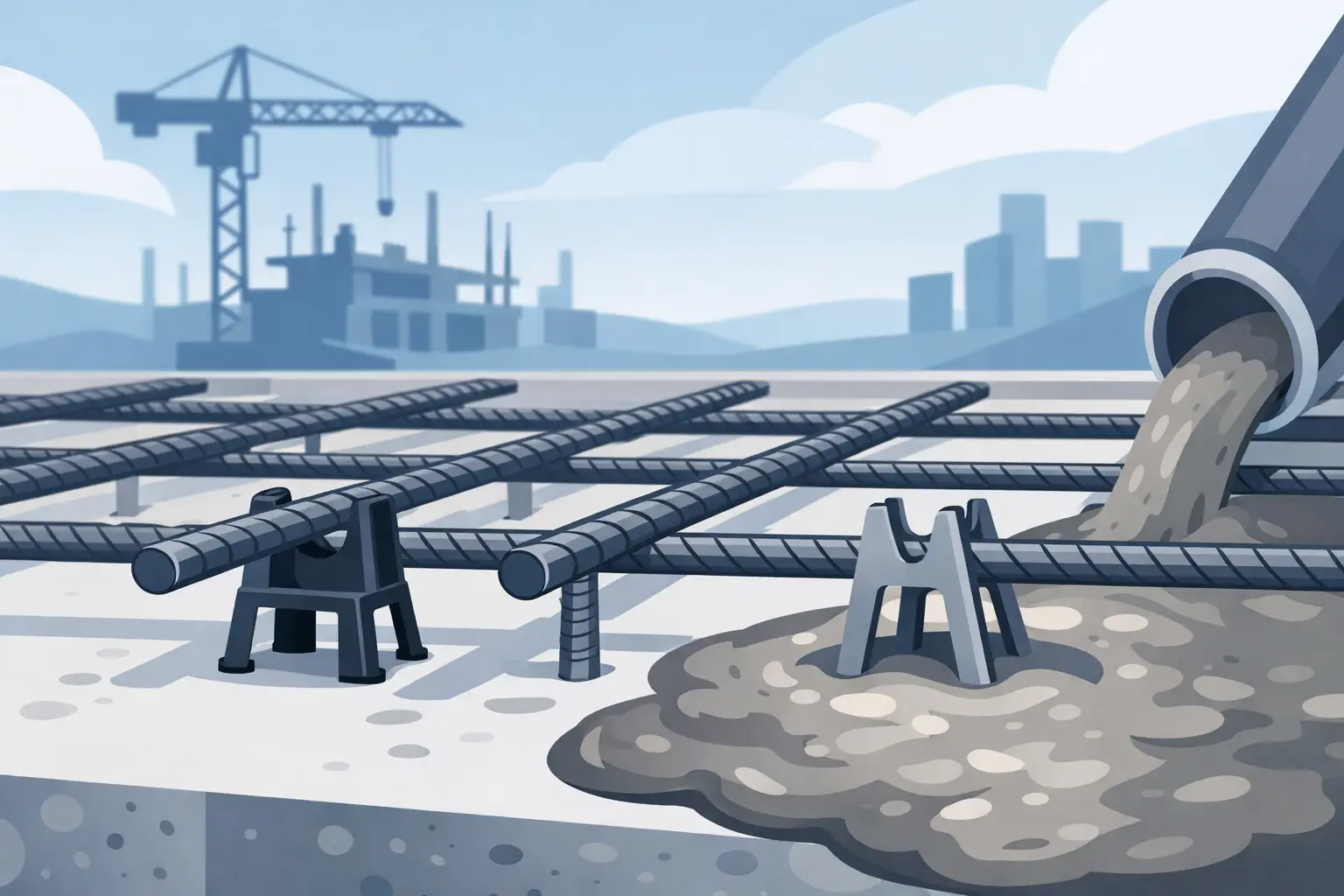
If the steel drops during placement, the pour is already going the wrong way. Rebar chairs for concrete pour are a small item on the order sheet, but they do a big job on site: they hold reinforcement at the correct height, protect specified cover, and help stop movement when the concrete starts going in. Get the chair type or spacing wrong, and you can end up with exposed steel, reduced cover, uneven reinforcement position, or a failed inspection.
For crews working to a tight program, chairs are not an add-on. They are part of the reinforcement system. Whether you are pouring a residential slab, footing, driveway, suspended slab, or commercial floor, the right chair setup helps keep the job compliant and keeps the pour moving.
Why rebar chairs for concrete pour matter
The purpose is straightforward. Chairs support reinforcing bar or mesh so it stays where the drawings and specifications require it to be. Concrete cover is not a rough guess. It is a defined distance between the reinforcement and the outer concrete surface, and that distance affects durability, corrosion protection, and structural performance.
On a live site, reinforcement wants to move. Mesh can sag between supports. Bar can shift when people walk it. Pump lines, screeds, and rakes can all disturb the steel during placement. Chairs reduce that movement by creating consistent support points under the reinforcement.
That does not mean any chair will do. Chair height, material, load capacity, and base style all affect performance. A chair that works fine under light mesh in a residential slab may not be suitable for heavier bar in a footing or a slab with high site traffic before the pour.
Choosing the right rebar chairs for concrete pour
The right selection comes down to four things: what steel you are supporting, what cover is specified, what surface the chair sits on, and how much traffic or load the setup will see before and during the pour.
Match chair height to required cover
This is the first check, and it should be a simple one. If your specified cover is 40 mm, your support system needs to hold the reinforcement at that level once the steel is tied and ready to pour. Guessing here causes trouble later. Too low and you lose cover. Too high and the steel can finish too close to the top surface, especially in thinner slabs.
The chair height has to suit the actual reinforcement arrangement, not just the nominal slab thickness. If you are supporting mesh, account for where the mesh sits in the sheet profile. If you are supporting bar, check whether the chair is designed for single bars, bar intersections, or heavier bundled load points.
Consider the reinforcement type
Mesh and rebar behave differently on site. Mesh usually needs even support across a broader area so it does not dip between points. Individual bars in footings or beams may need more targeted support at intersections or along runs where load is concentrated.
Plastic bar chairs are common for many slab applications because they are easy to place, resistant to corrosion, and quick for crews to work with. Steel chairs may be used in some applications where higher load support is needed, but suitability depends on the specification and environment. The key is using a chair made for the reinforcement you are actually placing, not whatever is left over in the container.
Look at the base condition
A chair on compacted subgrade, polythene, pods, formwork, or blinding concrete does not behave the same way. Narrow-based chairs can punch into softer surfaces or become unstable if the ground is uneven. Wider bases can spread the load better and reduce the chance of sinking or tipping.
This matters even more when crews are carrying mesh sheets across the setup or when a slab has multiple trades moving through before placement. Stable support on the base layer is part of keeping reinforcement in position.
Common mistakes that cause problems
Most chair issues are not complicated. They usually come from rushing the setup, under-ordering, or using the wrong product because it was close at hand.
One common mistake is spacing chairs too far apart. That saves a few units on paper but creates sag between supports. With mesh, that sag can be enough to lose the required cover once workers step on it or concrete starts flowing. The steel may look roughly right before the pour and still finish in the wrong place.
Another problem is using chairs that are too light for the load. A chair might technically fit the bar size, but if it collapses, twists, or settles under traffic, it is the wrong chair. Heavier reinforcement, suspended conditions, or busy site access may require a more stable option.
There is also the issue of mixing chair heights across the same pour area. That creates inconsistent steel levels and can be hard to spot once tying is complete. If the reinforcement plane is uneven, you are creating unnecessary risk before the concrete truck even arrives.
Then there is late-stage damage. Chairs get kicked over, crushed, or shifted during final checks, pump setup, and concrete placement. If nobody is watching reinforcement position during the pour, the original setup can change quickly.
How chair spacing affects the pour
There is no one spacing rule that covers every job. The right spacing depends on mesh type, bar size, slab thickness, load on the steel before the pour, and what the project details call for. The practical point is that support spacing must prevent deflection and movement.
For light residential work, crews sometimes assume the mesh will hold itself once tied. It usually will not. Unsupported spans between chairs let the steel drop under foot traffic. On larger commercial pours, the issue is often amplified because there is more movement across the steel before the concrete covers it.
A good setup gives consistent support without creating delays. That means enough chairs to hold the reinforcement properly, placed in a pattern that crews can work around without constantly kicking supports loose. If the reinforcement feels unstable when people walk it, spacing is probably part of the problem.
Site conditions change the best option
Rebar chairs for concrete pour should be selected for the actual job conditions, not just the drawing set. A tidy slab-on-grade setup under dry weather is one thing. A muddy site, uneven prepared surface, or congested reinforcement layout is another.
On pod slabs, support needs can differ because chair stability and placement interact with the pod layout and top mesh positioning. In footings, bar arrangement and trench conditions can make standard slab chairs a poor fit. In exposed or aggressive environments, durability and compliance become even more important when selecting support materials.
That is why experienced buyers usually order chairs as part of the reinforcement package, not as an afterthought. The chair type should suit the steel, the base, and the pour sequence.
What buyers should check before ordering
The fastest way to avoid a chair problem is to check the basics before the truck is booked. Confirm the specified cover, the reinforcement type and size, whether the application is slab, footing, beam, or wall, and what surface the chairs will sit on. Also think about how much site traffic the steel will see before and during placement.
It helps to order enough quantity from the start. Running short on chairs leads to makeshift fixes, wider spacing, or delays while someone chases stock. None of that helps when a crew is waiting and the pour window is fixed.
If the job has unusual details, heavy reinforcement, or high-volume requirements, it is worth talking through the setup with a supplier that handles reinforcement products every day. This is where a trade-focused supplier adds value – not by complicating the order, but by helping make sure the support products match the steel package and arrive when the site needs them. For Auckland projects needing reinforcement essentials quickly, Quality Steel Supplies works in that practical lane.
Compliance, cost, and the real trade-off
Everybody wants to keep material cost tight. That is fair. But chairs are one of those line items where cutting too hard can cost more later. The savings from under-supporting reinforcement are usually small compared with the risk of rework, delays, or compliance issues.
That said, the most expensive chair is not automatically the right one either. Over-specifying support on a straightforward slab wastes money just as surely as under-specifying it creates risk. The right approach is fit-for-purpose: enough support, correct height, suitable material, and reliable availability.
For procurement teams and site supervisors, that balance matters. You want products that meet the requirement, arrive on time, and do the job without site improvisation.
When the reinforcement stays where it should during placement, everything downstream gets easier – inspection, finishing, durability, and handover. That is why chairs deserve the same attention as the bar and mesh they are supporting. On pour day, small support details are often what keep a concrete job on track.
Related Posts