Rebar fabrication services reduce field cutting, support accurate placement, and help concrete crews keep schedules, inspections, and deliveries on track.

Chemical Anchors Versus Expansion Bolts
If you are standing on-site with a core-drilled hole, a concrete slab, and a deadline, the choice between chemical anchors versus expansion bolts is not academic. It affects load performance, edge distances, install time, inspection, and whether the fixing will suit the base material you are working with. Get it wrong and you can lose time, damage concrete, or end up with a fixing that does not match the job.
For most trade buyers, the real question is simple: which option gives you the safest, most practical result for this substrate, this load case, and this install window? That is where the differences matter.
Chemical anchors versus expansion bolts – the core difference
Expansion bolts work by mechanical force. Once installed, they expand against the sides of the hole and create holding power through friction or bearing. Wedge anchors, sleeve anchors, and similar mechanical fixings fall into this group. They are widely used because they are fast, familiar, and straightforward to install in solid concrete.
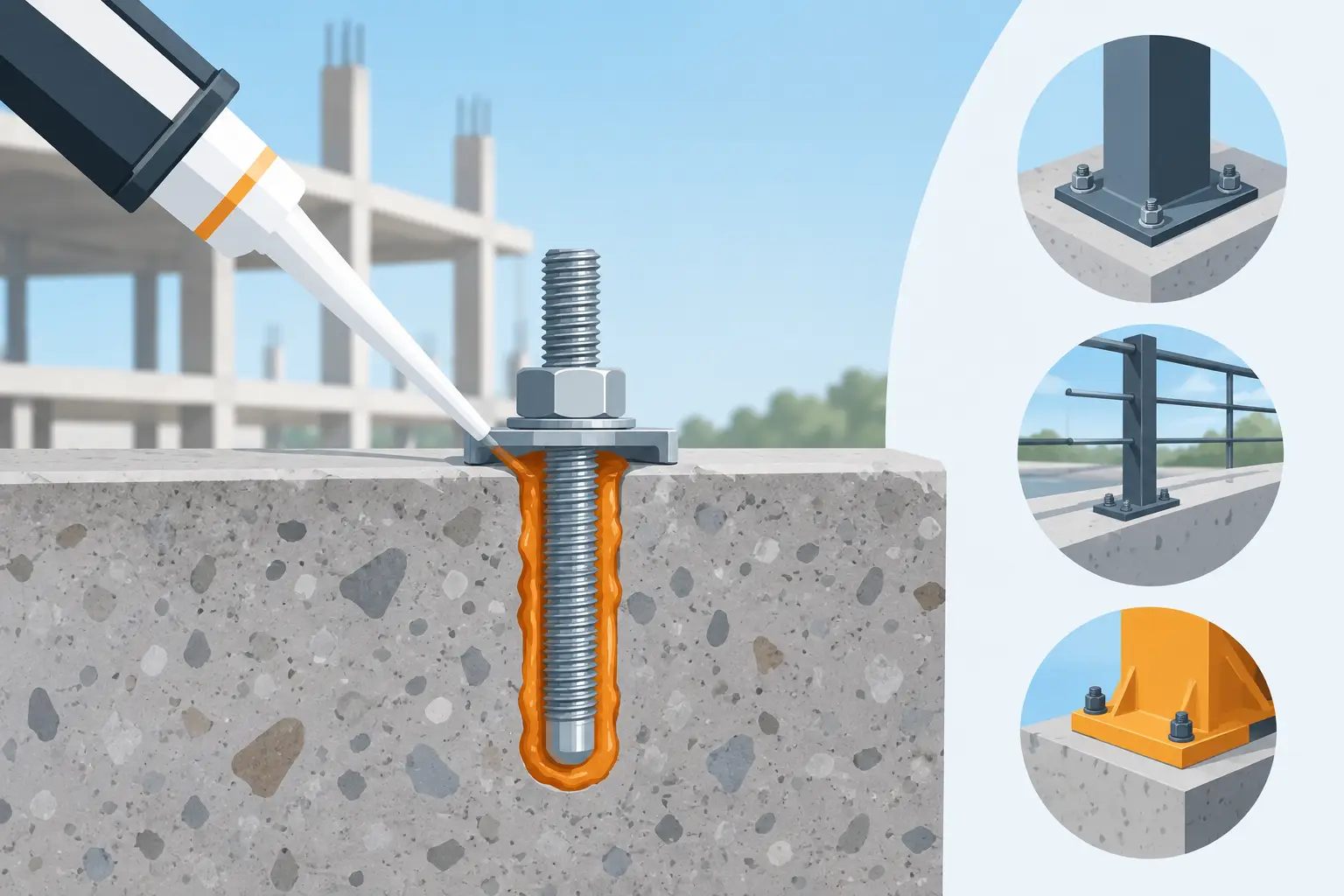
Chemical anchors work differently. A threaded rod or rebar is bonded into the hole using a resin system. The anchor relies on adhesion between the resin, the substrate, and the embedded steel rather than expansion pressure. That changes how the fixing behaves under load and how close it can be placed to edges or other anchors.
This is why chemical anchors versus expansion bolts is not just a brand or price comparison. It is a question of how the load gets transferred into the concrete or masonry and what installation conditions you can realistically control on-site.
When expansion bolts make more sense
Expansion bolts are often the right answer when speed matters and the substrate is sound, solid concrete. If the hole is drilled correctly and the concrete quality is suitable, they can be installed quickly with minimal waiting time. For many brackets, handrails, light structural supports, and general fixing work, that speed is a real advantage.
They also suit crews who want a simple installation sequence. Drill the hole, clean it as required, set the anchor, torque it correctly, and move on. There is no cure time to manage, and in many applications the fixing can be loaded immediately after installation.
That said, expansion bolts are less forgiving near edges and corners. Because they create outward pressure in the concrete, they can increase the risk of cracking or breakout if spacing and edge distances are tight. On retrofit jobs, that can become a problem fast, especially when the fixing position is dictated by existing steel, services, or plate dimensions.
They also depend heavily on proper torque. Under-torqued anchors may not develop full capacity. Over-torqued anchors can damage the concrete or the anchor itself. In trade terms, they are quick, but they still need discipline.
When chemical anchors are the better choice
Chemical anchors come into their own when the fixing position is close to an edge, when spacing is restricted, or when the substrate is less suited to expansion force. Because they do not rely on mechanical expansion, they can be a better option for reducing stress in the base material.
They are also common where high loads are involved, particularly with larger threaded rod diameters or rebar connections. Post-installed reinforcing bars, starter bars, heavy base plates, and structural retrofit applications often call for bonded anchors because of their design flexibility and strong load transfer when installed to spec.
Another major advantage is suitability across a broader range of substrates. With the right resin and sleeve system, chemical anchors can be used in solid concrete, hollow block, and some masonry applications where standard expansion anchors would not be appropriate.
The trade-off is installation control. Hole cleaning matters a lot. Resin selection matters. Temperature matters. Cure times matter. If the installer rushes the process or skips cleaning, the anchor may not achieve its design performance. Chemical anchors can deliver excellent results, but only when the install method is followed properly.
Load performance is not just about strength
A common mistake is to assume one system is always stronger than the other. In reality, load capacity depends on the anchor type, diameter, embedment depth, concrete condition, edge distance, spacing, and whether the load is tension, shear, or a combination.
Some expansion anchors offer very strong performance in suitable concrete and are more than adequate for demanding applications. Some chemical anchors can achieve excellent tension values, especially with deeper embedment and larger rods. But strength on paper is only part of the story.
What matters on-site is whether the anchor can achieve that performance in the actual conditions of the job. If you are fixing close to a slab edge, dealing with older concrete, or installing into a substrate with unknown quality, the theoretical headline number does not tell the whole story.
This is where spec, approval data, and actual install conditions need to line up. A fast fixing that is poorly suited to the substrate is not a gain. It is a rework risk.
Edge distance, spacing, and cracked concrete
This is where the gap between the two systems becomes clearer. Expansion bolts generally need more room from edges and between adjacent anchors because the expansion action puts stress into the concrete. If you are fixing a plate with multiple anchors in a tight layout, that can limit your options.
Chemical anchors usually offer more flexibility in these situations because they do not apply the same expansion forces. That can make them a better fit for retrofit plates, façade brackets, balustrade posts, and heavy-duty fixings where edge distance is restricted.
Cracked concrete is another factor. Not every anchor is rated for it, and not every site condition allows you to assume uncracked concrete. On suspended slabs and structural elements subject to movement or service loading, cracked concrete approvals can matter. Whether you are using chemical or mechanical anchors, this is a check worth making before material is ordered and installed.
Speed versus control on the job
If the program is tight, expansion bolts usually win on install speed. There is less process, less waiting, and less chance of delays from low temperature or incomplete curing. For crews working through repetitive fixing tasks, that simplicity has real value.
Chemical anchors slow things down a bit. Hole preparation is more critical, resin dispensing needs to be done correctly, and cure time has to be respected before loading. On a cold morning or in shaded areas, that can affect the schedule more than expected.
Still, speed is not only about how fast the anchor goes in. It is also about avoiding breakout, failed pull tests, or repositioning because the fixing was too close to an edge. On some jobs, the slower system is actually the faster outcome.
Cost is not just the unit price
Expansion bolts often look cheaper at first glance. The fixing itself may cost less, and labor time is usually lower. For standard applications in solid concrete, that can make them the most economical option.
Chemical anchors tend to carry a higher material cost, especially when resin, threaded rod, sleeves, and dispensing gear are all part of the system. Labor can also be higher because installation is more involved.
But unit price alone can be misleading. If a chemical anchor allows a fixing to stay in the exact required location without enlarging a base plate, moving the bracket, or risking edge failure, the higher anchor cost may save money overall. The right comparison is total installed cost for the actual condition, not just the price per anchor.
Choosing the right fixing for the substrate
For sound, solid concrete with adequate edge distance and a straightforward load case, expansion bolts are often the practical choice. They are quick, proven, and easy to stock for common site work.
For tight edge conditions, heavier structural loads, post-installed rebar, or substrates where expansion pressure is a concern, chemical anchors are often the safer route. They require more care, but they solve problems that mechanical anchors cannot always handle cleanly.
In masonry and hollow materials, chemical systems with the correct accessories are often the better fit. Standard expansion anchors can struggle or damage weaker material if used without proper consideration.
What buyers should check before ordering
Before choosing between chemical anchors versus expansion bolts, check the base material, the required load, the edge distance, the spacing, and whether the substrate may be cracked. Confirm the hole diameter, embedment depth, and whether the installation team can meet the required method on-site.
It also pays to think about lead time and site flow. If the crew needs a fixing they can install and load immediately, that narrows the field. If the project calls for compliance with specific approvals or engineering details, that should drive the product choice from the start rather than being sorted out after delivery.
At the supply end, practical support matters. Trade buyers do not need a lecture. They need the right fixing, in the right size, available when the pour, plate set, or retrofit window is happening. That is why a straightforward supplier model matters, especially when urgent delivery is part of keeping a job on track.
The best fixing choice is rarely about loyalty to one system. It is about matching the anchor to the concrete, the load, and the install conditions so the job gets done once and done right.
Related Posts