Rebar fabrication services reduce field cutting, support accurate placement, and help concrete crews keep schedules, inspections, and deliveries on track.
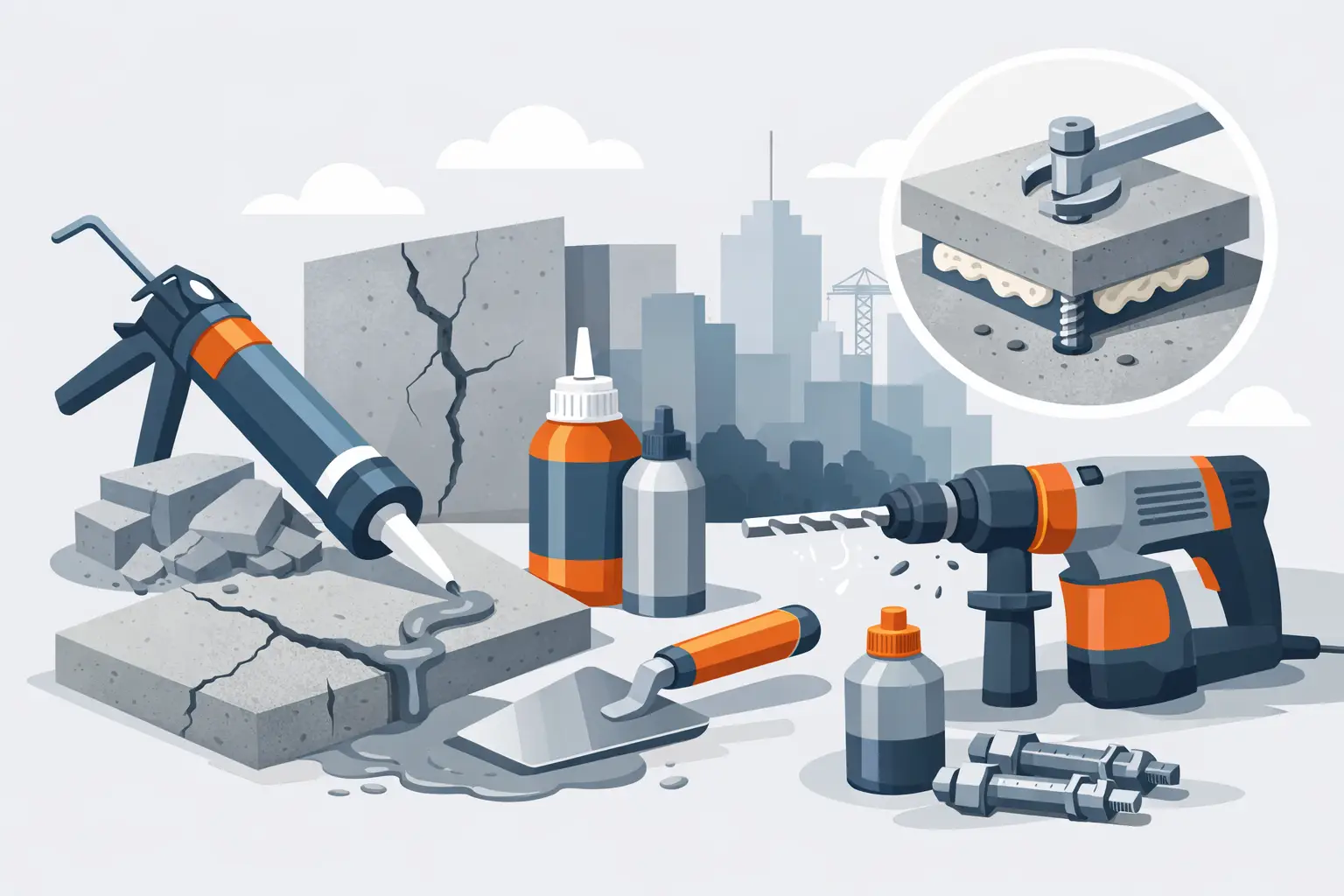
Best Concrete Fixing Options for the Job
Miss the fixing choice on concrete and the problem usually shows up fast – spun anchors, cracked edges, wasted holes, or hardware that simply will not hold the load it was meant to carry. The best concrete fixing options depend on four things first: the base material, the load, the edge distance, and whether the fixing needs to be removable later.
For trade buyers, that matters more than brand names or packaging claims. A slab for handrails, a block wall for services, and a structural pad for heavy steel all ask for different fixing methods. If you want clean installs, predictable holding power, and fewer call-backs, the right approach is to match the fixing to the job conditions rather than forcing one product across every pour.
What decides the best concrete fixing options?
Concrete is not one uniform substrate. A dense structural slab behaves differently from older concrete with unknown strength, and both are different again from masonry block or hollow-core material. Before choosing a fixing, look at the concrete condition, the compressive strength if known, the slab thickness, and whether you are close to an edge or control joint.
Load type matters just as much. A static vertical load is one thing. A fixing exposed to vibration, impact, wind movement, or repeated tension loading is another. The best concrete fixing options for a light bracket are not the same as the right choice for balustrades, equipment bases, or seismic restraint points.
Installation conditions also affect what works best on site. If speed matters and the crew is doing high volume repetitive fixing, mechanical anchors often make sense. If the hole position is slightly off, edge distances are tight, or the embedment needs flexibility, chemical anchoring can be the better call.
Expansion anchors for fast, solid installs
Expansion anchors are a common choice because they are quick to install and give immediate holding once tightened. Wedge anchors and sleeve anchors are the usual examples. For many builders and concrete crews, these are the first option when fixing base plates, brackets, racking, barriers, and general steelwork into sound concrete.
A wedge anchor works by expanding against the wall of the drilled hole as torque is applied. In good quality concrete, they provide strong performance and are well suited to medium and heavy-duty fixing. They are especially useful when you need a straightforward install with no cure time.
The trade-off is that expansion anchors put stress into the concrete. If you are working close to slab edges, into thinner sections, or in cracked or lower-strength concrete, that expansion force can become a problem. Hole accuracy matters too. If the hole is oversized, dusty, or poorly drilled, performance drops quickly.
Sleeve anchors offer a bit more flexibility across different base materials and can suit lighter to medium-duty applications. They are often used where the substrate is less predictable, but they still rely on expansion. That means the same caution applies around edges and weaker concrete.
Screw anchors when speed and removability matter
Concrete screw anchors have become a go-to option on many jobs because they are fast, clean, and practical. Drill the correct hole, clean it properly, drive the anchor, and the thread cuts into the concrete. For temporary works, service brackets, framing tracks, and installations that may need adjustment or removal later, they are often one of the best concrete fixing options available.
Their biggest advantage is convenience. There is no secondary expansion step, and many crews like them because they reduce install time. They also work well where fixture alignment matters, since removal and repositioning are easier than with some traditional anchors.
That said, they are not a universal answer. Concrete screws are sensitive to correct hole diameter and depth. Overdriven screws, poor hole cleaning, or weak substrate can lead to strip-out. On heavy structural applications, you still need to check the load data carefully rather than assuming a bigger screw solves the problem.
Chemical anchors for high loads and tight edge distances
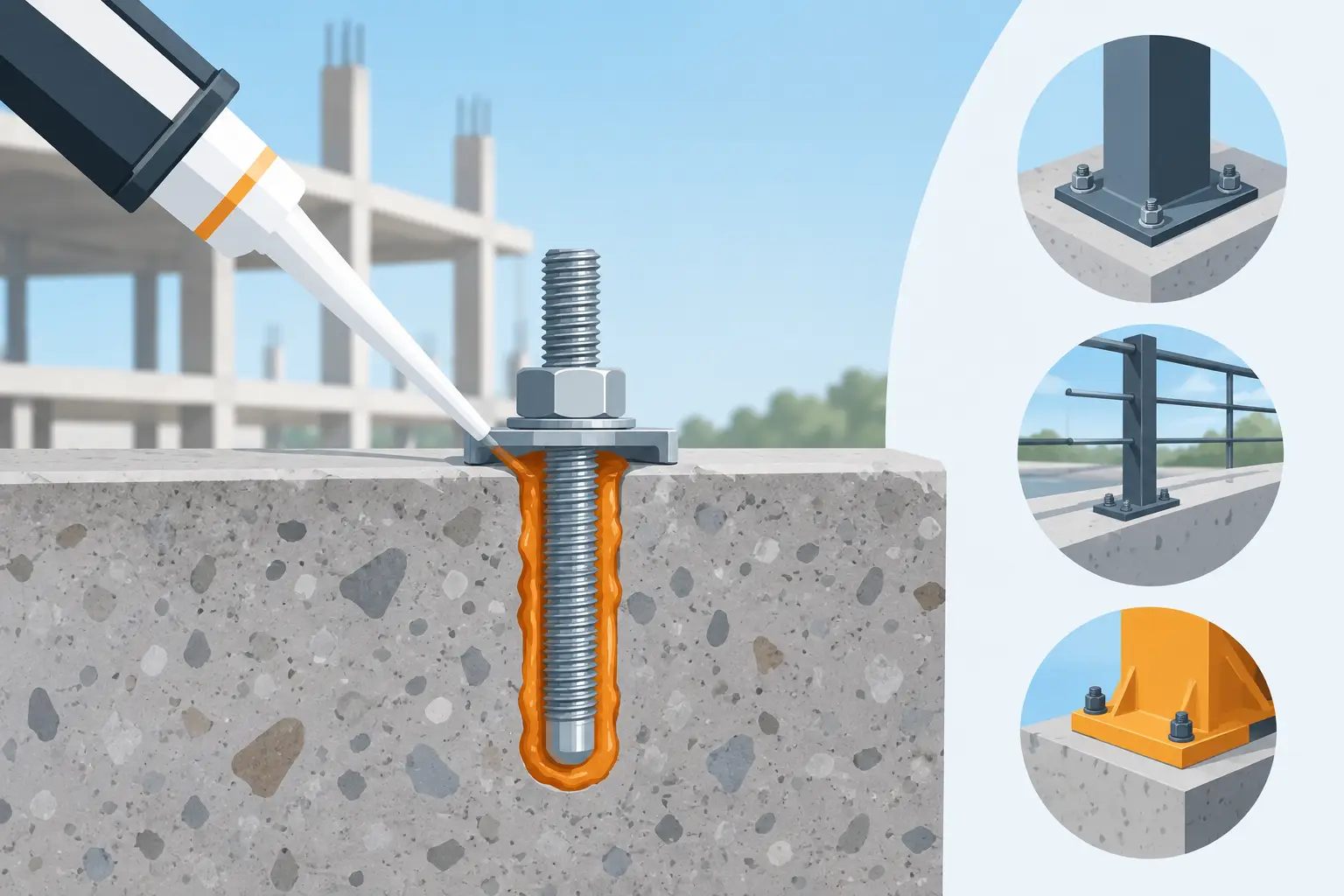
When the job calls for stronger pull-out performance, adjustable embedment depth, or fixing close to edges without expansion stress, chemical anchors are often the better option. These systems use a resin adhesive with threaded rod or rebar set into a drilled hole. Once cured, the bond transfers load into the concrete with less bursting pressure than mechanical expansion anchors.
This makes them a strong choice for structural connections, doweling, post-installed rebar, handrails, starter bars, and heavy steel base connections. They are also useful in retrofit work where existing concrete conditions make expansion anchors less desirable.
The trade-off is time and process control. Chemical anchors are only as good as the installation. Hole cleaning, resin selection, temperature, moisture conditions, and cure time all matter. If a crew is in a rush and skips cleaning or loads the anchor before cure, the fixing can fail long before the material itself is at fault.
For hollow block or voided substrates, chemical systems with sleeves can also perform well where standard expansion anchors would be unreliable. That flexibility is a major reason they remain one of the best concrete fixing options across mixed site conditions.
Drop-in anchors for flush finishes
Drop-in anchors are useful when you need an internal thread set flush with the concrete surface. They are commonly used for suspended services, pipe supports, cable trays, and overhead applications where threaded rod will be installed afterward.
Installed correctly, they give a neat finish and work well in repetitive commercial fit-out or service coordination work. They are efficient when multiple rods or hangers need to be set out cleanly.
Their limitation is application range. They are generally better suited to controlled, lighter to medium-duty uses rather than every heavy structural fixing job. Setting depth and proper expansion with the correct tool are critical. If the anchor is not set properly, performance drops fast.
Nail-in and hammer-set anchors for light duty work
For light-duty fixing, hammer-set or nail-in anchors can be practical and cost-effective. They are often used for battens, clips, conduits, and non-structural brackets where installation speed matters more than maximum load.
These anchors help keep simple jobs moving, especially when the cost of a heavier-duty fixing is not justified. On the right application, they do the job well and avoid over-specifying hardware.
The risk comes when they are used beyond their design range. They are not the right answer for safety-critical items, sustained heavy loads, or applications exposed to movement and vibration. They are useful, but only when the load case genuinely matches the product.
Matching fixing type to the job
If you are fixing light services or temporary items, concrete screws or hammer-set anchors may be the quickest route. For general steel brackets and medium to heavy loads into solid concrete, wedge anchors remain a reliable standard. Where edge distance is limited, load is high, or the specification calls for post-installed rebar or threaded rod, chemical anchors are often the smarter choice.
For overhead services and suspended rod systems, drop-in anchors keep the finish clean and practical. For unknown or mixed substrates, the safest path is usually to slow down, verify the base material, and avoid assuming that a fixing suitable for solid concrete will behave the same way in block or aged slab.
That is usually where supply support matters. A contractor-friendly supplier such as Quality Steel Supplies can help keep the order straightforward, especially when the job includes multiple fixing types across one site and delivery timing matters as much as product choice.
Common mistakes that cause fixing failures
Most fixing failures on site are not caused by the anchor itself. They come from choosing the wrong type, drilling the wrong hole size, failing to clean dust from the hole, or ignoring edge distance and embedment requirements. Even a compliant product will underperform if installation basics are missed.
Another common issue is treating all concrete as sound structural concrete. Older slabs, green concrete, cracked sections, and patched areas all change the holding capacity. If the substrate is questionable, it is worth reassessing before crews burn time installing the wrong hardware.
Over-tightening also causes trouble. Mechanical anchors need the correct torque, not guesswork with an impact driver. Chemical anchors need cure time, not pressure to get the handover done early.
Best concrete fixing options start with the load path
The strongest fixing on paper is not always the best fixing on the job. What matters is how the load travels into the concrete, how the substrate will respond, and whether the install method suits real site conditions. Speed, removability, edge distance, moisture, vibration, and compliance all affect the decision.
If you are buying for active jobs, the best concrete fixing options are usually the ones that balance holding power with predictable installation and ready availability. Get that balance right, and you save more than hardware cost – you save labor, rework, and time on site. When the fixing matches the slab, the load, and the install conditions, the rest of the job tends to go a lot smoother.
Related Posts