
What causes asphalt cracks? Learn how water, traffic, heat, poor drainage, and weak base preparation damage pavement - and how to plan lasting repairs.
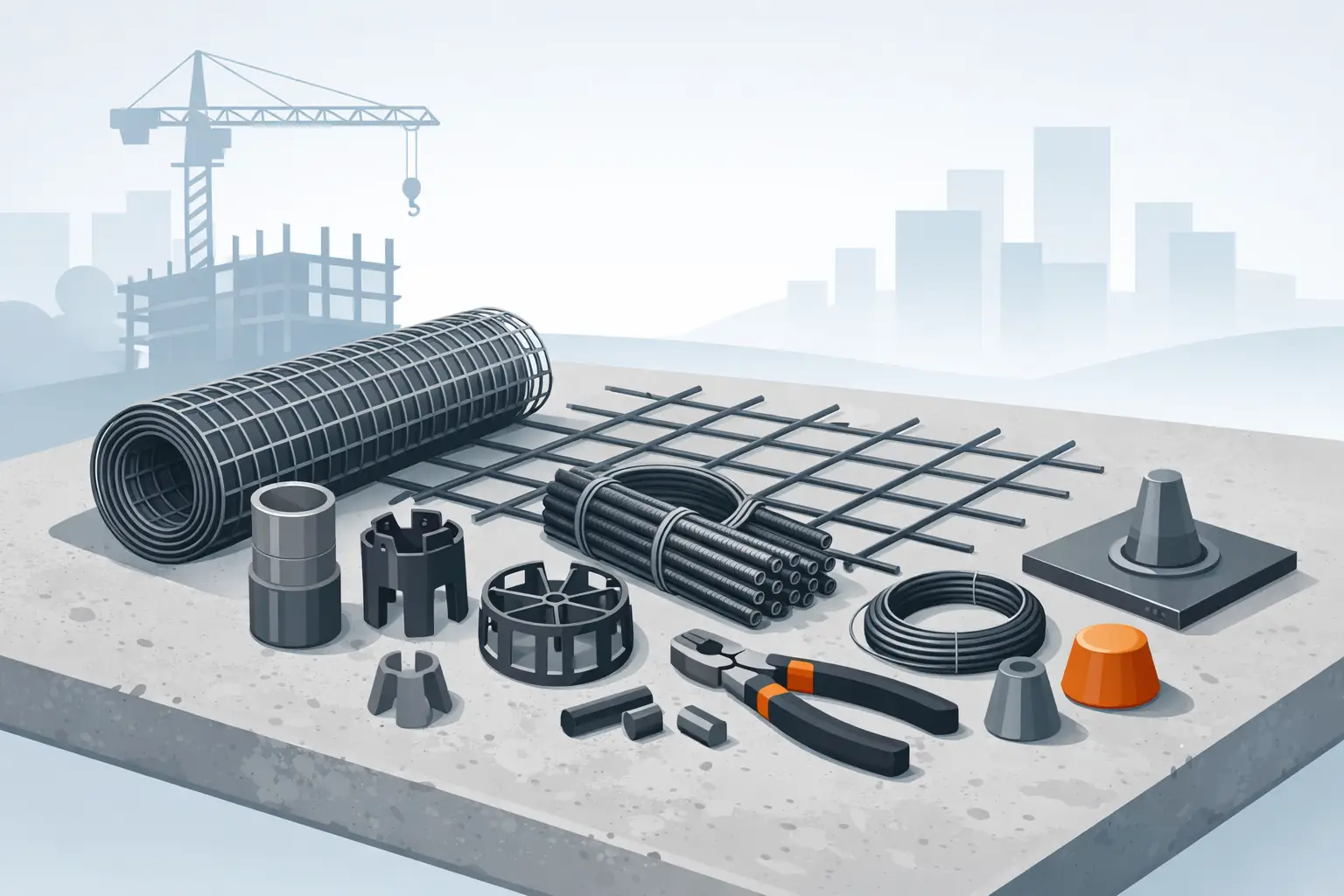
Concrete Reinforcing Accessories List
Miss one small accessory on a pour day and the whole reinforcement package can slow down. The main steel gets the attention, but a solid concrete reinforcing accessories list is what keeps mesh at the right height, bars tied in place, cover maintained, and the crew moving without rework.
For contractors, builders, and procurement teams, the point is simple: accessories are not add-ons. They are part of getting compliant reinforcement into the slab, wall, footing, or beam exactly as detailed. Some items are universal on almost every job. Others depend on the pour type, exposure conditions, engineer requirements, and how the crew plans to place and secure the steel.
What belongs on a concrete reinforcing accessories list
A useful concrete reinforcing accessories list should cover the products that support placement, spacing, tying, fixing, and protection of reinforcement before and during the pour. It should also reflect the type of work being done, whether that is a residential slab, commercial foundation, precast element, or civil structure.
At a minimum, most jobs look at chairs or spacers, tie wire, stirrups, fixings, and any void-forming or support products needed under slabs. If the site team is ordering only bar and mesh, there is a good chance they will need a last-minute run for the smaller items that actually hold the system together.
The core accessories most jobs need
Bar chairs and spacers
Bar chairs are usually the first accessory to check because they control cover and support the reinforcement during setup and the pour. If the chair height is wrong, the steel can sit too low or too high, which creates compliance issues and can affect structural performance and durability.
Plastic chairs are common on many slab and general concrete applications because they are quick to place, light to handle, and available in a range of cover sizes. Concrete spacers can be a better fit where specifications call for them, or where exposure conditions and finish requirements make them the preferred choice. Metal chairs are also used in some applications, but selection depends on the job details and what the engineer or specification allows.
The trade-off here is straightforward. Cheap or unsuitable chairs can collapse under foot traffic or under the weight of steel, while over-specifying chairs can add cost without much practical gain. Match the chair type and spacing to the load, pour method, and reinforcement density.
Tie wire
Tie wire is basic, but it is one of the easiest items to underestimate. It secures intersections, helps maintain bar spacing, and keeps cages, mats, and beam assemblies from shifting during handling and concrete placement.
Annealed tie wire is widely used because it is workable and fast for crews tying by hand or with tying tools. The gauge matters. Too light and it may not hold well in heavier assemblies. Too heavy and it can be slower to work with than needed. On small residential work, that may not matter much. On larger commercial or civil jobs, tying speed and consistency affect labor time.
If the reinforcement package includes a lot of mesh laps, beam cages, or starter bar connections, it pays to order more tie wire than the first estimate suggests. Running short is common because the product is low-cost and often treated as an afterthought.
Stirrups and ligatures
Stirrups are a key accessory where beams, columns, and cages are being assembled. They hold longitudinal bars in position and contribute directly to the reinforcement layout required by the design.
On some projects, stirrups are fabricated to schedule and supplied as part of the reinforcement package. On others, standard sizes cover the need. Either way, they are not just a convenience item. Their dimensions, spacing, and bar diameter need to match the structural drawings exactly.
This is one area where assumptions can cause delays. If the crew expects standard stirrups to work but the engineer has detailed non-standard shapes or tighter spacing, the job can stall waiting on fabrication. It is worth checking the drawings early rather than treating stirrups as a stock filler item.
Reinforcing mesh supports
When mesh is specified in slabs, mesh supports are often required to keep it in the correct position through the pour. Anyone who has seen mesh end up on the subgrade knows why this matters. Mesh that is walked down or not properly supported does not perform as intended.
The support type depends on slab thickness, mesh weight, and the site setup. On light residential pours, simple support systems may be enough. On heavier slabs or where traffic over the reinforcement is unavoidable before pouring, stronger support spacing may be needed.
Concrete fixings and connection hardware
Concrete fixings are often grouped separately from reinforcement, but they still belong on many concrete reinforcing accessories lists because they support connection points, starter systems, and attached elements during the build sequence.
This category can include anchors, bolts, inserts, and related fixing products used around reinforced concrete work. The exact item depends on the detail. In some cases, the fixing is structural. In others, it is there to support formwork, attachments, or follow-on trades. The important part is to confirm compatibility with the substrate, load requirement, and installation timing.
Accessories that depend on the job type
Polystyrene pods and slab void formers
For ribbed slab systems and other suspended or voided slab designs, polystyrene pods are part of the build-up that works alongside the reinforcement. They are not reinforcement accessories in the narrowest sense, but on real jobs they are ordered and planned with the steel package because they affect set-out, bar placement, and pour readiness.
Pods need to be the right profile and layout for the slab design. If deliveries arrive out of sequence, crews can lose time waiting to complete the setup. That is why practical ordering matters as much as the product itself.
Dowel accessories and starter systems
Where slabs, walls, or adjoining pours need continuity, dowels and related accessories may be part of the package. Sleeves, caps, and starter bar arrangements help align and protect bars and support accurate continuation of reinforcement across construction joints.
The detail is not always complicated, but it is exact. Wrong dowel size, poor alignment, or missing caps can create avoidable remedial work later.
Protective caps and safety items
Protective caps for exposed rebar are a site safety issue first, but they also belong in planning. Where bars are left protruding, crews need the right caps or covers to reduce risk on site. These products are simple, but they are often forgotten until the bars are already in place.
How to build the right accessories order
The fastest way to get the accessories order right is to review the structural drawings and match each reinforcement zone with what physically holds it in place. Slabs need support and cover control. Beams and columns need ties or stirrups. Starter bars and jointed sections may need sleeves, caps, or fixings. Void systems need pods or formers.
It also helps to think about installation sequence, not just quantities. A product can be technically correct and still cause delays if it arrives after the crew needs it. Accessories are usually low-cost compared with steel and labor, so the bigger risk is downtime rather than material spend.
For procurement teams, the smart move is to order accessories with the main steel package wherever possible. That cuts out split deliveries, reduces missed items, and gives the site one coordinated supply line.
Common mistakes with a concrete reinforcing accessories list
One common mistake is treating all spacers and chairs as interchangeable. They are not. Cover requirements, slab depth, bar size, and load on the support all matter.
Another is under-ordering tie wire. It is inexpensive, but a shortage slows installation fast. The same goes for stirrups or mesh supports on jobs with dense reinforcement layouts.
A third issue is failing to check compliance and suitability. Not every accessory fits every specification. Exposure conditions, finish requirements, and engineer notes can all affect product choice. If the project is high-load, highly exposed, or heavily inspected, the accessory decision matters more, not less.
Why supply speed matters as much as the product
Accessories tend to become urgent when someone realizes they are missing. That is why a dependable supplier matters. Fast turnaround, clear product details, and direct contact make a real difference when the pour schedule is tight and the site cannot wait through a long procurement chain.
For trade buyers, the best supplier is usually the one that understands how reinforcement is actually installed, not just how it is listed in a catalog. Quality Steel Supplies fits that practical model by focusing on reinforcement essentials, clear pricing, and fast delivery support for jobs that need materials on site without delay.
A good concrete reinforcing accessories list is not about padding the order. It is about making sure the steel you already paid for ends up in the right position, with the right cover, and ready for inspection and pour day without last-minute scrambling. Get that part right, and the whole job runs cleaner.
Related Posts