Rebar fabrication services reduce field cutting, support accurate placement, and help concrete crews keep schedules, inspections, and deliveries on track.
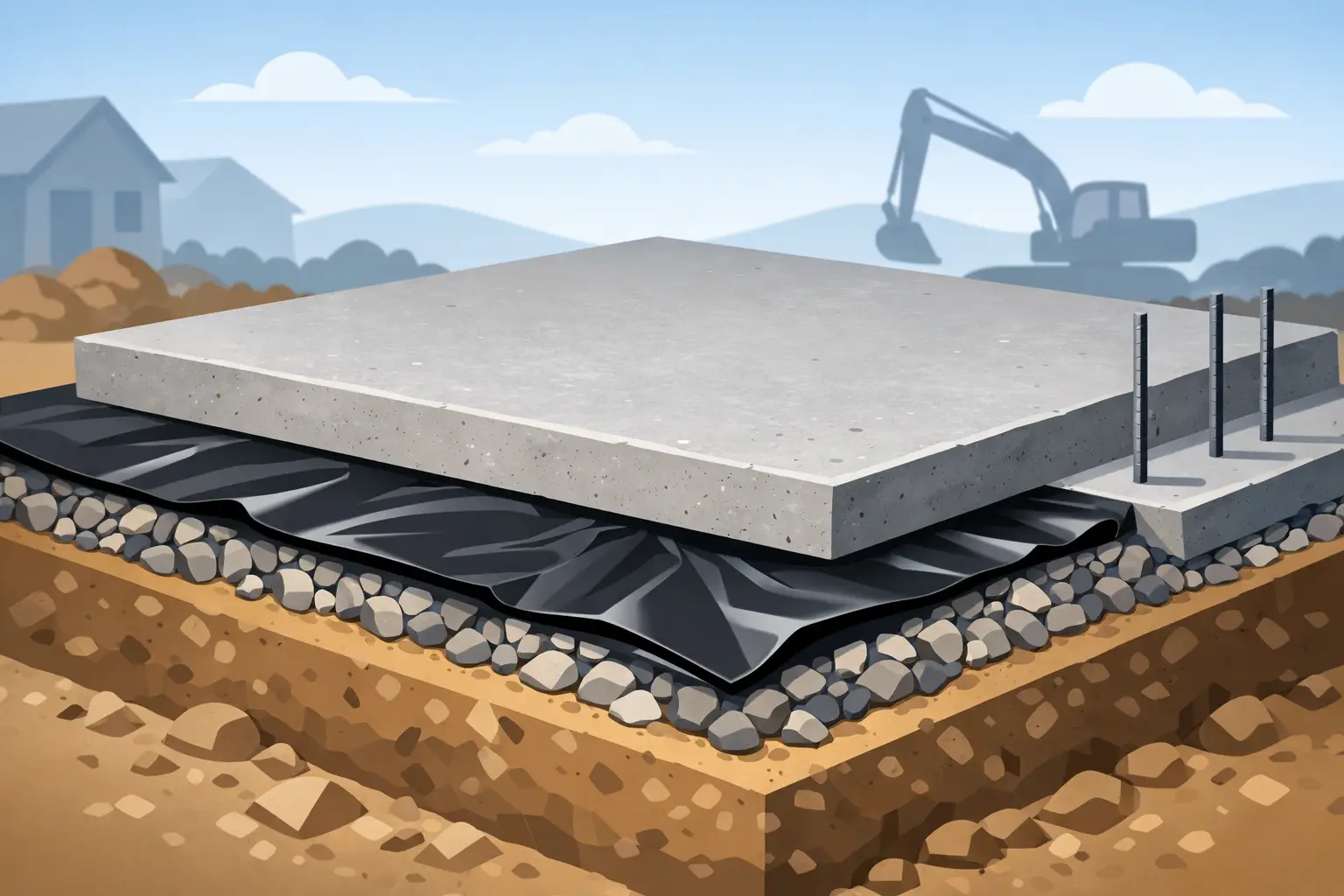
Black Polythene Under Concrete Slab
If a slab is going down over ground and someone asks whether black polythene under concrete slab is really necessary, the short answer is usually yes – but only when the right material is used, installed properly, and matched to the build-up. This is one of those details that looks simple on paper and causes expensive problems when it gets skipped, punctured, or specified too lightly.
On site, people call it plastic, poly, DPM, vapor barrier, or membrane. Whatever the label, its job is straightforward. It limits moisture moving up from the ground into the concrete and into the floor system above. That matters for residential slabs, warehouses, garages, commercial interiors, and any space where trapped moisture can damage adhesives, coatings, floor coverings, or internal finishes.
What black polythene under concrete slab actually does
Concrete is not waterproof. It is dense when well placed and cured, but it still allows moisture vapor transmission. If the ground below the slab holds moisture, that moisture can migrate upward over time. Without a membrane, the slab can stay damp longer, floor coverings can fail, and internal humidity can become harder to manage.
Black polythene under concrete slab acts as a moisture barrier between the prepared subgrade or base course and the concrete pour. In practical terms, that means less risk of damp spots, fewer issues with vinyl or timber flooring, and better protection for coatings, adhesives, and fit-out materials.
It can also help reduce bleed water loss into the base during placement, depending on the slab design and the layer sequence. That said, the membrane is not a cure-all. It does not replace proper drainage, compaction, reinforcement, or concrete mix control. It is one part of the slab system, not the whole system.
When black polythene under concrete slab is most important
For interior slabs and any conditioned building space, the case is strong. If the slab will carry carpet, tile, epoxy, timber, laminate, or glued finishes, moisture control is not optional. The cost of replacing a failed floor is far higher than the cost of installing membrane properly before the pour.
For detached sheds, open-sided structures, or some exterior flatwork, it depends more on the intended use. If it is a basic utility slab with no moisture-sensitive finish above, the requirement can be less strict. But even then, local code, engineering details, and soil conditions still decide the right approach.
Sites with high groundwater, poor drainage, clay-heavy soils, or consistently wet conditions deserve extra attention. On those jobs, the membrane detail matters even more because the slab will be exposed to ongoing ground moisture pressure over its life.
Not all polythene is equal
This is where shortcuts usually start. Some crews still think any black plastic roll will do. It will not. Thin builder’s film or generic plastic sheet is easily torn during steel placement, foot traffic, and concrete work. Once it is punctured across the slab area, its performance drops fast.
A proper underslab vapor barrier or damp-proof membrane should have the right thickness, puncture resistance, and compliance for the application. The exact spec depends on local requirements, slab use, and engineer or architect details. In higher-demand commercial work, heavier-duty membrane is often the better call because site traffic, reinforcement, and service penetrations all increase the risk of damage before the pour.
Color is less important than performance. Black polythene is common because it is widely available and easy to identify on site, but the key question is whether it meets the required standard for underslab use.
Where it sits in the slab build-up
In a typical slab-on-ground assembly, the membrane is placed over the prepared granular base and under the concrete. The base below should already be trimmed, compacted, and drained correctly. If the base is rough, full of sharp aggregate, or poorly compacted, the membrane is more likely to tear.
Some details include a sand blinding layer or protection layer, while others place the membrane directly over a smooth compacted base. There is no one-size-fits-all answer here. The right sequence depends on the engineer’s detail, the membrane product, and whether the priority is puncture protection, curing behavior, or moisture control.
If reinforcement mesh, rebar, chairs, pods, or service lines are going in, planning matters. A membrane laid neatly can still be ruined by careless steel placement. This is why slab prep needs to be treated as one coordinated system rather than separate trades working over each other.
Installation is where most failures happen
The material can be compliant and still fail if the install is poor. Laps need to be wide enough, sealed where required, and kept continuous around penetrations, edges, and upturns. Pipes, conduits, and column bases are common weak points. If these areas are left loose or cut roughly, moisture finds the path of least resistance.
Membrane should be laid flat without unnecessary folds that trap air or create placement issues. It also needs to stay intact while reinforcement is positioned. Bar chairs should support steel without shredding the sheet below, and crews should avoid dragging mesh or bar across the surface.
Any puncture or tear should be repaired before the pour. That sounds obvious, but rushed jobs miss this step all the time. Once the concrete is placed, you do not get a second chance.
The trade-offs to know before specifying it
There are a few practical considerations. A slab poured directly over an impermeable membrane can show different curing and finishing behavior compared with one placed over an absorptive base. Bleed water has fewer places to go, so surface finishing timing needs attention. On some mixes, that can affect how quickly the slab is ready for the next operation.
There is also the question of curling and shrinkage behavior in certain slab designs. That does not mean the membrane should be omitted. It means the slab design, concrete mix, curing plan, joints, and finishing sequence need to be aligned with the use of the membrane.
For exterior slabs or unconditioned utility pours, some teams choose not to use black polythene under concrete slab because they are prioritizing drainage characteristics or following a simpler detail. That can be acceptable in some cases, but it should be a deliberate decision based on the build requirement, not a habit carried over from another type of job.
Common mistakes that cost money later
The first mistake is using cheap, thin film that does not belong under a structural slab. The second is laying membrane over a base that is too sharp or uneven. The third is treating penetrations as an afterthought.
Another regular issue is poor coordination with reinforcement. Mesh, rebar, tie wire, chairs, and service trades all interact with the membrane zone. If those materials are being moved around after the sheet is down, damage risk goes up. On busy slab days, that is where experienced crews save time – by setting the sequence properly before concrete trucks arrive.
There is also a paperwork side to this. If the project requires a compliant vapor barrier and the install is not documented or inspected, disputes can surface later when flooring or moisture issues appear. For commercial work especially, that is not something procurement teams or site managers want landing back on them months after handover.
How to decide what you need
Start with the slab use. Is the space enclosed? Will it receive moisture-sensitive floor finishes? Is there underfloor insulation, heating, or interior fit-out that depends on moisture control? Then look at the ground conditions, drainage, and any engineer or architectural documentation.
After that, choose a membrane with the right performance rating for the job rather than the cheapest roll available. Make sure the install detail covers laps, taping, penetrations, edge upturns, and protection during steel fixing and concrete placement.
For contractors, this is also a supply-chain issue. Slab jobs move fast, and delays happen when one part of the package is missing. Membrane, reinforcement, chairs, tie wire, and related slab materials are easier to manage when they are ordered with the pour sequence in mind. That is the practical side of keeping labor productive and avoiding site downtime.
At Quality Steel Supplies, that same jobsite logic applies across reinforcement and slab support products – get compliant materials on site when they are needed, and the rest of the pour has a better chance of staying on program.
Black polythene under concrete slab is a simple product detail with outsized consequences. If the slab needs moisture protection, do not treat the membrane as a throwaway line item. Specify it properly, protect it during installation, and make sure the slab system around it is set up to do the job right the first time.
Related Posts