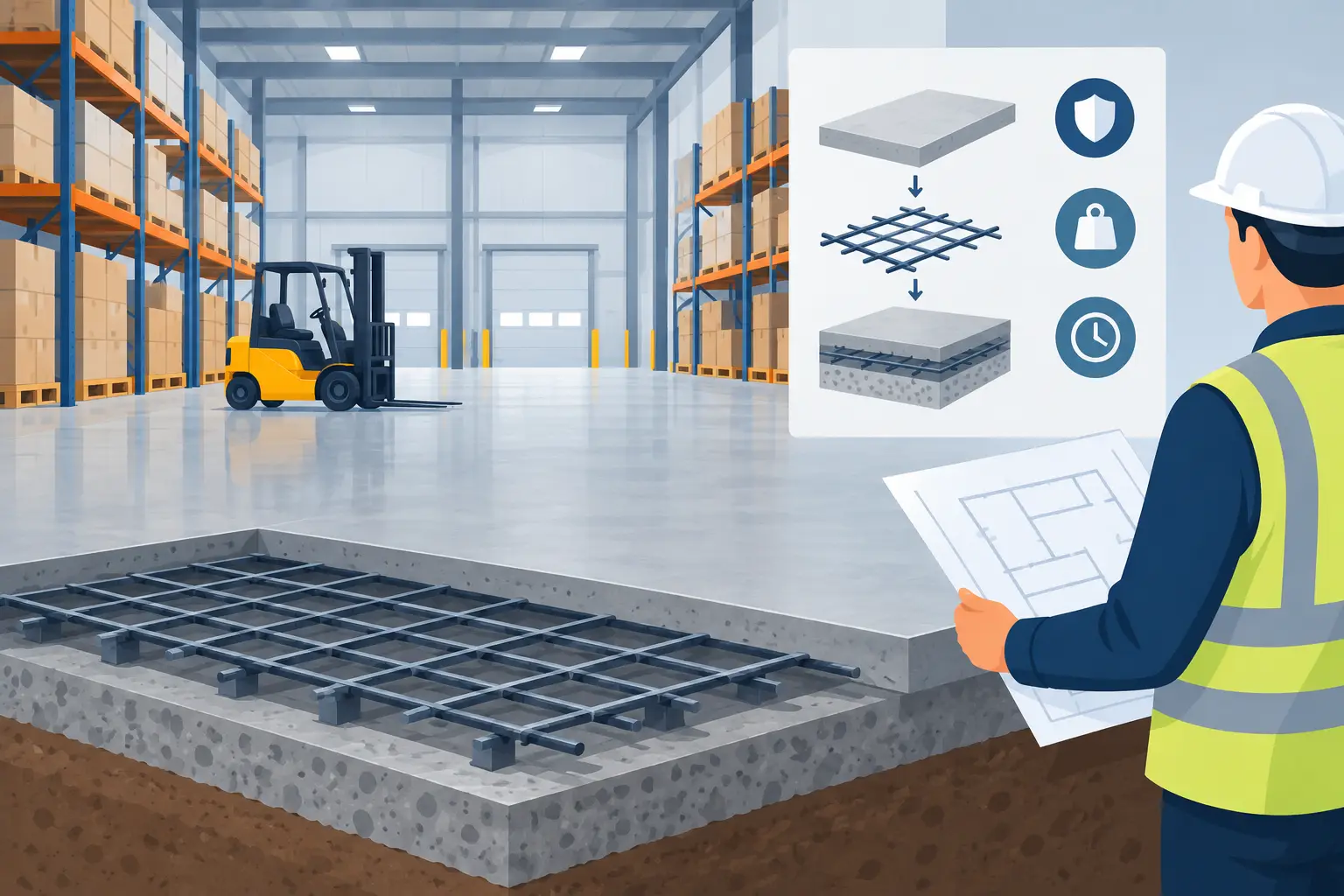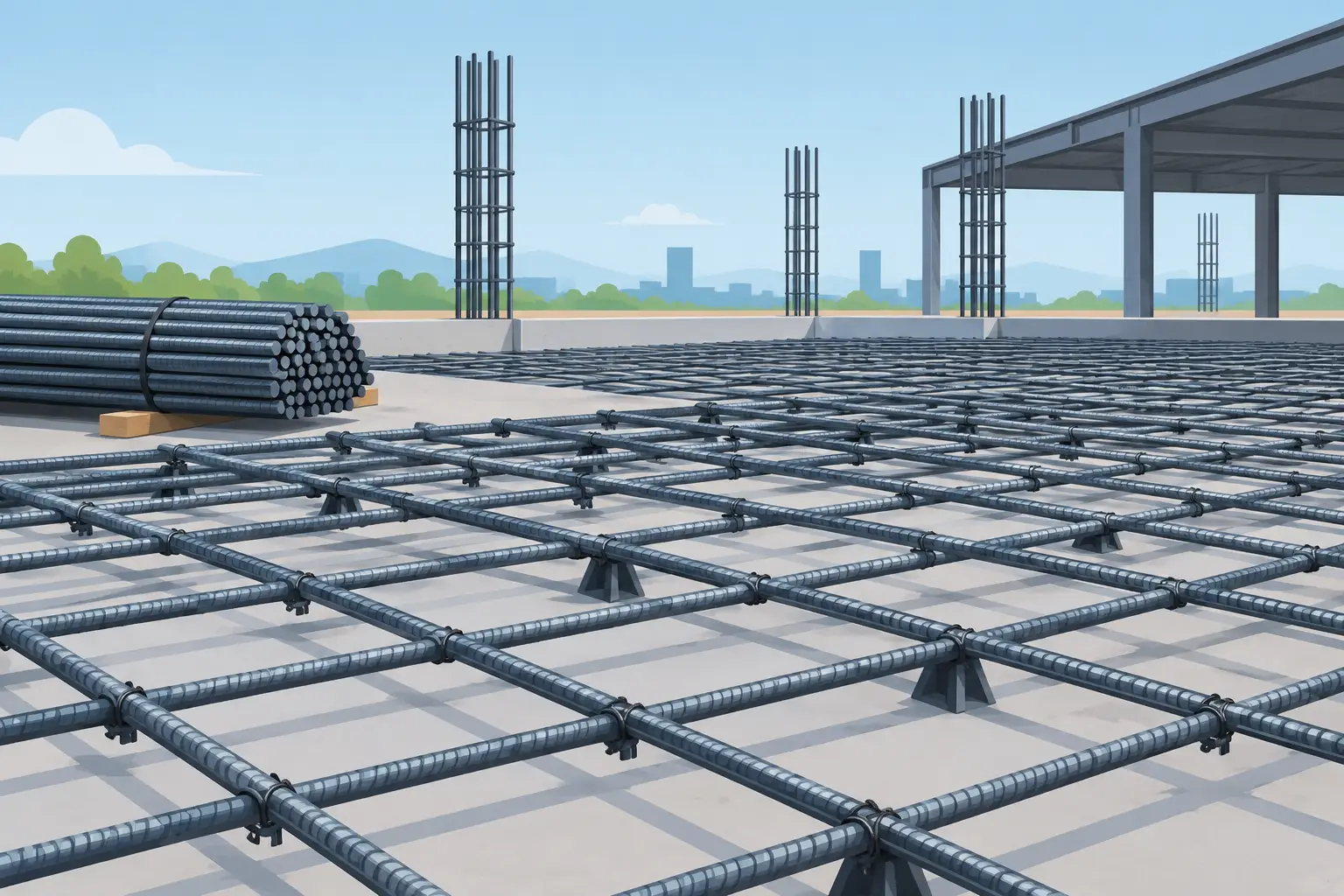
See a warehouse floor reinforcement example with mesh, rebar, joints, chairs, and subgrade checks that help crews build slabs ready for real loading use.
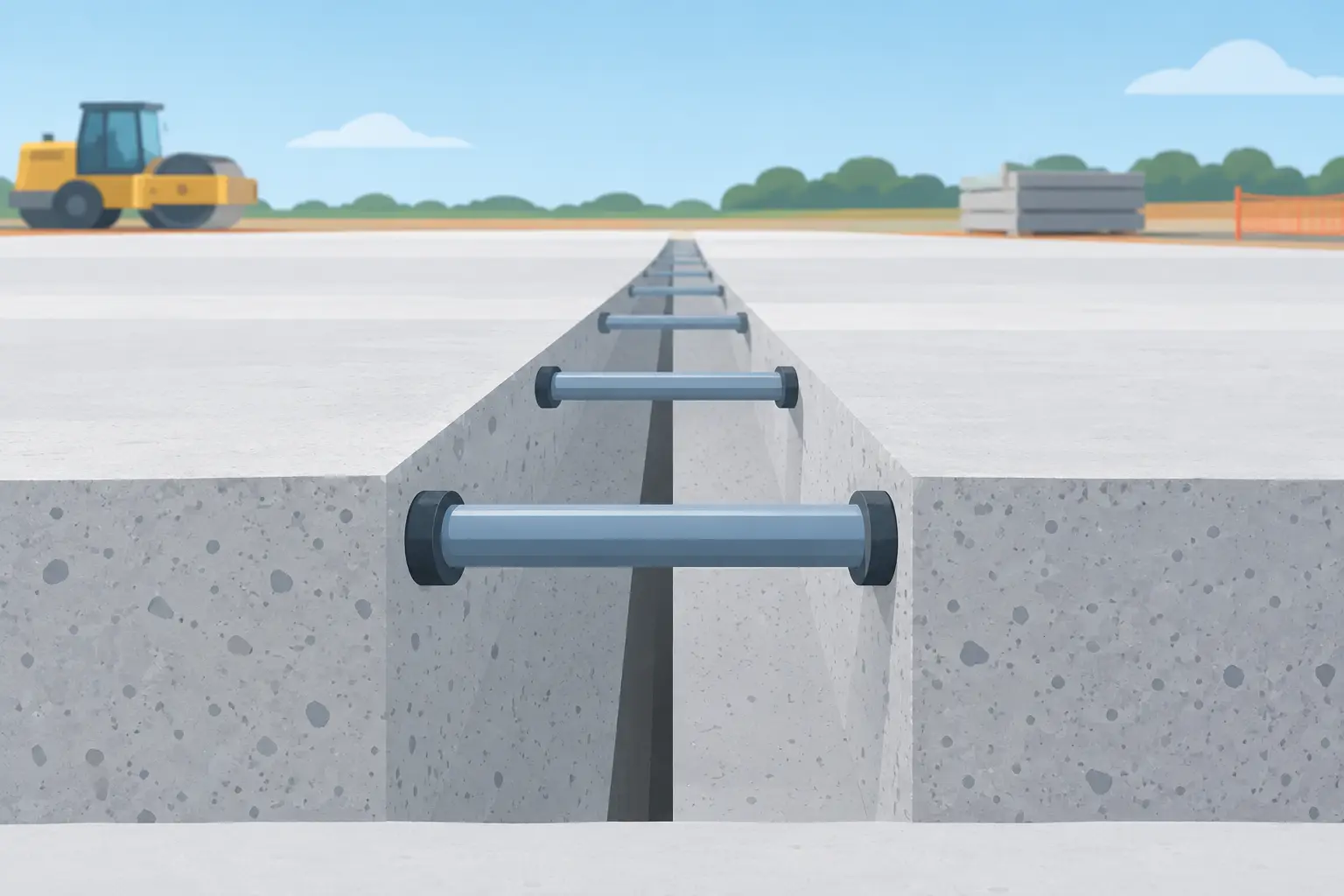
Dowel Bars for Concrete Joints That Stay Level
A concrete slab can have the right mix, adequate thickness, and well-compacted base, then still develop a rough joint line under repeated wheel traffic. Dowel bars address that weak point. Installed across selected joints, they transfer loads from one slab panel to the next while allowing the concrete to expand and contract as intended.
For contractors, the detail matters because failed joints are expensive to repair and disruptive to a working site. For procurement teams, it means buying the correct bar diameter, length, coating, and quantity before the pour – not trying to solve a joint issue after traffic has already started to fault the slab.
What dowel bars do in a concrete slab
Dowel bars are smooth, round steel bars placed horizontally across transverse joints in concrete pavement and heavy-duty slabs. When a wheel load approaches a joint, the loaded slab wants to deflect. A properly installed dowel transfers part of that load into the neighboring slab, reducing edge stress and limiting vertical movement between panels.
This load transfer helps prevent joint faulting, where one side of a joint sits higher than the other. It also reduces pumping of water and fine material from beneath the slab, which can gradually weaken the support conditions at the joint. The result is a flatter driving surface and a slab system better able to handle repeated traffic.
Dowel bars are not the same as deformed reinforcing bar. Rebar is designed to bond with concrete and provide tensile reinforcement. Dowels need to permit controlled longitudinal movement at the joint, so they are generally smooth. Their job is load transfer, not tying two slab panels together so tightly that shrinkage and thermal movement cause cracking.
Where dowel bars are commonly used
Dowel bars are most common in concrete pavements, industrial yards, warehouse floors, loading areas, hardstands, and other slabs exposed to regular vehicle loads. They are particularly relevant where forklifts, trucks, trailers, or concentrated wheel loads cross joints repeatedly.
A light residential walkway may not need them. A driveway, equipment pad, or commercial slab may, depending on slab thickness, joint layout, base support, wheel loads, and the engineer’s design. There is no reliable one-size-fits-all rule. A bar suitable for a thin slab under passenger vehicles may be inadequate for a heavy truck route or distribution center floor.
They are usually installed at contraction joints and construction joints where load transfer is required. Expansion or isolation joints need special attention. In those locations, the detail must allow enough movement to prevent restraint, often using sleeves, caps, or proprietary expansion-joint assemblies specified for the project.
Bar size, length, and spacing must work together
Dowel selection is a system, not a single product choice. Diameter affects shear capacity and bearing stress in the concrete. Length provides embedment on each side of the joint. Spacing determines how effectively loads are distributed along the joint line.
On many projects, dowels are specified at regular centers across the slab width, with the exact diameter and length set by the design. Larger bars are not automatically better. An oversized bar may create placement issues, increase restraint if the movement side is not properly debonded, and add cost without improving the designed performance. Undersized or short bars, on the other hand, can concentrate stress and reduce load-transfer efficiency.
The project drawings and engineer’s details should always control. Before ordering, confirm the following information against the slab schedule: bar diameter, overall length, spacing, joint type, coating requirement, and whether one end needs a sleeve or bond-breaking treatment. This avoids a common site problem – receiving smooth bars that look right but do not meet the specified dimensions or corrosion protection.
For larger pours, calculate quantities from the actual joint layout rather than slab area alone. Count every joint requiring dowels, allow for end conditions and construction breaks, and include a sensible allowance for handling and site changes. Ordering by a vague estimate can leave a crew short halfway through a pour.
Alignment is where good materials can still fail
A dowel bar performs properly only when it is aligned correctly. It needs to sit at the specified depth, remain parallel to the slab surface, and be parallel with the direction of expected slab movement. Poor alignment can restrain movement, concentrate stress at the joint, and lead to cracking or joint deterioration.
The three alignment issues that cause the most trouble are vertical tilt, horizontal skew, and bars placed too high or too low in the slab. Vertical tilt reduces effective embedment and can interfere with joint movement. Horizontal skew means the bar is not running in the direction of expansion and contraction. Incorrect depth can reduce cover, affect joint performance, or place the bar outside the intended load-transfer zone.
For new slabs, dowel baskets are often the most reliable way to hold bars in position before concrete placement. The baskets need to be set firmly on the prepared base so they do not move when concrete is placed, vibrated, or screeded. If bars are inserted or placed individually, use a method that maintains line, level, spacing, and support throughout the pour.
At construction joints, dowel bars may be fixed into the first pour or installed using a formed joint system. Whatever method is used, protect the projecting ends and check their position before placing the adjoining slab. A quick visual inspection before concrete arrives is far cheaper than cutting out and repairing a bad joint later.
Coatings, sleeves, and bond breakers
Because dowels need to move within the concrete as slabs expand and contract, their surface condition matters. Bare smooth steel may be appropriate in dry, low-corrosion environments when specified. Where moisture, deicing chemicals, or aggressive exposure is expected, epoxy-coated, galvanized, stainless steel, or other corrosion-resistant dowel options may be required.
The trade-off is straightforward: higher corrosion resistance generally costs more upfront, but can be justified where replacement or repair would be difficult and costly. The coating must also be suitable for movement. A rough, damaged, or contaminated surface can increase friction and stop the dowel from sliding as designed.
One end of the dowel is commonly debonded or sleeved where the joint detail requires movement. Sleeves and expansion caps must have enough space to accommodate expected expansion. A sleeve filled with concrete slurry, crushed during placement, or installed without adequate allowance is not doing its job. Keep components clean, protected, and matched to the bar size.
Installation checks before the concrete truck arrives
A short pre-pour check can prevent most dowel-related issues. Confirm that the bars match the approved specification and that their placement corresponds with the joint layout. Check that baskets or supports are stable, spacing is consistent, and bars are at the required depth.
Also inspect the subbase and joint-forming method. Dowel bars cannot compensate for poor support beneath the slab. If the base is soft, uneven, wet, or inadequately compacted, the slab can still pump and settle around the joints even with correctly sized dowels in place.
During placement, keep traffic, hoses, rakes, and vibration from shifting the assembly. After finishing, saw-cut contraction joints to the specified timing and depth. The joint needs to activate where intended. If random cracking develops away from the planned joint, the load-transfer detail may no longer be working in the location it was designed for.
Buying dowel bars without slowing the job down
For standard work, the fastest procurement starts with an accurate takeoff. Have the drawing detail, required diameter and length, finish or coating, quantity, and delivery timing ready when ordering. If the project includes multiple joint types, separate the requirements clearly so plain dowels, sleeved dowels, and other reinforcement products do not get mixed up on site.
Quality Steel Supplies supports trade buyers who need jobsite-ready steel products without unnecessary purchasing delays. For urgent pours or larger volume requirements, confirm stock, lead time, and delivery access early. It is easier to schedule a delivery around site constraints than to have a concrete crew waiting on missing materials.
A dowel bar is a simple item, but it protects one of the most heavily worked parts of a concrete slab. Get the specification right, keep the bars aligned, and treat the joint detail with the same care as the rest of the structural work. That is how a new slab stays level where traffic hits it hardest.
Related Posts