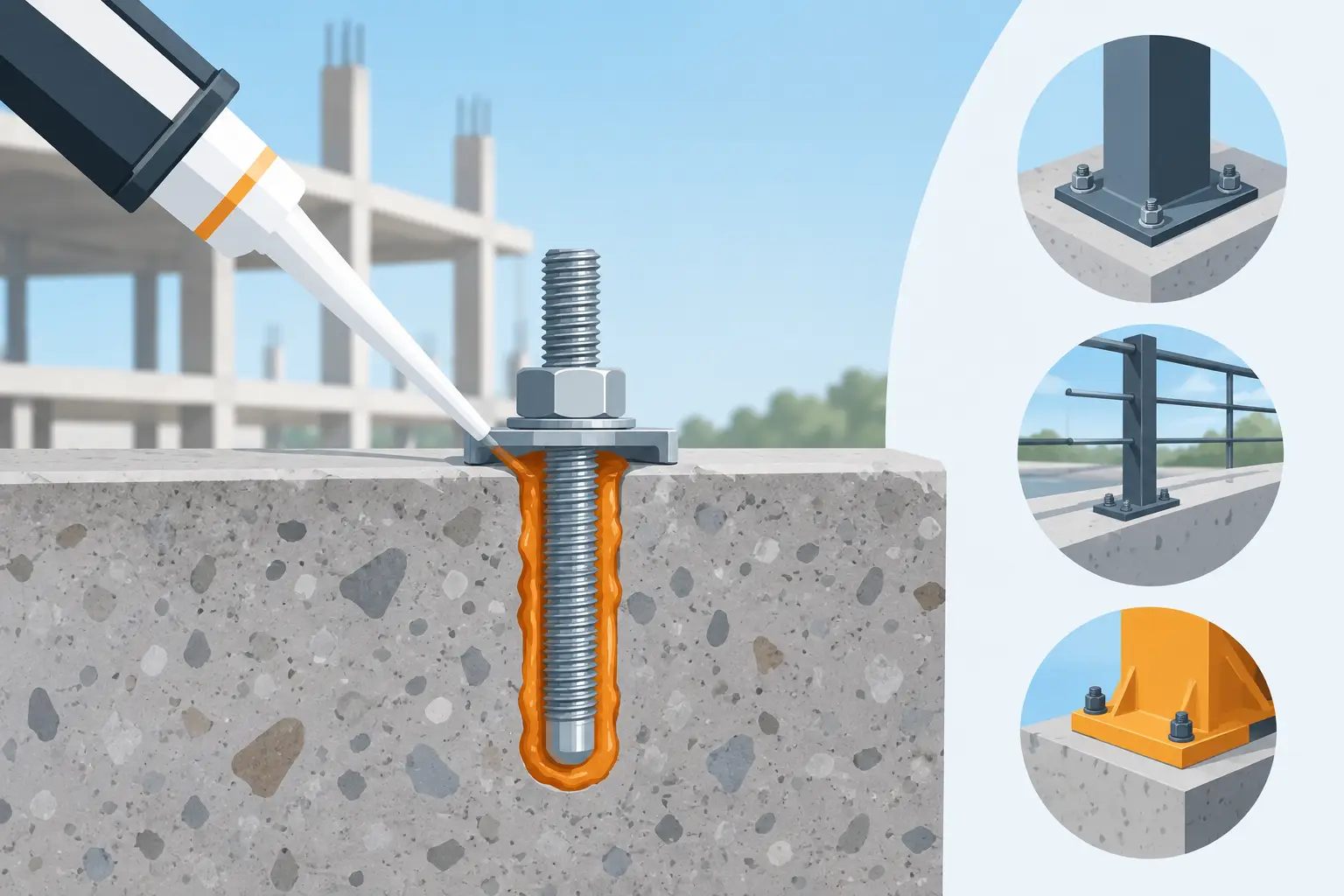
Rebar fabrication services reduce field cutting, support accurate placement, and help concrete crews keep schedules, inspections, and deliveries on track.
Guide to Concrete Fasteners for Real Jobsite Use
If a fixing fails in concrete, the problem usually shows up late and costs more than it should. Railings loosen, bottom plates shift, pipe supports sag, and rework starts eating time. That is why a solid guide to concrete fasteners matters on any job involving slab, block, or structural concrete. The right fastener is not just about what fits the hole. It is about load, edge distance, embedment, base material condition, and how fast the crew needs to move without compromising the result.
What this guide to concrete fasteners should help you decide
Most fastening issues start with using the wrong anchor for the substrate or the load case. Concrete is not drywall or timber. It can crack, it can spall at the edge, and it reacts differently depending on age, strength, reinforcement, and whether the fixing is under tension, shear, or vibration.
A good decision starts with four questions. What are you fixing, how much load will it carry, what is the base material, and is the installation temporary or permanent? If you can answer those early, you avoid the common site habit of grabbing a generic anchor and hoping for the best.
For trade buyers, there is also a supply question. You want fasteners that are available when the pour is cured and the crew is ready. Delays over a missing box of anchors are avoidable if the fastening requirement is scoped at the same time as mesh, rebar, or formwork accessories.
The main concrete fastener types
Mechanical anchors
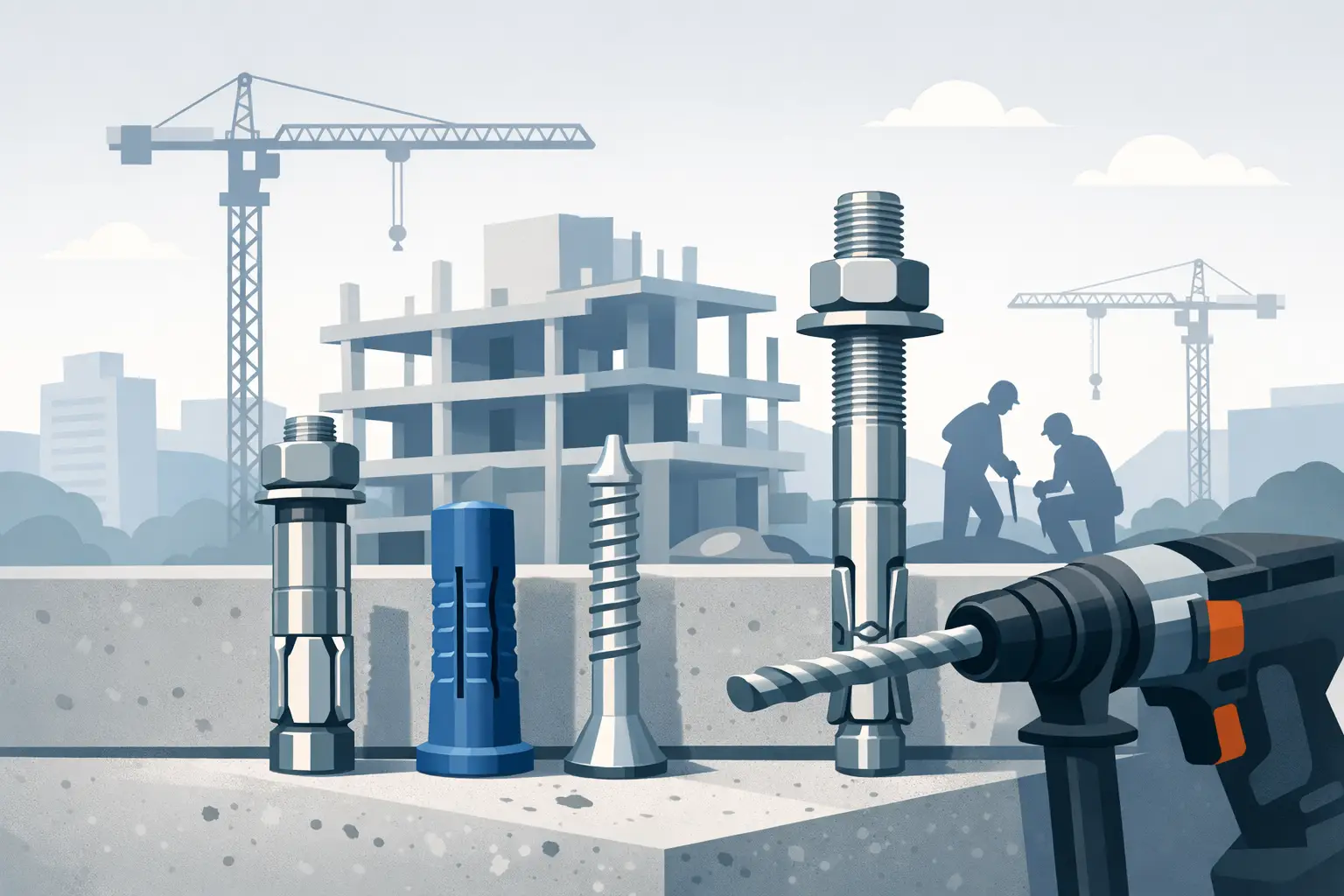
Mechanical anchors expand or grip inside the hole. These include wedge anchors, sleeve anchors, drop-in anchors, and concrete screws. They are widely used because they install quickly and give predictable performance when the hole is drilled cleanly and the substrate is sound.
Wedge anchors are a common choice for heavier duty fixing into solid concrete. They are often used for base plates, steel posts, racking, and equipment supports. They need proper embedment and enough distance from slab edges. If you are too close to the edge, expansion force can crack the concrete.
Sleeve anchors are more forgiving across a range of applications and are often used for medium-duty fixing. They can work well for brackets, handrails, and general attachment where loads are moderate. They are not always the first pick for high-load structural applications, but they are practical and fast.
Drop-in anchors are set flush into the concrete and accept threaded rod or bolts. They are useful where you need a clean finished surface and a removable fixing point. Overhead services and suspended elements often use this style, provided the concrete and loading conditions match the anchor rating.
Concrete screws cut threads into the substrate. They are quick to install and useful for lighter to medium-duty applications such as tracks, battens, conduit clips, and temporary bracing. They are convenient, but hole size and depth need to be right. A sloppy hole means less holding power.
Chemical anchors
Chemical anchors use adhesive resin to bond threaded rod or rebar into the drilled hole. These are often used where higher loads, reduced edge stress, or closer spacing are needed. Because they do not rely on expansion in the same way as a mechanical anchor, they can be a better choice near slab edges or in cracked concrete, depending on the system.
They also suit retrofit work and applications where alignment matters. You can set threaded rod into a precise position and fix steelwork afterward. The trade-off is installation discipline. Hole cleaning, resin mixing, cure time, and temperature all matter. Rush any of that and the anchor may not achieve its design performance.
Matching the fastener to the base material
Solid concrete
Solid, cured concrete gives you the widest range of options. Mechanical anchors and chemical anchors can both perform well here. The key variables are concrete strength, slab thickness, edge distance, and whether the concrete is cracked or uncracked in service.
For heavier items, solid concrete usually points toward wedge anchors or engineered adhesive systems. For lighter items, concrete screws or sleeve anchors may be enough. The load case decides it.
Masonry block and hollow base materials
Not every gray surface on site is suitable for the same anchor. Hollow block, grout-filled block, and solid masonry all behave differently. Expansion anchors can be a poor fit in hollow material unless they are specifically designed for it. In many cases, chemical anchors with sleeves or purpose-made masonry fixings are the safer route.
This is where mistakes happen on smaller jobs. Someone assumes block behaves like a slab, drills the same hole, and gets a weak fixing. It may hold at first, then fail under movement or repeated load.
Green or damaged concrete
Fresh concrete that has not reached strength, or older concrete with cracking and edge damage, changes the calculation. Even if the anchor itself is rated for the load, the substrate may not be. If the concrete is suspect, it is worth slowing down and checking whether a different location, longer embedment, or an adhesive system is needed.
Load, spacing, and edge distance
A fastener is only as good as the concrete around it. You can buy a heavy-duty anchor, but if it is installed too close to the slab edge or too close to the next anchor, the concrete can fail before the steel does.
Tension load tries to pull the anchor straight out. Shear load pushes across it. Many site fixings see a mix of both. Handrails, brackets, machinery, and bottom plates may also see dynamic load or vibration. That matters because repeated movement can reduce performance over time if the wrong anchor is used.
Manufacturers publish spacing and edge distance requirements for a reason. Ignore them and the anchor may still tighten up, but that is not the same as being reliable in service. If the fixing is safety-critical or carrying substantial load, the anchor schedule should be checked against actual site conditions, not assumed from a catalog photo.
Installation is where good anchors go bad
The best concrete fastener can still fail if the hole is wrong. That is not theory. It is one of the most common reasons for pull-out, spin, or underperformance.
Drill diameter has to match the anchor exactly. Hole depth has to allow proper embedment and clearance for dust where required. Blow out and brush the hole if the anchor system calls for it, especially with chemical anchors. Resin set into drilling dust is not bonded to concrete. It is bonded to dust.
Torque matters too. Under-torquing can leave an expansion anchor loose. Over-torquing can damage the anchor or the concrete. If the application matters, use the specified torque, not just feel.
For chemical anchors, temperature and cure time are the usual pressure points. Cold conditions slow curing. Hot conditions can reduce working time. If the rod is loaded too early because the job is being rushed, the anchor may never reach full capacity.
Common applications and what usually works
For sill plates, tracks, and general framing into slab, concrete screws or sleeve anchors are common where loads are moderate and speed matters. For structural steel base plates, bollards, and heavier post fixing, wedge anchors or chemical anchors are often more appropriate.
For suspended services, drop-in anchors and threaded rod setups are practical, provided the anchor is rated for the direction and magnitude of the load. For retrofit handrails, balustrades, and equipment mounts near edges, chemical anchors often make sense because they reduce expansion stress in the concrete.
There is no single best fastener for every job. A quick-install screw anchor may save time on one task and be the wrong product entirely on another. That is the trade-off. Speed is useful, but not if it creates a callback.
Buying concrete fasteners without slowing the job down
Trade buyers usually do not need more theory. They need the right product, in the right quantity, with clear sizing and dependable delivery. The practical move is to order fasteners based on the actual fixing detail, not as a vague allowance at the end.
That means checking diameter, length, coating, substrate compatibility, and installation method before the crew is standing around. If the project also includes reinforcement products, chairs, tie wire, mesh, or other concrete accessories, it makes sense to source the package in one go where possible. Suppliers like Quality Steel Supplies work best for crews that want straightforward product access and quick turnaround without chasing multiple channels for basic site essentials.
A few mistakes worth avoiding
Using an indoor-rated fastener outside is one of the easiest ways to create future failure. Corrosion matters, especially in damp, coastal, or exposed environments. The same goes for mixing incompatible metals in the wrong conditions.
Another mistake is treating anchor length as the only indicator of strength. A longer anchor is not automatically a better anchor if the hole, edge distance, and substrate are wrong. And finally, avoid substituting one fastener type for another just because it is in the van. Similar size does not mean similar performance.
Concrete fastening is one of those details that only gets noticed when it goes wrong. Pick the anchor for the load, respect the base material, install it properly, and the rest of the build keeps moving.
Related Posts