What causes asphalt cracks? Learn how water, traffic, heat, poor drainage, and weak base preparation damage pavement - and how to plan lasting repairs.
Mechanical Anchor vs Chemical for Concrete
A mechanical anchor vs chemical anchor decision is rarely about which product is stronger on a data sheet. On site, the right choice comes down to the base material, load direction, edge distance, installation time, and whether the hole can be drilled and cleaned properly. Getting it wrong can mean cracked concrete, failed inspections, wasted labor, or a fixing that does not perform as designed.
For concrete contractors, builders, and civil crews, both fixing types have a place. Mechanical anchors are fast and practical for many standard structural and non-structural fixings. Chemical anchors offer more flexibility where loads are higher, holes are close to an edge, or threaded rod and rebar must be installed into existing concrete. The job conditions should drive the product choice.
Mechanical Anchor vs Chemical: The Working Difference
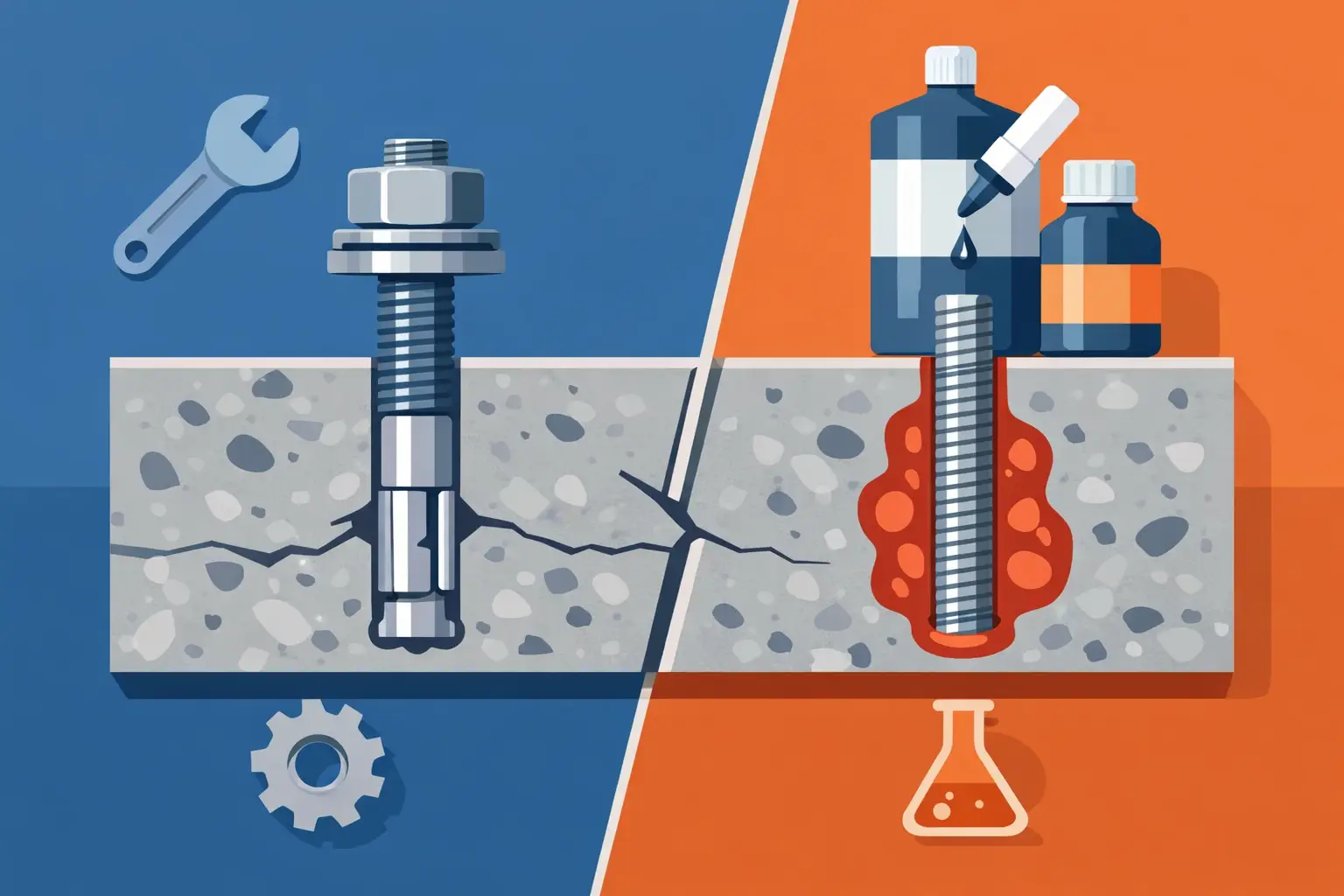
A mechanical anchor grips the concrete by expansion, undercutting, or bearing. Tightening a nut on a wedge anchor, for example, pulls a clip against the wall of the drilled hole. Sleeve anchors and drop-in anchors use similar mechanical principles. The holding force is immediate once the anchor has been installed and tightened to the required torque.
A chemical anchor uses an adhesive resin to bond threaded rod, reinforcing bar, or an internally threaded insert to the concrete or masonry. The resin fills the gap between the fixing and the hole wall, then cures. Depending on the product and conditions, cure times can range from minutes to several hours.
That difference affects the whole installation sequence. Mechanical anchors need the correct hole diameter, drilling depth, embedment, and torque. Chemical anchors need correct hole drilling, thorough cleaning, resin dispensing, embedment depth, and enough cure time before loading. Neither system is forgiving when the installation instructions are ignored.
When Mechanical Anchors Make Sense
Mechanical anchors are usually the efficient choice when the concrete is sound, the fixing locations have adequate spacing and edge distance, and the work needs to be loaded quickly. They are widely used for base plates, handrails, brackets, light steelwork, equipment supports, temporary works, and general concrete fixings.
Their main advantage is speed. Drill the hole, remove drilling dust as required, insert the anchor, and tighten it with a calibrated wrench where specified. There is no cure window to manage, which is useful when crews are working against a concrete pour schedule, a shutdown window, or a handover date.
Mechanical anchors also make inspection straightforward. The anchor size, embedment, washer arrangement, and tightened nut are visible. For repeatable site work, that helps supervisors check installation quality quickly.
The trade-off is the expansion force transferred into the concrete. A wedge or sleeve anchor pushes outward against the hole wall as it is set. If anchors are installed too close to an edge, too close together, or in thin concrete, that force can contribute to breakout or splitting. Manufacturer data and the engineer’s design need to be followed, especially for loaded base plates and safety-critical connections.
Mechanical anchors are also less adaptable when the drilled hole is oversized, irregular, or damaged. A poor hole is not something to solve by overtightening the anchor. Redrill in an approved position or use an engineered alternative.
Common Mechanical Anchor Applications
For ordinary fixing work, a mechanical anchor is often the cleanest answer. It suits dry, sound concrete and installations where the fixing can be placed with sufficient clearance from slab edges, joints, and adjacent anchors. It is particularly practical for repetitive work where crews can drill accurately and install a known anchor size at a consistent spacing.
Not every mechanical anchor is interchangeable. Wedge anchors, sleeve anchors, drop-in anchors, concrete screws, and undercut anchors all have different load behavior and installation requirements. Match the anchor type to the substrate, loading, and approved design rather than selecting by diameter alone.
Where Chemical Anchors Have the Advantage
Chemical anchors are commonly chosen when expansion pressure needs to be minimized. This is useful near concrete edges, in narrow members, or where anchor spacing is tight. Because the adhesive bonds the rod to the hole wall rather than relying on a large expansion force, it can provide a practical solution in locations where a standard expansion anchor is unsuitable.
They are also useful where longer embedment is needed. A threaded rod can be cut to suit the required depth, subject to the system design, allowing loads to be developed over a longer bonded length. That makes chemical systems common for structural steel connections, starter bars, dowels, barrier fixings, façade supports, and retrofitting reinforcement into existing concrete.
Another advantage is flexibility in hole size and fixing material. Many adhesive systems can be used with threaded rod or rebar, provided the specific resin is approved for that application. This matters for post-installed rebar, where bond performance, hole diameter, bar condition, embedment, and concrete condition all need to align with the engineer’s detail.
Chemical anchors are not automatically the answer for every heavy load. Their performance is dependent on correct installation and curing. A resin cartridge left in a hot vehicle, a wet hole with a resin not rated for wet conditions, or an uncleaned hole can materially reduce capacity. Site conditions matter as much as the stated load rating.
Hole Cleaning Is Not Optional
The most common chemical anchor failure starts before the resin is injected. Drilling dust left in the hole prevents proper bond between the adhesive and the concrete. Brushing and blowing the hole in the correct sequence, with the specified brush diameter and air method, is part of the installation – not an extra step.
For deep holes, overhead work, or heavily reinforced concrete, cleaning needs even more attention. The crew must be able to reach the full hole depth with suitable brushes and blow-out equipment. If the hole cannot be cleaned to the product requirement, the fixing method should be reviewed before installation proceeds.
Mechanical anchors also benefit from clean holes. Dust can affect seating, embedment, and the ability to set an anchor correctly. The key difference is that chemical systems rely directly on a clean bond surface, so the consequences are generally greater.
Check the Concrete Before Selecting a Fixing
Anchor capacity is not just a property of the anchor. It is a property of the complete connection: the fixing, concrete strength, slab thickness, reinforcement, edge distance, spacing, embedment, load direction, and installation quality.
Cracked concrete deserves particular attention. Many slabs and structural members crack under normal service loading. If the fixing is specified for cracked concrete, use a product approved for that condition and install it within its published limits. Do not assume an anchor suitable for sound, uncracked concrete will provide the same result in a cracked slab.
Concrete age and condition also matter. Green concrete, deteriorated concrete, hollow block, and old masonry do not behave like fully cured, sound structural concrete. Pull-out testing or an engineer’s review may be needed where the base material is uncertain, particularly for safety rails, heavy equipment, suspended services, or structural steel.
Installation Time and Site Conditions
If the connection must be loaded immediately, mechanical anchors are usually easier to program. They are set as soon as they are installed correctly. This can reduce delays on fast-moving jobs.
Chemical anchors need a planned cure period. Temperature has a major effect: cold conditions slow curing, while high temperatures may shorten working time after the resin is mixed. Crews need to check the cartridge instructions for substrate temperature, gel time, and full cure time. Loading an anchor early because the resin feels hard at the surface is not acceptable.
Wet or flooded holes require the right resin system. Some adhesives are rated for damp or water-filled holes; others are not. The same applies to overhead applications, where the resin must be approved for the orientation and installed using the required accessories. Product approvals are not fine print when the fixing carries real load.
Cost Should Include Labor and Risk
A mechanical anchor may have a lower unit cost and faster installation, making it economical for high-volume standard fixings. Chemical anchors can cost more per hole and require cartridges, nozzles, cleaning tools, and cure time. But they may avoid costly redesign where expansion anchors cannot meet edge-distance or embedment requirements.
Look at the whole job, not just the box price. A fixing that is quick to buy but difficult to install correctly can create more cost through delays, rework, and inspection issues. For repeated anchors, establish the approved drilling depth, hole diameter, torque or resin quantity, and inspection process before the crew starts.
Select the Fixing From the Design, Not Habit
For light brackets in sound concrete, a mechanical anchor is often the practical answer. For a loaded steel connection close to an edge, post-installed reinforcing bar, or a location where expansion forces are a concern, a chemical anchor may be the better system. There is no universal winner.
Start with the engineer’s fixing detail and the product’s approved load data. Confirm the substrate condition, concrete thickness, edge distances, anchor spacing, environmental exposure, and the actual load direction. Then make sure the material on site matches the specification, including the correct rod grade, washer, nut, resin, and installation accessories.
The best concrete fixing is the one that can be installed correctly, inspected confidently, and relied on after the crew has left site. That is the standard worth buying to.
Related Posts