Rebar fabrication services reduce field cutting, support accurate placement, and help concrete crews keep schedules, inspections, and deliveries on track.
Bar Chairs vs Dobies: Which Support Fits Your Pour?
A reinforcement cage can be tied perfectly and still fail the inspection if it sits at the wrong height. That is the practical issue behind bar chairs vs dobies: both hold reinforcing steel in position, but they suit different loads, surfaces, cover requirements, and placement methods. Choosing the cheaper item without checking the detail can leave steel too close to the ground, too low in the slab, or unsupported when concrete is placed.
For builders, concrete crews, and site buyers, the decision usually comes down to three questions: What cover does the drawing require? What is supporting the reinforcement? And will the spacer stay in place through the pour? Get those answers right before the truck arrives.
What Bar Chairs and Dobies Actually Do
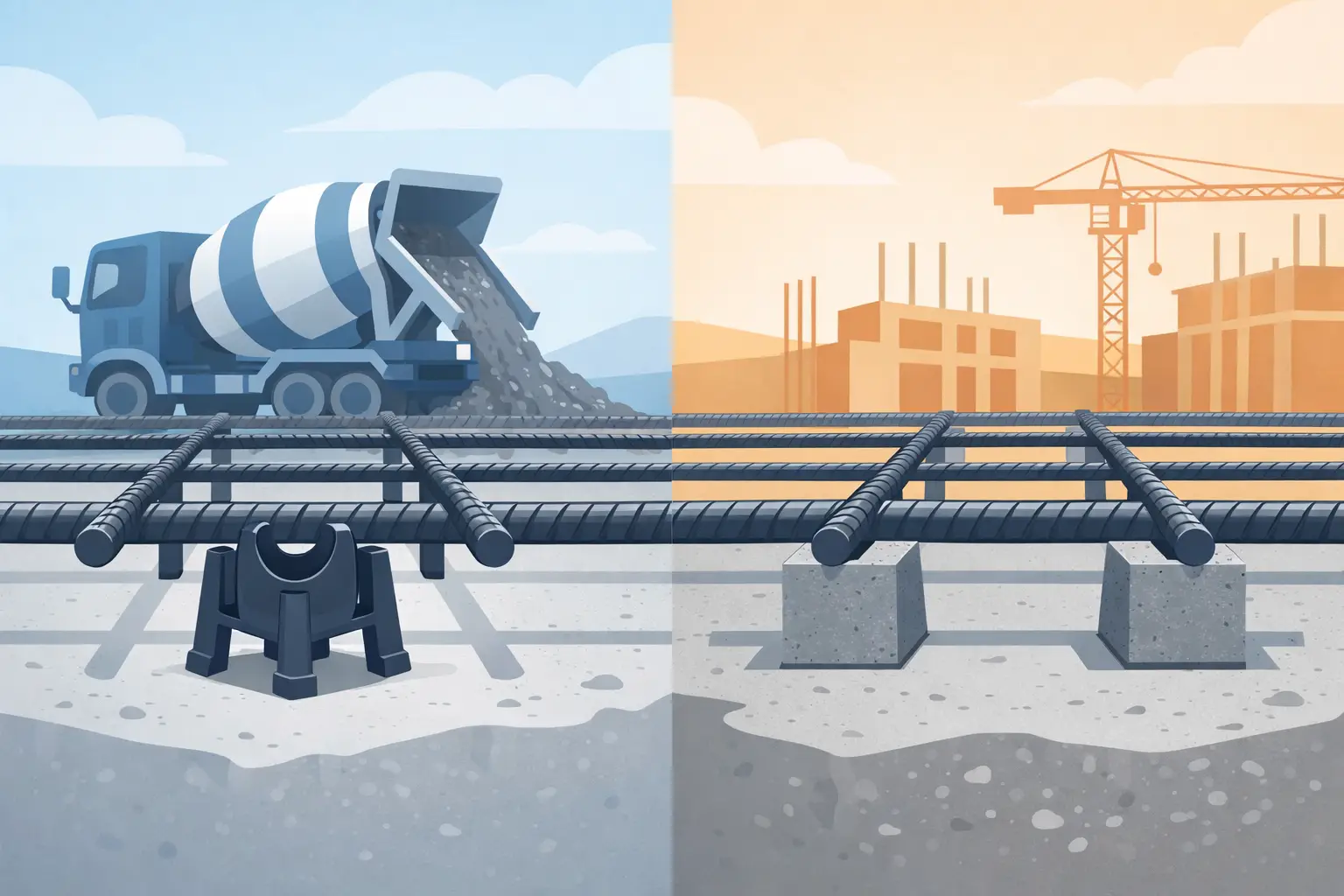
Bar chairs are manufactured supports, commonly plastic or steel wire, designed to lift reinforcing bar or mesh to a specified height. They are available in a wide range of cover heights and profiles, including low slab chairs, mesh chairs, heavy-duty bar chairs, and taller supports for upper reinforcement mats.
Dobies, also called concrete dobies or concrete spacers, are small precast concrete blocks. They are normally tied to reinforcement or placed beneath it to maintain bottom cover in footings, slabs, walls, and other concrete elements. Many include tie-wire holes or grooves so they can be secured to the steel.
Neither product adds structural strength to the finished member in the way reinforcing bar does. Their job is positioning. That positioning matters because reinforcement only performs as designed when it has the specified concrete cover around it. Cover protects the steel from moisture, corrosion, fire exposure, and site conditions, while also placing it where the engineer expects it to resist tension.
Bar Chairs vs Dobies: The Main Difference
The biggest difference is material and application. Bar chairs are purpose-made for speed, repeatable height, and broad support across slab and mesh work. Dobies are concrete-based supports that are particularly useful where reinforcement sits close to soil, blinding, formwork, or other rough surfaces.
Plastic bar chairs are widely used on residential slabs because they are light, quick to set out, and available in consistent sizes. They can support reinforcing mesh above a vapor barrier or compacted base without the labor of tying every individual spacer. Heavy-duty chairs are also available for larger bar, denser reinforcement, and higher site traffic, provided their load rating suits the job.
Concrete dobies are often the stronger choice for bottom reinforcement in footings and foundations. They are less likely to be crushed by heavier reinforcing cages and are well suited to direct contact with compacted ground or lean concrete. Because they are made from concrete, they also provide a compatible support material within a concrete pour.
That does not make dobies the automatic answer for every footing or chairs the automatic answer for every slab. The engineer’s drawings, project specification, and local code requirements take priority. Spacer selection should follow the required cover and the actual weight and layout of the reinforcement.
When Bar Chairs Are the Better Choice
Bar chairs are generally the practical option when the work involves large areas of reinforcing mesh, standard slab construction, or upper layers of steel that need a reliable and consistent elevation. A crew can place them on a set grid, lay mesh or bar over them, tie laps, and move on without slowing the pour schedule.
They are especially useful where the reinforcement needs to remain clear of a membrane. In slab-on-grade work, placing steel directly on a vapor barrier and pulling it up during the pour is unreliable. Once workers and concrete pumps start moving across the steel, the mesh can settle back down. Chairs establish the intended position before concrete placement starts.
Use bar chairs when you need:
- Consistent support heights across a broad slab or mesh area
- Quick installation for standard reinforcing layouts
- Support for top mats, slab mesh, or elevated bar cages
- A spacer profile suited to vapor barriers and smooth formwork
The key word is suited. A light plastic chair that works well under standard mesh may not be suitable under a congested beam cage, a heavy bar mat, or a work area subject to repeated foot traffic. If the chairs flatten, tip, or punch through the surface, the cover is no longer controlled.
Chair Spacing Matters as Much as Chair Height
A correctly sized chair placed too far apart can still allow bar or mesh to sag. Spacing depends on the bar size, mesh type, reinforcement weight, chair capacity, and whether workers will step on the steel during placement. A light mesh panel needs a different support grid from a heavily reinforced suspended slab.
Set chairs out before steel placement, then check the reinforcement elevation after tying. Do not assume the first layout remains correct after crews walk the grid, install penetrations, or add extra bars around openings. A quick pre-pour inspection is cheaper than correcting low steel after the concrete is down.
When Concrete Dobies Are the Better Choice
Dobies are commonly used where reinforcing steel needs dependable support over rough or uneven substrates. Footings, grade beams, pile caps, retaining walls, and heavily reinforced foundation work are typical applications. Their mass and compressive strength help them stay put beneath reinforcing cages that would overload lighter chairs.
They are also useful where bottom cover is critical. A footing cage placed directly on dirt, gravel, or timber scraps is not properly supported, and those temporary materials should not be left in the concrete. Dobies provide a defined concrete cover distance and can be tied to the cage so it does not shift while being lowered into the excavation.
For vertical reinforcement, purpose-made concrete spacers can maintain cover between bars and formwork. This is particularly relevant for walls, columns, and formed foundation edges. The spacer must be sized for the required side cover, not simply whatever block happens to be on site.
Dobies do have trade-offs. They are heavier to handle, can be slower to distribute across a large slab, and may not be the best fit over delicate membranes if their edges could damage the barrier. They also need to be stored carefully so broken or chipped spacers are not used where accurate cover is required.
Match the Spacer to the Pour Conditions
The right support is not only about the drawing dimension. Consider how the concrete will be placed and how the reinforcement will be treated before the pour. Pump hose movement, wheelbarrows, workers walking the steel, vibration, and crowded lap zones can all dislodge poorly selected spacers.
For a typical slab, plastic or composite bar chairs may be the efficient choice, especially under mesh and on a prepared membrane. For a heavily loaded foundation cage, concrete dobies may offer better bearing and stability. For elevated reinforcement, taller bar chairs or purpose-designed continuous supports may be necessary to keep upper bars from dropping during placement.
Also check compatibility with the finish requirements. If the concrete face will remain exposed, spacer marks and surface appearance can matter. Form-facing spacers should be appropriate for architectural, precast, or visible concrete work. On standard buried footings, appearance is less of a concern, but cover and stability remain non-negotiable.
Common Site Mistakes to Avoid
The most common mistake is treating spacers as an afterthought. Steel arrives, the crew starts tying, and someone searches for whatever offcuts or blocks are nearby. That approach creates inconsistent cover and makes inspection harder.
Another mistake is using one chair size everywhere. Bottom cover in a footing, cover beneath slab mesh, and side cover in a formed wall can all be different. Read each reinforcement detail rather than ordering a single spacer height for the entire project.
Avoid setting chairs or dobies too sparsely. Reinforcement can bend between supports, especially at laps, around service penetrations, and where extra trimming bars have been added. Add support where steel is heavier or where it is likely to be walked on.
Finally, do not rely on lifting mesh during the pour. Even experienced crews cannot consistently hold reinforcement at the correct level while placing and consolidating concrete. Support it correctly beforehand, then verify it stays there.
Order for the Drawing, Not the Guesswork
Before ordering, confirm the required cover dimensions, reinforcement type, substrate, and whether the job needs standard, heavy-duty, or form-facing spacers. Include enough units for the support spacing required by the steel layout, not just the slab area. Running short halfway through steel placement is an avoidable delay.
Quality Steel Supplies can help contractors source reinforcing essentials for slab, footing, and structural work, including bar chairs, reinforcing steel, mesh, tie wire, and related site materials. For unusual reinforcement layouts or a large-volume order, have the drawings and cover requirements ready when you call.
The best spacer is the one that holds the specified cover from the first tie through the last concrete truck. Put that decision on the pre-pour checklist, and the rest of the reinforcing work has a much better chance of staying where it belongs.
Related Posts