Rebar fabrication services reduce field cutting, support accurate placement, and help concrete crews keep schedules, inspections, and deliveries on track.
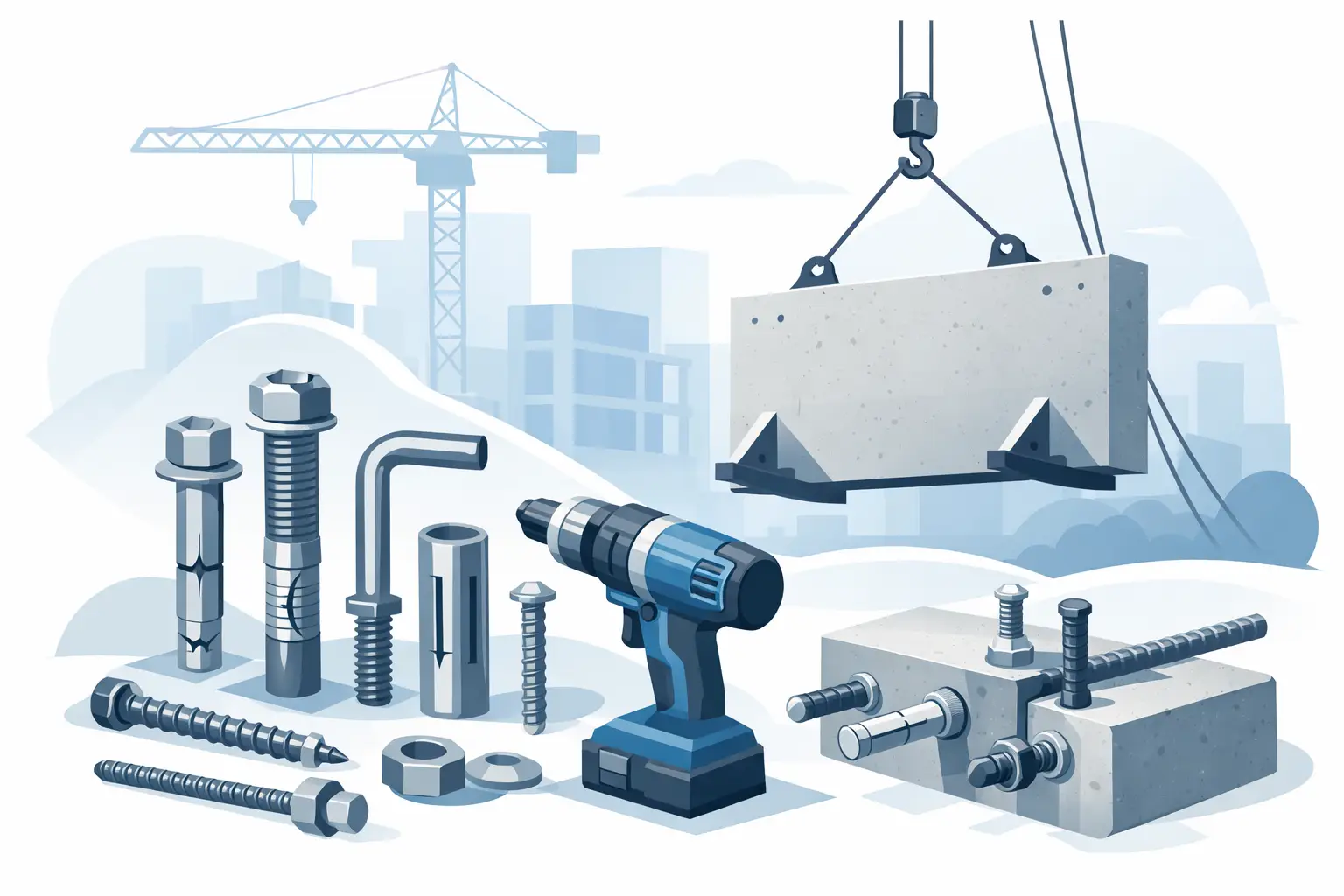
Best Fixings for Precast Concrete Jobs
A precast panel can be perfectly made and still cause trouble on site if the fixing choice is wrong. That is usually where delays start – cracked edges, misaligned brackets, poor pull-out performance, or hardware that looked fine on paper but was never right for the load case. When contractors ask about the best fixings for precast concrete, the real answer starts with the application, not the catalog page.
Precast concrete behaves differently from cast-in-place work in a few key ways. You are often dealing with thinner sections, tighter edge distances, factory-made tolerances, and lifting or connection points that need to perform exactly as designed. The fixing has to suit the concrete strength, the panel geometry, the installation sequence, and the load direction. There is no single best option for every job, but there are clear best choices depending on what you are trying to hold, lift, brace, or connect.
What makes a fixing right for precast concrete?
The first question is whether the fixing is cast in or installed after the panel is cured. Cast-in fixings are often the cleanest and strongest option because they become part of the unit during manufacture. Post-installed fixings give more flexibility on site, especially when final positions shift or retrofit work is involved.
Load matters, but so does how the load acts. A fixing carrying pure tension is different from one taking shear, vibration, dynamic movement, or a combination of all three. Edge distance also matters more than many people expect. Precast elements can be vulnerable to breakout if the anchor sits too close to an edge or corner, especially under high point loads.
Then there is the environment. Internal dry-use hardware may be perfectly acceptable in one job and completely wrong in a coastal, industrial, or wet area application. Corrosion resistance is not a detail to sort out later. It should be part of the initial selection.
Best fixings for precast concrete by application
If you break the category down by use, the decision becomes more practical.
Cast-in anchors and inserts
For many factory-produced precast units, cast-in anchors and threaded inserts are the best fixings for precast concrete because they deliver predictable performance and cleaner installation. These are set in place before the pour and become embedded in the panel or element.
Threaded inserts are commonly used for attaching brackets, facade supports, rails, and secondary steelwork. Their main advantage is accuracy. If the casting setup is right, installation on site becomes faster because there is no drilling, less dust, and less chance of damaging the concrete. They also reduce the risk of edge spalling that can come with post-installed anchors.
The trade-off is that cast-in hardware has to be planned early. If dimensions change late, or if the panel arrives with a mismatch, there is less room to improvise.
Lifting anchors
Lifting anchors are a specialist category and should stay that way. For moving precast panels, stairs, beams, or pits, purpose-designed lifting systems are the right choice – not general fixings used creatively. Load rating, clutch compatibility, panel orientation during lift, and concrete strength at the time of lifting all need to line up.
This is one area where shortcuts create expensive problems quickly. A lifting point is not just about ultimate capacity. It also has to deal with dynamic load during handling, transport, rotation, and placement. If the application involves lifting, the best fixing is the one designed and rated for that exact lifting scenario.
Mechanical anchors
For post-installed work, mechanical anchors are often the go-to option. Wedge anchors, sleeve anchors, and drop-in anchors all have their place in precast concrete.
Wedge anchors are commonly used for structural steel baseplates, handrails, brackets, and equipment supports where the concrete quality is known and the section is thick enough to suit expansion forces. They are fast to install and perform well in solid concrete, but they are not always ideal near edges or in thinner precast sections because expansion can increase the risk of cracking or breakout.
Sleeve anchors can be useful for lighter to medium-duty applications where installation speed matters. They are often more forgiving in general-purpose site work, but they are usually not the first choice for higher structural demand.
Drop-in anchors work well where a flush internal thread is needed, such as suspended services or removable fixtures. In precast, they are practical when the element thickness and embedment depth are suitable. If depth is limited, they may not be the right fit.
Chemical anchors
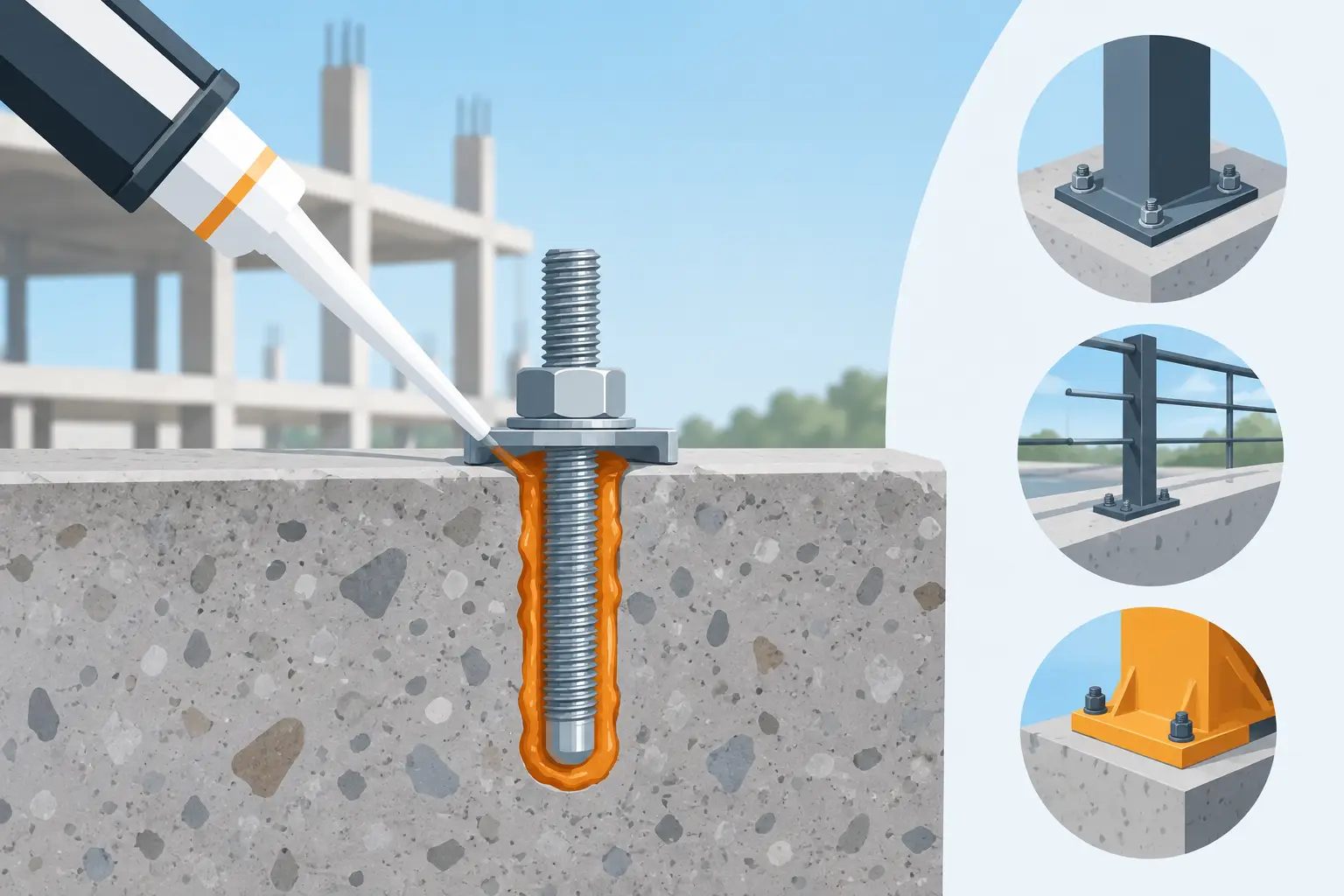
When edge distance is tight, spacing is limited, or high load is required without expansion pressure, chemical anchors are often among the best fixings for precast concrete. These use adhesive resin to bond threaded rod or reinforcing bar into a drilled hole.
Their main advantage is versatility. They are especially useful in retrofit work, connection upgrades, and applications where expansion anchors may overstress the concrete. Because they do not rely on expansion in the same way, they can perform better in challenging layouts.
That said, installation quality matters more with chemical systems. Hole cleaning, resin selection, cure time, temperature, and embedment depth all affect performance. On a rushed site, that can be the weak point. A chemical anchor installed badly is not a premium fixing. It is just an expensive mistake.
Choosing the best fixing for the load case
A lot of fixing failures come from choosing by product type instead of load path. Start with what the fixing actually has to do.
If the load is mainly static shear on an internal bracket, a mechanical anchor may be the simplest answer. If the fixing is close to an edge and carrying tension, adhesive anchor systems or cast-in inserts may be safer. If the panel will be lifted, braced temporarily, and then permanently connected, you may need more than one fixing type across the life of the same element.
Concrete strength is another factor that gets overlooked. Precast units are often high-strength, but that does not automatically make every fixing suitable. Thickness, reinforcement congestion, voids, and insert location all influence the final decision. Drilling into a heavily reinforced area can slow installation or force relocation on site.
Common mistakes when fixing into precast
The first mistake is treating precast like standard slab concrete. Precast elements are engineered products with specific geometry and reinforcement patterns. Drilling without checking drawings can hit steel, damage cover, or weaken the unit.
The second is ignoring edge distance. Even a strong anchor can fail the surrounding concrete if it is too close to an unsupported edge. This is particularly common with facade work, balustrades, and edge-mounted brackets.
The third is underestimating corrosion exposure. Galvanized hardware may be acceptable in some conditions, but stainless steel or higher-spec protection may be the better call in marine or aggressive environments. The cheap option at purchase can become the expensive option in service.
The fourth is focusing only on ultimate load and ignoring installation conditions. If the crew cannot reliably drill to the right depth, clean holes properly, or wait for cure times, the fixing choice needs to reflect that reality.
Best fixings for precast concrete in real site conditions
On site, the best product is usually the one that balances structural performance with practical install. A cast-in insert may be technically ideal, but if the unit is already made, a chemical anchor may be the better path. A wedge anchor may look faster, but if the panel is thin and edge distance is tight, it may create more risk than it saves.
This is where experienced supply support matters. Contractors do not just need a box of hardware. They need fixings that suit the detail, can be sourced without delay, and match the pace of the job. That is why many trade buyers work with suppliers that understand reinforcement, concrete behavior, and what happens when install conditions are less than perfect. Quality Steel Supplies fits that practical end of the market well because the conversation stays focused on product availability, compliance, and getting the right material to site without wasting time.
How to narrow the choice quickly
If you need to make a fixing decision fast, work through four checks. First, confirm whether the job is cast-in or post-installed. Second, check the actual load type – tension, shear, dynamic, or combined. Third, measure the available edge distance and embedment depth. Fourth, match the fixing material to the exposure conditions.
That short process rules out a lot of bad options early. It also makes supplier conversations more useful, because you are discussing actual constraints rather than guessing from a generic product name.
The best fixings for precast concrete are rarely the ones with the broadest marketing claims. They are the ones that fit the panel, the load, the environment, and the install method without creating problems two steps later. Get that part right, and the rest of the connection usually goes a lot smoother.
Related Posts