Rebar fabrication services reduce field cutting, support accurate placement, and help concrete crews keep schedules, inspections, and deliveries on track.
Pod Slab Foundations: Costs, Pros, and Specs
When a slab pour is on the program and the site conditions are less than perfect, pod slab foundations usually come up fast. Builders like them because they can reduce excavation, speed up setup, and cut the amount of concrete needed. But the real value is not just speed or material savings. It is whether the slab is designed, reinforced, and installed properly for the ground it is sitting on.
For trade buyers, that is where the conversation gets practical. A pod slab is not a shortcut. It is a system. If the engineer’s details, pod layout, reinforcement schedule, and site preparation all line up, it can be an efficient foundation solution for residential work and some light commercial applications. If they do not, the problems show up later in cracking, movement, edge failures, and rework no one wants to own.
What pod slab foundations actually are
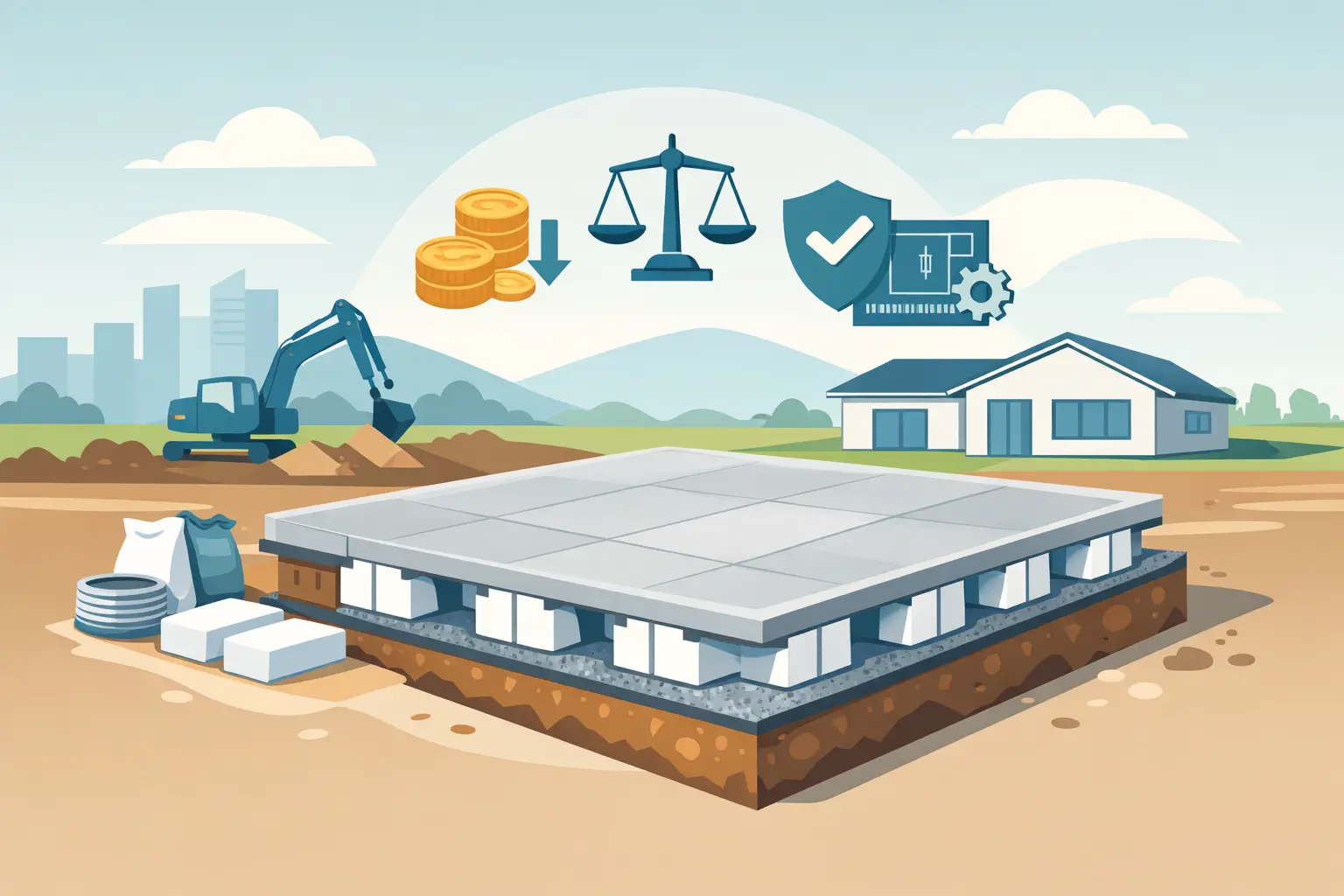
Pod slab foundations are concrete slabs formed over a grid of void-forming polystyrene pods set between reinforced concrete ribs. Instead of pouring a full-thickness slab across the entire footprint, the pods create gaps below parts of the slab while the concrete ribs carry the structural load.
On site, that usually means prepared subgrade, sand or basecourse leveling, moisture barrier, pod layout, spacers or bar chairs, reinforcing mesh and trench mesh or bars as specified, then the pour. The finished slab acts as a stiffened raft, distributing loads across ribs and slab sections rather than relying on one uniform mass of concrete.
That distinction matters. A lot of people describe pod slabs as a cheaper slab. Sometimes they are. Sometimes they are not. The savings often come from reduced spoil, less concrete volume, and faster placement. But those savings can disappear if the site needs significant preparation, the engineer calls for heavier steel, or access issues slow the pour.
Why builders use pod slab foundations
The main reason pod slab foundations are popular is efficiency. On the right site, they reduce digging and simplify forming compared with some conventional stiffened slabs. The pods are lightweight, easy to place, and straightforward to set out when the plan is clear.
There is also a structural reason they are widely specified. Because the slab includes a ribbed grid, it can provide good stiffness over reactive or variable soils when engineered correctly. That does not mean it suits every ground condition, but it gives designers a proven option where movement control matters.
For crews managing labor, the system can also help keep work moving. Materials are easier to stage, pod placement is repetitive, and reinforcement can be planned around a known layout. That is valuable when scheduling concrete, steel, and finishing crews in a tight window.
Where the cost savings really come from
The sales pitch around pod slabs is usually about using less concrete. That is true in many cases, but it is only part of the picture.
A pod slab can lower concrete volume because the pods replace non-structural fill space under the slab. It can also reduce excavation depth and the amount of material carted off site. On a clean residential pad with decent access, those two factors can make a real difference to total installed cost.
But experienced contractors know foundation cost is never one number. Engineering requirements, subgrade condition, slab geometry, edge thickening, pumping access, and reinforcement density can move the budget quickly. A simple rectangle on stable ground is one thing. A stepped slab, poor bearing conditions, or a job with drainage conflicts is another.
That is why pricing pod slab foundations properly means looking at the whole assembly, not just the pods. Reinforcing mesh, bars, trench reinforcement, chairs, tie wire, penetrations, vapor barrier, and delivery timing all affect the final number just as much as concrete volume does.
Reinforcement is where performance is won or lost
If there is one area that should never be treated lightly, it is reinforcement. A pod slab relies on the ribs and slab acting together, and that only happens if the specified steel is placed accurately and supported correctly during the pour.
In practical terms, that means using the right mesh grade, bar sizes, cover, laps, and support accessories. It also means making sure the steel stays where the engineer intended once the concrete starts flowing. Mesh dropped to the bottom of the slab is not doing the same job as mesh held at the right height. The same goes for rib bars that shift or chairs that collapse under traffic.
This is where material selection on site matters more than many buyers allow for. Compliant reinforcing steel is the baseline. After that, the small items matter. Bar chairs, tie wire, trench mesh, stirrups where detailed, and reliable pod spacing all contribute to a slab that gets poured once and performs as intended.
For suppliers, this is not just about selling steel by the ton. It is about making sure the job has the reinforcement package to match the specification and site sequence. Missing one low-cost item can hold up a pour just as effectively as missing the mesh.
Site preparation still decides the outcome
One common mistake is assuming the pod system makes ground issues less important. It does not. Pod slab foundations still depend on proper subgrade preparation, compaction, drainage, and moisture control.
If the base is uneven, poorly compacted, or prone to moisture variation, the slab can still move in ways the design was not intended to handle. The pods are not structural magic. They are formers within a designed slab system. The load path still ends at the ground.
That is why site prep needs to be checked with the same discipline as the reinforcement. Levels need to be right. The base needs to be stable. Service penetrations need to be coordinated before the pour. Drainage needs to move water away from the slab edge long term, not just get the site through inspection week.
On jobs where the site is soft, sloping, or inconsistent, the right answer may still be a pod slab, but the setup will need more attention. There is no value in saving a bit of concrete if the slab ends up carrying the cost later.
Trade-offs worth knowing before you specify or order
Pod slabs are not automatically the best choice because they are common. They suit many projects well, especially detached housing and standard slab-on-ground builds, but there are trade-offs.
The first is coordination. The layout has to match the engineer’s details closely. Pods, ribs, mesh, bars, and penetrations all need to work together. If the set-out is loose or changes happen late, fixing the system can be slower than adjusting a simpler slab arrangement.
The second is site handling. Pods are light, which is good for labor, but they can shift if the site is not managed properly before and during the pour. Wind, foot traffic, poor fixing, or sloppy sequencing can all create headaches.
The third is that savings are project-specific. On one job, pod slab foundations can be a clear win. On another, a conventional raft or thickened edge slab may be just as competitive once engineering and ground prep are factored in. That is why experienced buyers compare systems based on actual drawings and soil information, not assumptions.
What to check before materials are ordered
Before a pod slab job moves from quote to delivery, the smart approach is to confirm a few basics. The engineering drawings should clearly identify slab type, pod configuration, rib dimensions, reinforcement schedule, and cover requirements. Soil classification and any geotechnical notes should also be in hand, because they shape the slab design.
From a procurement angle, the key is making sure every component is accounted for in the same order cycle. That includes pods, reinforcing mesh, bar, chairs, tie wire, trench products, and any fixing accessories needed for setup. Splitting the package across too many suppliers often creates timing issues, especially when a pour date changes.
This is where a practical supplier adds value. Fast turnaround matters, but accuracy matters more. If the reinforcement arrives incomplete or the chairs are wrong for the specified cover, the job slows down immediately. A trade-focused supplier like Quality Steel Supplies understands that the material list is tied directly to inspection and pour sequencing, not just to a sales order.
When pod slabs make the most sense
Pod slab foundations make the most sense when the design suits the soil conditions, the site can be prepared properly, and the build benefits from reduced excavation and concrete volume. They are especially useful where a stiffened slab system is needed and the crew wants a repeatable setup process.
They make less sense when the site complexity outweighs the system’s efficiencies or when the detailing is likely to change repeatedly during construction. In those cases, what looks efficient on paper can become expensive in the field.
The good jobs are the ones where design, supply, and site execution stay aligned. Get the engineering right, use compliant reinforcement, support the steel properly, and treat ground prep as non-negotiable. That is usually the difference between a slab that performs and a slab that turns into a defect discussion six months later.
If you are pricing or planning pod slabs, the best move is simple: treat the slab as a full structural system from the start, and buy materials like the pour date actually matters.
Related Posts