Rebar fabrication services reduce field cutting, support accurate placement, and help concrete crews keep schedules, inspections, and deliveries on track.
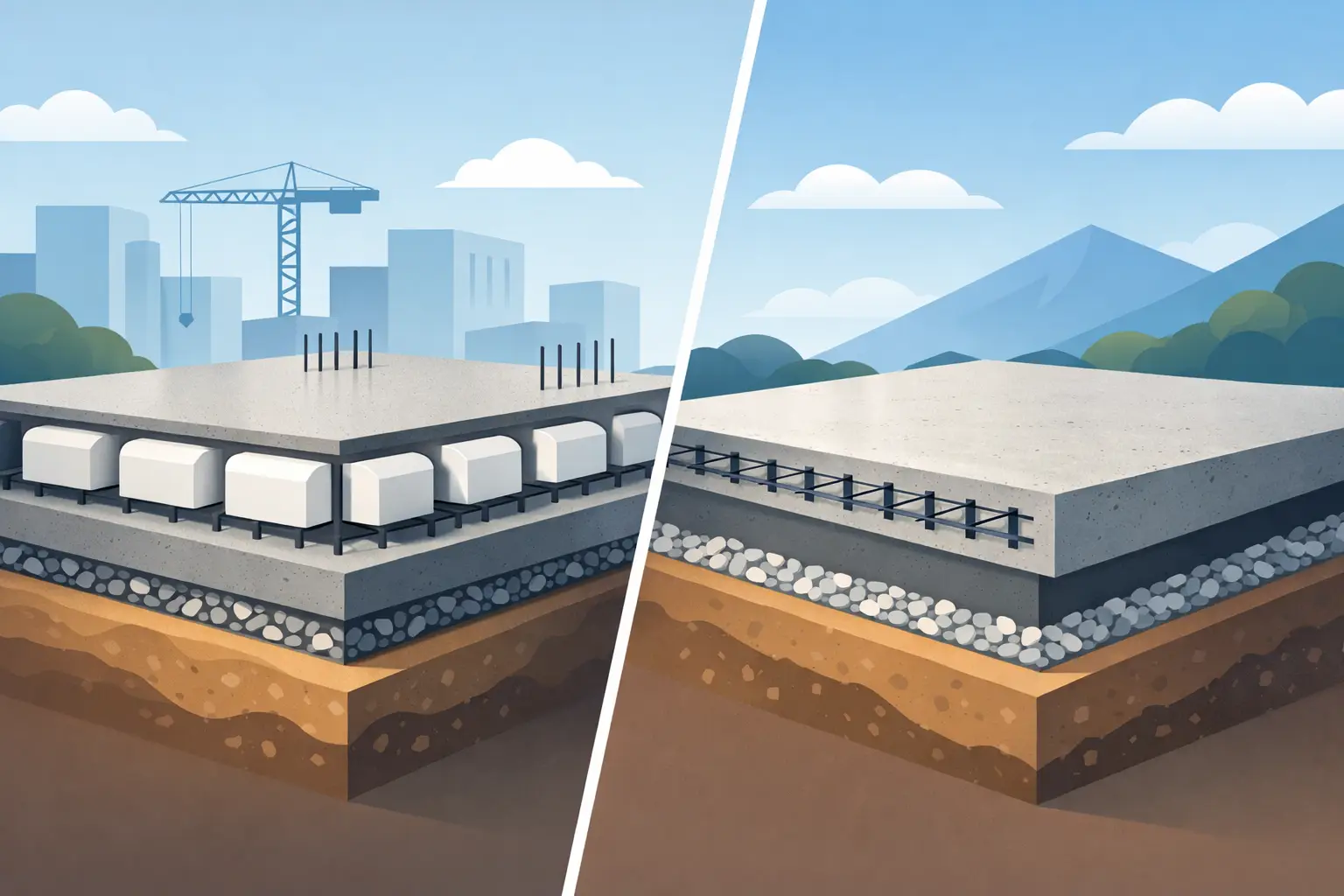
Pod Slabs Versus Raft Slabs Explained
If you’re pricing a slab package and trying to keep the pour on schedule, the pod slabs versus raft slabs question usually comes down to three things – ground conditions, build type, and how much complexity the site can handle. Both systems can deliver a strong, compliant foundation, but they do it in different ways, and the reinforcement detail, excavation requirements, and material handling on site can look very different.
For builders, concrete crews, and project buyers, this is not just a design conversation. It affects steel takeoffs, mesh and bar selection, labor, freight, and how quickly the site can move from prep to pour. Getting the slab type right early helps avoid redesign, wasted materials, and delays when the engineer’s details hit the ground.
Pod slabs versus raft slabs: the basic difference
A raft slab is a reinforced concrete slab foundation that spreads building loads across a broad area. It is typically thickened at the perimeter and under load-bearing walls or key points, which helps distribute weight over the soil. The idea is straightforward – instead of relying on isolated deep footings, the slab works as one integrated platform.
A pod slab is a type of stiffened raft slab that uses expanded polystyrene void formers, commonly called pods, placed between the concrete ribs. Those pods reduce the volume of concrete needed while maintaining the structural rib system that gives the slab strength. In practical terms, you are still building a raft-style foundation, but with a lighter, more material-efficient form.
That distinction matters on site. With a conventional raft slab, more of the footprint is solid concrete. With a pod slab, the load is carried by a grid of reinforced ribs and beams, while the pods create voids in the non-structural zones. That changes how the formwork is laid out, how steel is placed, and how the pour is managed.
Where pod slabs make the most sense
Pod slabs are often chosen for residential work, especially on sites where speed and concrete volume matter. Because the pods replace a significant amount of fill concrete, the overall slab can be lighter and more efficient to build. That can reduce truck movements, pumping time, and in some cases the total installed cost.
They also work well where ground movement is a concern and the slab needs to bridge variable soil conditions with a stiffened rib system. Engineers commonly use pod slabs on reactive clay sites, provided the design matches the soil classification and local requirements. The pods themselves are not structural reinforcement, but they support the system by allowing the ribs and slab topping to do the structural work with less dead load.
From a supply point of view, pod slabs require a coordinated package. You are not just ordering concrete. You also need the right pod layout, reinforcing mesh, trench mesh or bars in ribs, tie wire, bar chairs, and often edge form accessories. If one part is missing, the crew slows down. That is why many contractors prefer to line up all reinforcement and slab consumables before the site crew starts setting pods.
Where raft slabs are often the better option
Raft slabs still make sense on many jobs, especially where the design is simpler, the loads are heavier, or the project is not chasing the installation method used in pod systems. On some commercial and industrial applications, a more solid slab build-up may suit the engineering better. The same applies when the slab needs to accommodate unusual point loads, service penetrations, or detailed footing transitions.
Raft slabs can also be a practical choice when crews are experienced with conventional slab forming and want fewer moving parts in the setup. There is less reliance on pod placement accuracy, and some teams simply prefer the familiarity of a more traditional reinforced concrete slab arrangement.
This is also where the phrase pod slabs versus raft slabs can be slightly misleading. A pod slab is essentially a variation of a raft slab system, not the opposite of one. The real comparison is between a conventional solid or more heavily filled raft arrangement and a pod-based stiffened raft system.
Cost is not just about concrete volume
A lot of buyers assume pod slabs are automatically cheaper because they use less concrete. Sometimes they are. Sometimes they are not.
The material savings from lower concrete volume can be offset by pod supply, added layout time, and the need for tighter coordination during installation. On the other hand, a conventional raft slab may use more concrete and carry more dead load, but it can be simpler for crews that already know the process and have the gear to form and place it efficiently.
The best way to think about cost is total installed cost, not just line-item material cost. That means looking at excavation, subgrade prep, concrete quantity, reinforcement requirements, freight, labor hours, waste, and the risk of delays. If the site is tight, access is poor, or the pour schedule is compressed, the cheapest slab on paper may not be the cheapest slab in real conditions.
Reinforcement considerations for both systems
No matter which slab type is selected, reinforcement has to match the engineer’s design and the slab’s structural role. That sounds obvious, but on busy jobs the pressure to swap products, combine deliveries, or make last-minute substitutions can create problems.
In a pod slab, steel placement is especially important because the ribs do the heavy lifting. Mesh placement in the slab topping, bar placement in the ribs and beams, correct lapping, and proper chair spacing all affect performance. If the chairs are too low, the steel cover is wrong. If the bars are not secured properly, they can move during the pour. If the pod layout shifts, the rib dimensions can be compromised.
In a conventional raft slab, reinforcement is still doing critical work across thickened sections, slab panels, and load paths. You may be dealing with trench mesh, ligatures, straight bar, starter bars, and slab mesh depending on the design. The quantities can add up quickly, and it pays to have clear takeoffs and compliant product on site before placement starts.
For trade buyers, this is where supplier reliability matters more than marketing claims. Reinforcing steel needs to be compliant, correctly sized, and delivered when promised. If a crew is standing around waiting on mesh, chairs, or tie wire, the slab package stops being efficient very quickly.
Site conditions usually make the decision
If you strip the issue back, most slab selection decisions are driven by site and engineering conditions rather than preference alone. Soil reactivity, bearing capacity, slope, drainage, fill depth, building loads, and service penetrations all shape the final answer.
On a flat residential pad with reactive soil, a pod slab may be a very efficient solution. On a site with heavier structural loading or more specialized requirements, a conventional raft configuration may be the cleaner path. The slab type also needs to suit the rest of the build sequence. There is no benefit in choosing a technically efficient foundation if it creates avoidable headaches for follow-on trades.
For owner-builders, this is where professional input matters. It is easy to focus on the visible difference between pods and solid concrete, but the right system depends on engineering, code requirements, and installation quality. For experienced contractors, the bigger issue is usually procurement timing – making sure the specified reinforcement and slab components are available when needed.
Common mistakes when comparing pod slabs versus raft slabs
One common mistake is comparing one quoted slab system to another without checking what is actually included. A lower number may exclude key reinforcement items, pod accessories, additional excavation, or freight. Another is assuming all crews install both systems equally well. Labor familiarity can affect both quality and speed.
There is also a tendency to treat pods as a shortcut. They are not. A pod slab still needs accurate set-out, compliant steel, correct concrete cover, and proper supervision during the pour. If the job is underprepared, the speed advantage disappears fast.
A final issue is late ordering. Slab work runs on sequence. If pods arrive but the mesh does not, or if the bars are on site but the chairs are short, the whole slab prep loses momentum. That is why many contractors prefer to source reinforcement and slab essentials from one dependable supplier where possible. Quality Steel Supplies works with that reality every day – straightforward product supply, compliant materials, and fast delivery matter because slab work does not wait.
Choosing the right slab for the job
If the project is residential, the soil report supports it, and the engineer has detailed a stiffened raft design, a pod slab can be a smart, efficient option. If the build has heavier loading, a simpler conventional setup, or project-specific engineering demands, a raft slab without pods may be the better fit. Neither option is universally better. The right choice is the one that suits the ground, the structure, the crew, and the program.
When you’re reviewing plans, it helps to look beyond the slab label and focus on execution. Ask what steel is required, what tolerances matter most, how the site will be staged, and whether the materials can be delivered in the order the crew needs them. Foundations are not the place to save money by guessing. Get the slab system right, get the reinforcement package right, and the rest of the build starts on firmer ground.
Related Posts