What causes asphalt cracks? Learn how water, traffic, heat, poor drainage, and weak base preparation damage pavement - and how to plan lasting repairs.
Deformed Bars vs Round Bars: Key Differences
If you are ordering steel for concrete work, the difference between deformed bars vs round bars is not a minor detail. It affects bond strength, placement, load transfer, and in some cases whether the material is even suitable for the job. On site, that matters because the wrong bar can create delays, rework, or a failed inspection.
For most reinforced concrete applications, deformed bar is the standard choice. The ribs along the surface are there for one reason – to improve mechanical bond with concrete. Round bar, by contrast, has a smooth surface and behaves differently under load. It still has valid uses, but they are usually more limited and more specific.
Deformed bars vs round bars at a glance
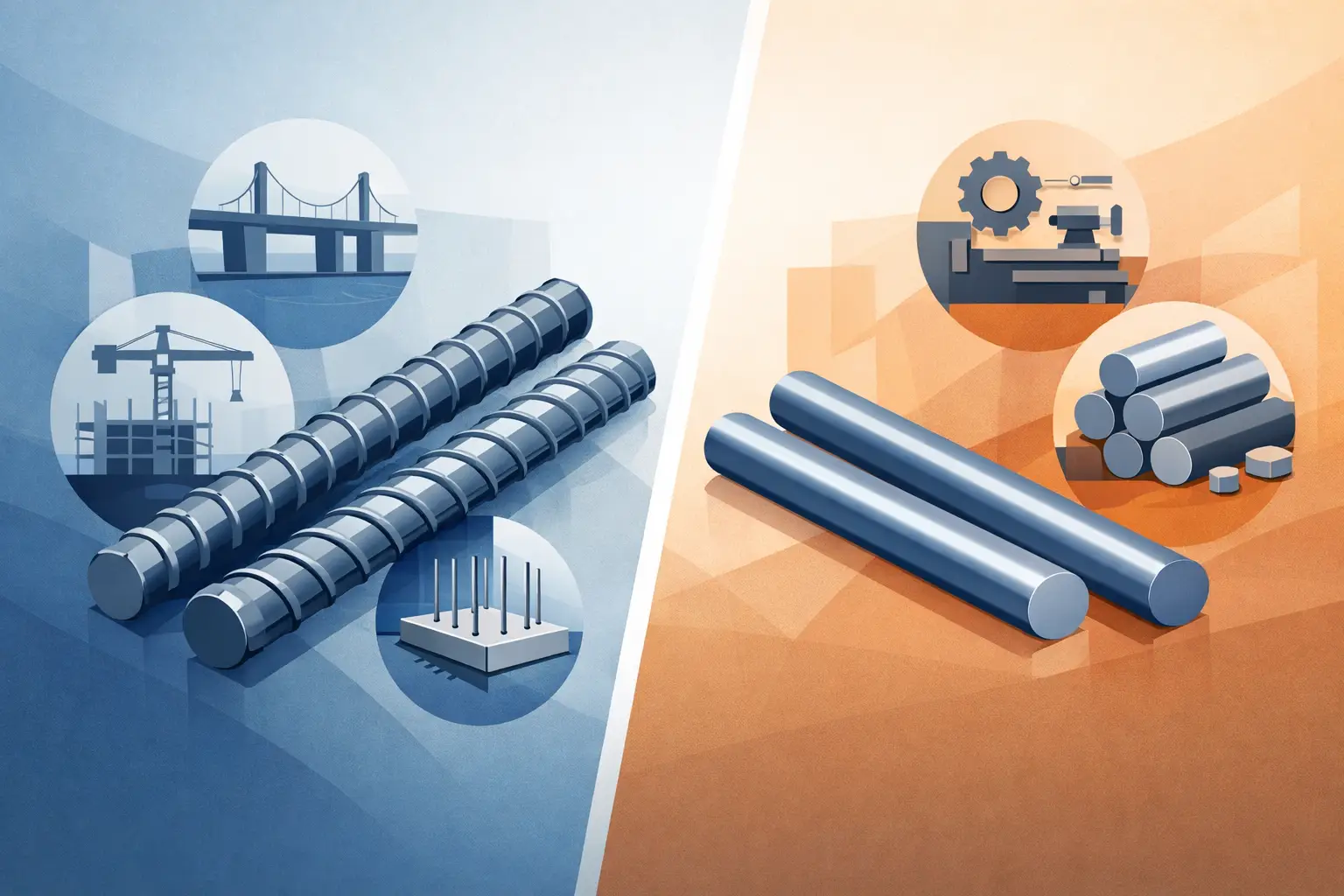
The simplest way to understand deformed bars vs round bars is to look at how each bar grips concrete. Deformed bars have raised lugs or ribs that help lock the steel into the concrete matrix. That bond reduces slippage and improves force transfer between the concrete and the reinforcement.
Round bars are smooth. They do not key into the concrete in the same way, so bond performance is lower unless other design measures are used. That does not automatically make round bar wrong. It just means it is not usually the first pick for structural reinforcement where tension development and anchorage are critical.
In practical terms, deformed bar is what most builders, concrete crews, and civil teams expect to see in footings, slabs, beams, columns, walls, and general reinforced concrete work. Round bar tends to show up more often in dowels, tie applications, temporary uses, or fabrication where a smooth profile is preferred.
Surface profile is the main difference
The defining feature of deformed bar is the patterned surface. Those deformations are rolled into the bar during manufacture and are designed to increase bond with surrounding concrete. When concrete cures around the bar, the ribs help resist pullout and movement.
That extra grip is a big reason deformed bars are used in structural concrete. Reinforced concrete relies on the concrete handling compression and the steel carrying tension. If the bar can slip inside the concrete, the system does not perform as intended.
Round bar does not provide that same mechanical interlock. It relies more on adhesion and friction, which are less reliable under higher stress. Designers can account for that, but it usually means longer embedment lengths, different detailing, or limiting the bar to non-primary reinforcement roles.
Where deformed bars are usually used
On most jobs, deformed bar is the default reinforcement product. It suits slabs, strip footings, pad footings, retaining walls, suspended elements, driveway pours, precast components, and larger commercial or industrial concrete works. If the bar needs to develop strength inside concrete, deformed steel is usually the right direction.
This is also the better option when the project is working to structural drawings that call up specific bar grades, diameters, spacing, cover, and lap requirements. In those cases, substitution is not a casual decision. A smooth round bar cannot simply be swapped in because it is available or easier to bend.
For contractors, that means one thing: if the drawing, engineer, or code intent is structural reinforcement, deformed bar is generally the bar you should be pricing and ordering first.
Where round bars still make sense
Round bars are not obsolete. They are just more specialized. Smooth bars can be useful where slip is acceptable or even desirable, such as dowel applications between concrete slabs. In some movement joints, a smooth dowel allows horizontal transfer while still permitting expansion and contraction.
Round bar can also be used in fabricated items, temporary supports, or general steel applications outside primary reinforced concrete. Some crews prefer it for straightforward bending or site-made accessories because the smooth surface is simpler to handle in certain cases.
The key point is that round bar is usually chosen for a reason tied to function, not as a like-for-like alternative to deformed reinforcement.
Strength is not just about steel grade
A common mistake is assuming that if two bars have similar diameter and steel strength, they will perform the same in concrete. They will not. In the deformed bars vs round bars question, bar surface matters almost as much as bar strength because reinforced concrete depends on composite action.
A smooth round bar with acceptable tensile properties may still underperform as embedded reinforcement if bond is the weak point. That affects development length, crack control, anchorage, and overall behavior of the element.
This is why engineers specify not just bar size, but also bar type and grade. The detail is there because the structural behavior changes when the bar profile changes.
Installation and handling on site
From a handling point of view, both products are familiar to most crews. But there are small differences worth noting. Deformed bars stay put better once tied into cages or mats because the ribs help reduce movement. That can be useful when you are building reinforcement for footings, beams, or walls and want the cage to hold its shape during placement.
Round bars are easier to slide through certain assemblies and can be quicker to align where a smooth interface is needed. They may also be simpler to clean in some fabrication environments. But in reinforced concrete, the same smoothness that helps with movement can become a drawback if high bond is required.
It depends on what the bar is meant to do once the concrete is poured.
Cost differences and what actually matters
Price always matters on a project, but the cheapest bar per piece is not always the lowest-cost choice. If round bar costs less in some sizes but cannot meet the structural requirement, any savings disappear fast. Reordering, redesign, rejected inspections, and schedule loss cost more than choosing the correct reinforcement up front.
Deformed bar may carry a different price point depending on size, grade, and market conditions, but for standard reinforced concrete work it is usually the economical choice because it aligns with the intended application. It is the bar most crews need, most engineers specify, and most concrete reinforcement schedules are built around.
For procurement teams and site managers, the better question is not just price per length. It is whether the material meets the specification, arrives on time, and can go straight into the work without argument.
Compliance comes first
If your job is subject to code, engineering sign-off, or inspection, deformed bars vs round bars is first a compliance question and only then a buying decision. Reinforcement has to match the design intent. Using the wrong profile can trigger non-conformance even if the steel looks similar at a glance.
That matters on residential foundations, commercial slabs, retaining structures, and civil work alike. Reinforcement is not a category where near enough is good enough. The bar type, size, spacing, cover, and placement all work together.
A dependable supplier should be able to tell you exactly what you are getting, including the bar type and grade, and help you avoid ordering material that is not right for the detail. That is the practical value of working with a reinforcement-focused supplier instead of treating steel like a generic commodity.
How to choose the right bar for the job
If the steel is being embedded in concrete to carry structural tension, deformed bar is usually the correct call. If the application involves dowels, controlled movement, or non-structural fabrication, round bar may be appropriate. The drawings and engineering details should decide the issue, not guesswork on site.
When there is any doubt, check the schedule before placing the order. Confirm diameter, grade, bar profile, lengths, cut and bend requirements, and whether the steel is for main reinforcement, ties, dowels, or fabricated accessories. That extra five minutes is cheaper than having a crew wait around because the wrong material showed up.
For trade buyers, speed matters, but accuracy matters more. At Quality Steel Supplies, that is usually where the real time saving happens – getting compliant reinforcement steel to site fast enough that the pour stays on track.
The short version is simple. Deformed bar is the standard for reinforced concrete because it bonds properly and performs as intended under load. Round bar still has its place, but only where the detail calls for a smooth bar and the function matches it. If the job is structural, treat bar selection as a specification issue, not a convenience purchase. That approach keeps the work moving and avoids problems after the concrete is already down.
Related Posts