Rebar fabrication services reduce field cutting, support accurate placement, and help concrete crews keep schedules, inspections, and deliveries on track.

Chemical Anchors vs Dynabolts: Which Fits?
On site, the wrong fixing usually shows up at the worst time – when the base material is already poured, the steel is ready to go, and the crew is waiting. That is why chemical anchors vs dynabolts is not a minor product choice. It affects load performance, edge breakout risk, install time, rework, and whether the detail will pass inspection without an argument.
For builders, concrete crews, landscapers, and steel installers, both systems have a place. The better option depends on the substrate, the loading, the spacing, and how much tolerance the job gives you. If you are choosing fixings for structural steel, handrails, base plates, brackets, bollards, or retrofit work, it pays to know where each one performs well and where it does not.
Chemical anchors vs dynabolts: the basic difference
A dynabolt is a mechanical expansion anchor. You drill the hole, insert the anchor, and tighten it so the sleeve expands against the concrete. The fixing holds because of that expansion force. It is quick, familiar, and widely used for medium to heavy-duty fastening into sound concrete.
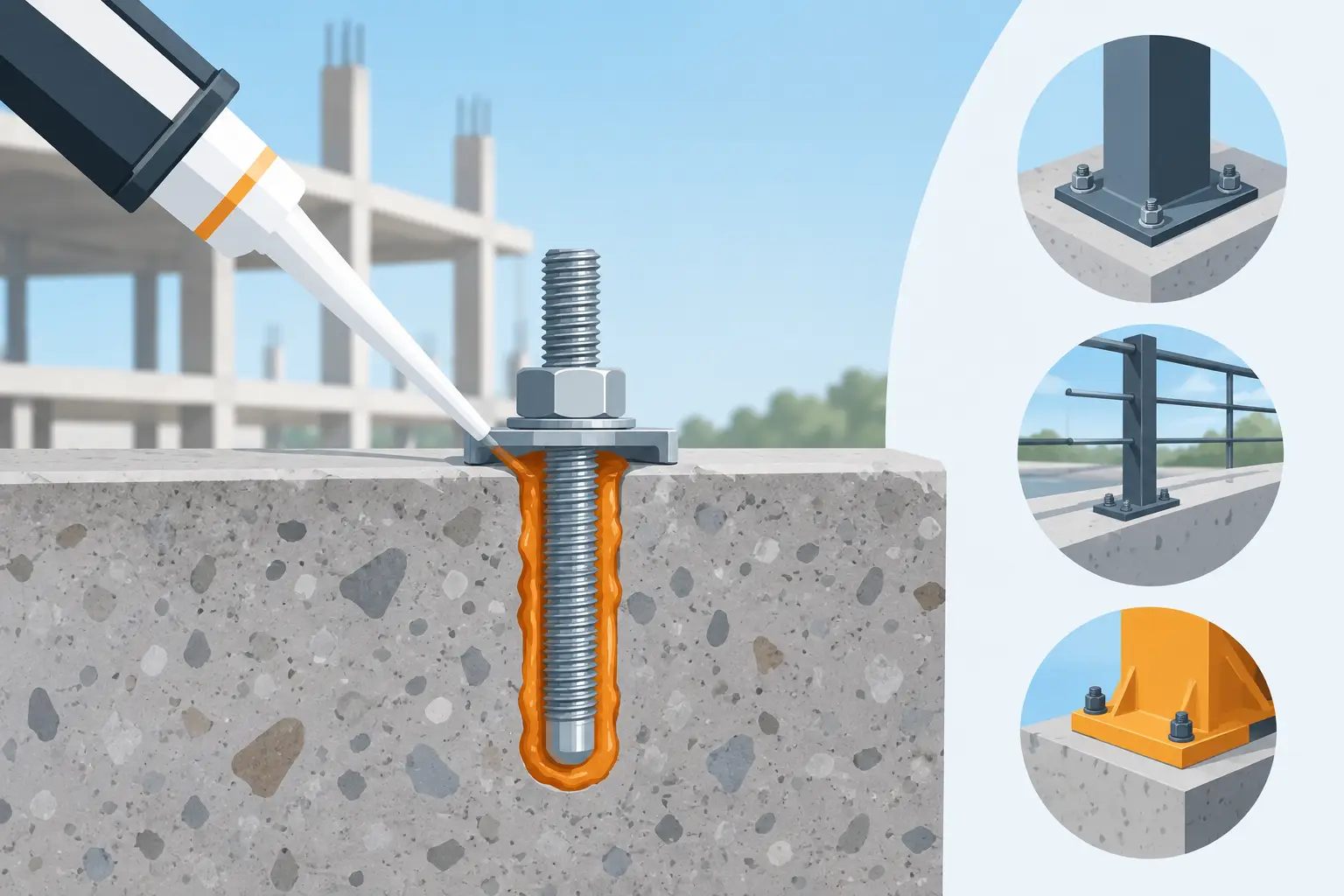
A chemical anchor works differently. You drill and clean the hole, inject a resin, then insert a threaded rod or rebar. Once the resin cures, the bond between the steel, adhesive, and concrete creates the hold. There is no expansion pressure in the same way you get with a dynabolt, which matters a lot near edges or in tighter fixing patterns.
That difference in how they load the concrete is the reason these two products suit different conditions.
Where dynabolts make the most sense
Dynabolts are often the practical choice when speed matters and the base material is solid, uncracked concrete with enough thickness and edge distance. For many general fixing tasks, they are straightforward to install and easy for crews to inspect visually as they go.
If you are fastening a non-critical bracket, a sill plate, a temporary support, a light-to-medium steel component, or similar hardware, dynabolts are attractive because they are simple. Drill diameter is fixed, embedment is known, torque can be applied immediately, and there is no cure time to manage.
They also work well when the crew needs to move fast across repetitive fixings. On a job where downtime costs more than the hardware, that speed can be worth a lot.
The trade-off is that dynabolts rely on expansion. If the anchor is too close to an edge, too close to another anchor, or installed into weaker or damaged concrete, the expansion can increase the risk of cracking or spalling. They also need a hole drilled accurately enough that the anchor can seat and expand properly. If the hole is oversized or the concrete quality is poor, performance drops quickly.
Where chemical anchors are usually the better call
Chemical anchors are commonly chosen when loads are higher, edge distances are tighter, or the detail is more sensitive. Because they do not create the same expansion pressure, they are often better suited to close-to-edge fixing, reduced spacing, and retrofit applications where concrete breakout is a real concern.
They are also useful when the design calls for threaded rod or rebar to be bonded into existing concrete. That is common in structural upgrades, starter bar doweling, heavy base plates, handrail posts, facade brackets, and machinery fixings.
Another advantage is flexibility. With a chemical anchor, you can often adjust rod length, embedment depth, and diameter to suit the engineering detail instead of being locked into one pre-assembled anchor format. That can be valuable on jobs with mixed conditions or revised drawings.
The trade-off is installation control. Chemical anchors are only as good as the hole preparation, resin selection, and curing conditions. If the hole is not cleaned properly, if the resin is wrong for the temperature or moisture, or if the load is applied before full cure, you can end up with a fixing that looks fine and performs badly.
Load capacity is not a one-line answer
A lot of buyers ask which is stronger. Fair question, but it depends on the application.
In many heavy-duty applications, a properly specified chemical anchor can deliver higher load performance than a dynabolt, especially in tension. That is one reason engineers often prefer chemical systems for structural connections and retrofit reinforcement.
But a dynabolt can still be the right fixing for plenty of anchors on site. If the load is moderate, the concrete is sound, and the fixing layout gives enough room, a mechanical anchor may be more than adequate. Paying extra for a chemical anchor on a simple fixing detail does not always buy you a real advantage.
The better question is not which product is stronger in theory. It is which fixing gives reliable performance in the actual substrate, under the actual load case, with the actual edge distances and install conditions on your job.
Chemical anchors vs dynabolts near edges and in cracked concrete
This is where the choice often becomes clearer.
Dynabolts expand into the concrete, so they generally need more conservative edge distances and spacing. If you are fixing near slab edges, narrow upstands, small plinths, or congested bolt patterns, mechanical expansion can become a problem. Even if the anchor installs, the surrounding concrete may be the weak point.
Chemical anchors are often more forgiving in those situations because the bonded system does not wedge the concrete apart during installation. That makes them a common choice where fixing geometry is tight or where the design load puts more stress on the connection.
Cracked concrete adds another layer. Not every anchor is rated for cracked concrete, and not every resin performs the same under those conditions. This is where product data and engineering sign-off matter. On structural work, guessing is expensive.
Installation speed versus installation discipline
If you want the fastest path from drill to finished fixing, dynabolts usually win. Drill, clean if required, insert, tighten, and move on. For crews doing repetitive work under time pressure, that simplicity matters.
Chemical anchors take longer. The hole has to be drilled and cleaned thoroughly. Resin has to be mixed and injected correctly. The rod has to be inserted without voids, and then the curing time has to be respected. In cold weather, that wait can stretch out. If the crew is not trained or the site is rushed, the chance of installer error is higher.
That does not make chemical anchors slow in a bad way. It just means they reward discipline more than speed. On a job where the fixing detail is critical, that extra process is usually justified. On a straightforward install with a short program, dynabolts may be the more practical answer.
Cost on paper versus cost on site
Unit cost is only part of the story.
Dynabolts are often cheaper per fixing and faster to install, so they can look like the easy win on labor and materials. For many standard applications, they are.
Chemical anchors usually cost more once you account for resin, rods, accessories, cleaning gear, and cure time. But if they let you fix closer to edges, avoid breakout, meet a higher load requirement, or save a failed inspection, they can be the cheaper option overall.
Rework is where bad fixing choices really hurt. Pulling out failed anchors, patching concrete, redrilling, and waiting on replacement materials can wipe out any small saving you made by choosing the wrong product first time.
What to check before you choose
Before ordering either system, check five things: the concrete condition, the required load, the edge distance, the anchor spacing, and the installation environment. If one of those is uncertain, stop and verify it.
Concrete strength and condition matter because both systems rely on the substrate. Loads matter because shear and tension do not affect anchors in the same way. Edge distance and spacing matter because they can rule out expansion anchors quickly. The environment matters because moisture, temperature, and corrosion exposure can change what product is suitable.
For engineered connections, the fixing should match the specified system, not just the hole size. Swapping anchor types on site because one is easier to source is a good way to create a compliance issue.
The practical choice for most jobs
If you need a simple, fast fixing into good concrete with enough room around it, dynabolts are often the efficient option. They suit a lot of day-to-day construction work and keep installation moving.
If the detail is structural, close to an edge, heavily loaded, or dependent on precise performance, chemical anchors are often the safer call. They take more care to install, but they solve problems that mechanical anchors can struggle with.
That is the real answer to chemical anchors vs dynabolts. One is not universally better than the other. The right fixing is the one that matches the concrete, the load, and the detail without creating risk somewhere else.
On a busy site, good buying decisions come down to getting the correct product the first time, with specs that make sense for the work in front of you. If the fixing matters, treat it like a structural decision, not just a line item.
Related Posts