Learn how dowel bars transfer loads across concrete joints, reduce faulting, and support durable slabs with correct sizing, alignment, and installation.
Cut Rebar Versus Stock Lengths for Your Job
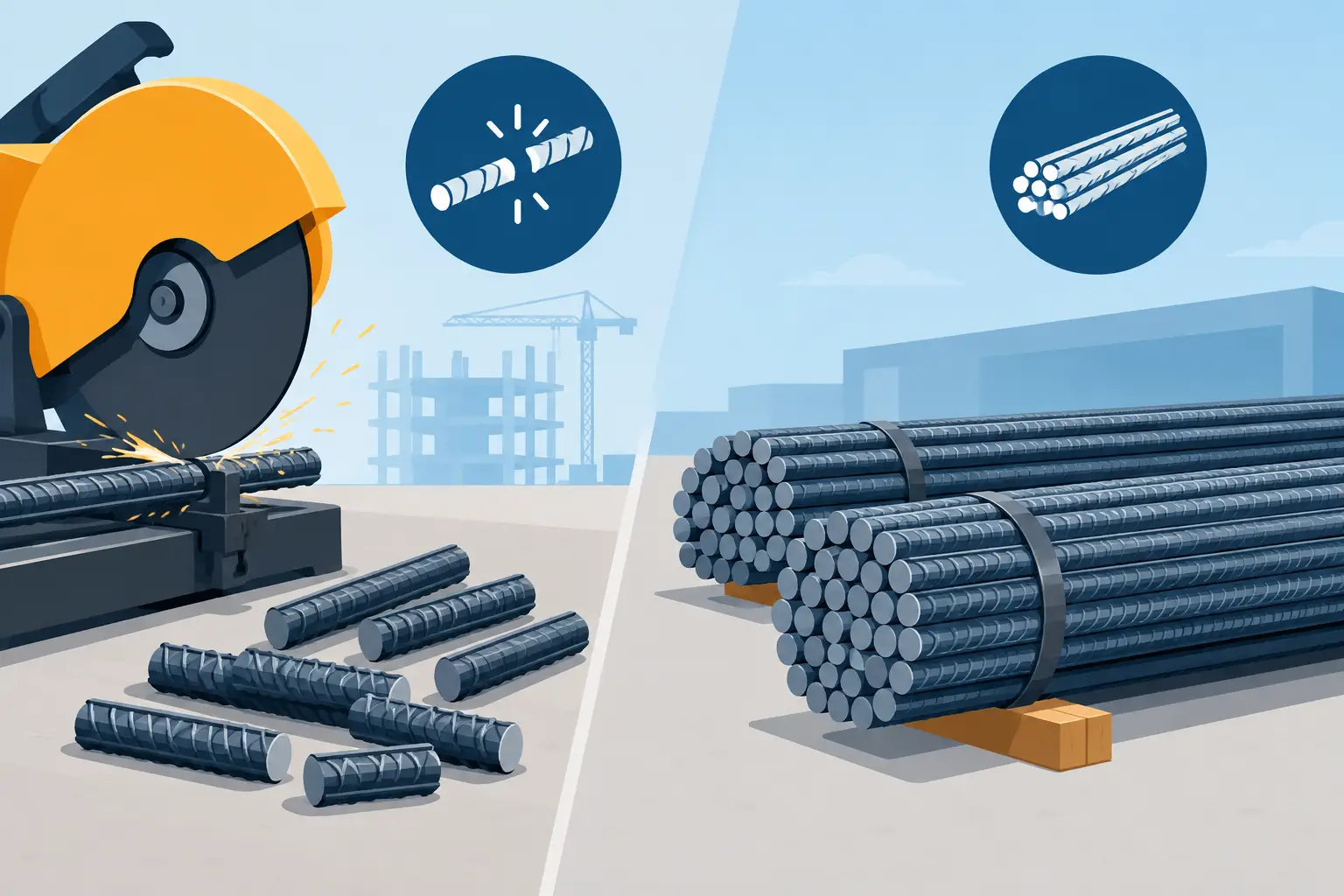
A crew waiting on reinforcement is a crew that cannot pour. That is why the choice between cut rebar versus stock lengths should be made well before the concrete truck is booked. Both options can deliver compliant reinforcement when the correct bar grade, diameter, placement, lap length, and cover are specified. The better buying decision comes down to how much processing your site can absorb without adding labor, waste, handling issues, or schedule risk.
For a simple footing, slab edge, driveway, or small retaining wall, stock bar lengths may be the quickest and most economical route. For repeatable cages, heavily detailed foundations, commercial pours, and jobs with limited laydown space, cut-to-length bar can take real pressure off the crew. The key is pricing the full job, not just comparing the per-piece cost.
What changes when rebar arrives cut to length?
Cut rebar is supplied to the lengths shown on an approved bar schedule, takeoff, or clearly confirmed cutting list. Instead of receiving full commercial lengths and trimming them on site, the crew receives bars that are ready to place, tie, or form into the required reinforcement assembly.
The immediate benefit is less site processing. There is less measuring, marking, cutting, stacking offcuts, and moving long bars around an active work area. That matters when the pour sequence is tight or when several workers are needed on formwork, vapor barriers, chairs, embeds, and final checks.
It also improves consistency. Repetitive bars for footings, grade beams, columns, walls, and slabs are cut to the same nominated length. That does not replace site supervision or a check against the drawings, but it reduces the chance that one hurried cut creates a short bar, a missed lap, or a last-minute scramble for extra material.
Cutting is particularly useful where bar lengths vary throughout the job. A package containing many 8-foot, 10-foot, 12-foot, and 14-foot pieces is easier to control than a pile of full lengths and a growing stack of unidentified offcuts. If the work is staged, labeling or separating bundles by pour area makes the delivery even more useful.
Where cut lengths can create problems
Custom cutting depends on accurate information. If the drawing revision changes after the order is processed, or if the cutting list includes an incorrect length, cut material may not be as flexible as stock bars. A full-length bar can often be trimmed or reassigned elsewhere. A short, job-specific piece may have limited use.
Lead time also needs attention. Stock sizes can often be dispatched quickly when available, while cut material requires processing and confirmation. For urgent work, the practical answer may be a combination: secure the standard stock needed to keep the crew moving, then schedule the custom-cut package for the detailed sections.
When stock rebar lengths make more sense
Stock lengths are straight reinforcing bars supplied in standard lengths. They give contractors flexibility to cut, lap, and allocate steel as conditions on site develop. For many small and medium jobs, that flexibility is worth more than the labor saved by pre-cutting.
A straightforward residential slab is a good example. If the reinforcing layout uses repeated runs with a modest range of dimensions, full lengths can be cut efficiently on site. The crew can adjust around penetrations, step-downs, changed formwork, and field measurements without waiting for replacement pieces.
Stock bar is also a practical choice when the job has uncertain quantities. Excavation conditions may alter footing dimensions, or a civil repair may reveal more damaged area than expected. Keeping standard lengths available allows the team to respond without placing a new order for every adjustment.
The trade-off is that the site takes on the processing. Workers need suitable cutting equipment, a safe cutting area, time to measure accurately, and a plan for offcuts. The apparent saving on the material line can disappear if skilled labor is spending hours cutting bar instead of installing reinforcement.
Offcuts are not automatically waste
A stock-length order should not be judged only by the fact that some cutting will occur. Offcuts can be used for dowels, short laps where permitted by the design, tie bars, edge reinforcement, small pads, and future repairs. The issue is whether your team has a realistic reuse plan.
If every required bar is a different length and the short pieces cannot be used elsewhere, waste can become expensive. This is where a basic cutting plan earns its keep. Group required lengths by diameter, map them against the stock length, and calculate the expected remainder before ordering. It is better to identify a waste problem at the takeoff stage than after a bundle has been cut down.
Comparing cut rebar versus stock lengths on real job costs
The cost comparison is not simply custom-cut price versus full-length price. A useful comparison includes material yield, cutting labor, crew downtime, delivery timing, handling, storage, and the risk of ordering more steel after the first package is consumed.
Cut lengths may carry a processing charge, but they can reduce waste and keep installers focused on placing steel. They can also reduce congestion. On a tight urban site, fewer long bars and fewer offcut piles make it easier to move forms, mesh, chairs, and other materials safely.
Stock lengths may have a lower initial material cost and can be available faster. They are often the right answer when your crew is equipped to process bar efficiently and can use the offcuts. They also provide a useful buffer for design changes or site variation.
For larger pours, look at labor in practical terms. If two workers spend half a day measuring and cutting bar, the cost is more than their wages. It can delay pre-pour inspections, interfere with other trades, and create pressure at the end of the shift. A cut package that arrives organized for the pour can be the lower-cost option even when the invoice price is higher.
Use the reinforcement schedule, not a rough guess
Whether you order cut bar or stock lengths, start with the latest structural drawings and reinforcement schedule. Confirm bar diameter, grade, quantities, lengths, bends, laps, hooks, spacing, and any notes that affect fabrication or placement. Do not assume a bar length from a scaled drawing when a schedule or engineer detail provides the actual requirement.
Cut-to-length supply is not the same as fabricated reinforcement. If the job requires bent bars, stirrups, U-bars, hooks, or other shaped pieces, identify those requirements separately. The supplier needs the correct shape, dimensions, quantity, and bar size to quote and supply the right product.
It is also worth separating the order by pour sequence. Ordering all the steel for a project at once can be efficient, but only if you have dry, safe storage and enough room to keep different bar marks organized. On restricted sites, staged deliveries reduce double-handling and make it less likely that steel intended for a later pour gets used early.
Delivery and handling can decide the best option
Long stock bars need room to unload and maneuver. Before ordering, check truck access, gate width, overhead obstructions, unloading equipment, and where the bundle will sit. A bar that is easy to buy is not useful if it blocks access or has to be moved three times before installation.
Cut lengths can be easier to unload and stage, especially when bundles are sorted by size or work area. But small pieces still need to be secured and identified. Ask for a delivery plan that matches the site sequence, particularly where urgent delivery is needed to protect a booked pour.
At Quality Steel Supplies, the practical approach is to provide the bar size, grade, quantity, required lengths, and delivery timing upfront. For cut material, send a clear, checked cutting list and note whether bundles need to be separated by pour, area, or bar mark. That gives the supplier the information needed to process the order correctly and get it to site without avoidable back-and-forth.
A simple way to choose
Choose stock lengths when the work is simple, dimensions may change, offcuts have likely reuse, and your crew can cut safely and efficiently on site. Choose cut rebar when lengths are repetitive or varied, labor is tight, waste is likely, site space is limited, or the pour schedule leaves little room for last-minute processing.
Many jobs need both. Stock bars provide flexibility for field adjustments, while cut lengths handle the high-volume, repeated pieces that would otherwise consume crew time. Build that decision into the takeoff early, confirm the latest drawings, and have reinforcement on site in a form your crew can place with confidence before the pour clock starts.
Related Posts