Rebar fabrication services reduce field cutting, support accurate placement, and help concrete crews keep schedules, inspections, and deliveries on track.
Reinforcing Mesh vs Rebar: Which Fits?
If you’re pricing a slab, footing, wall, or driveway, reinforcing mesh vs rebar is not a small detail. It affects labor time, placement speed, crack control, structural performance, and how smoothly the pour goes on site. Get it right and the job moves. Get it wrong and you can lose time fixing layout issues, chasing stock, or dealing with failed inspections.
For most contractors, the real question is not which product is better in general. It is which product suits the specific element being poured. Mesh and rebar both reinforce concrete, but they do different jobs well. The best choice depends on span, thickness, load paths, spacing requirements, handling on site, and what the drawings call for.
Reinforcing mesh vs rebar: the basic difference
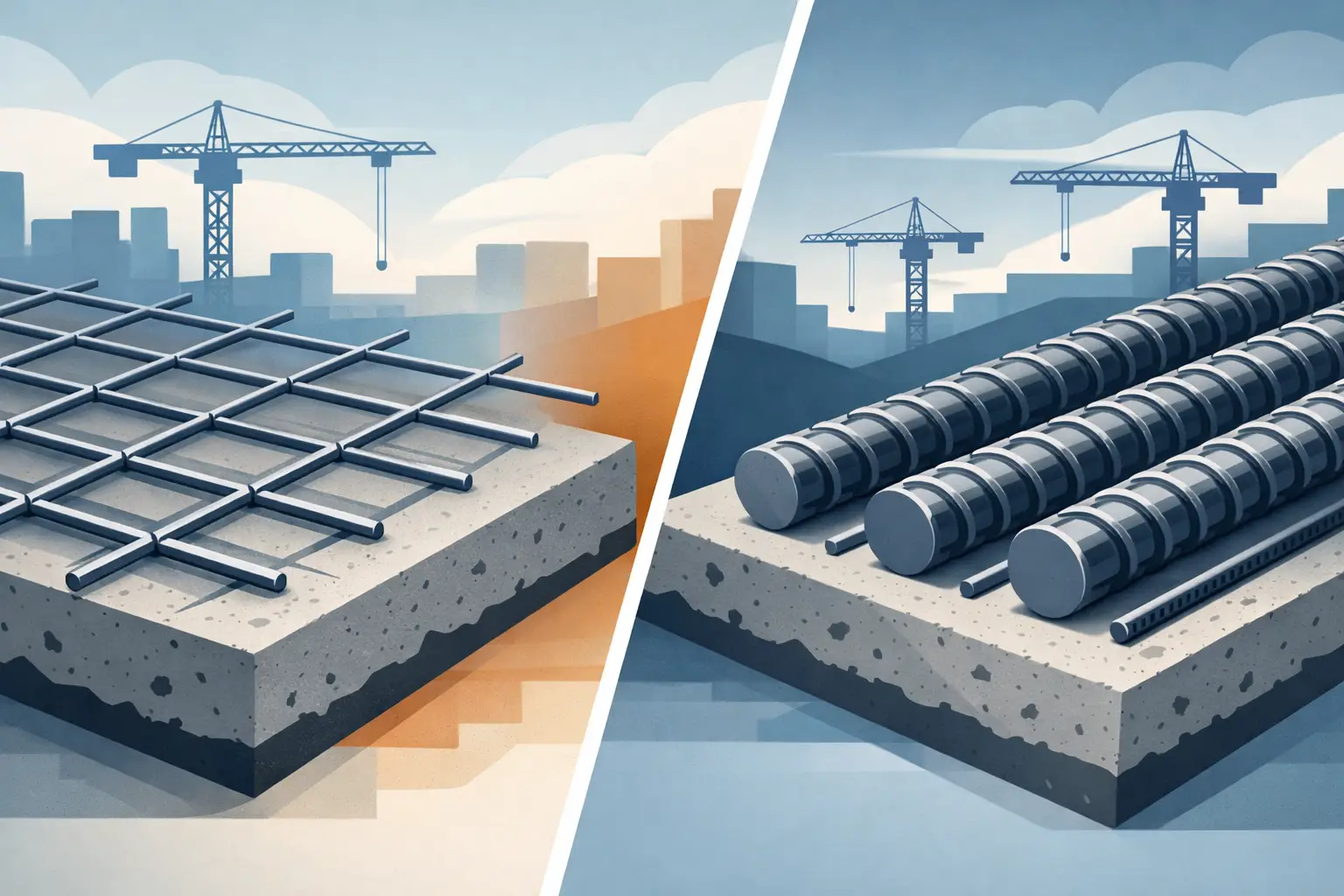
Reinforcing mesh is a prefabricated grid of steel wires or bars welded together at consistent spacing. It is commonly used in slabs and flatwork where you want even reinforcement across a wide area. Because it comes in sheets, it covers ground quickly and helps crews maintain regular spacing without tying every intersection by hand.
Rebar is individual reinforcing bar supplied in straight lengths, and sometimes formed into specific shapes such as stirrups or bent bars. It gives more flexibility for custom placement, heavier loads, edge detailing, beam cages, footings, columns, and areas where reinforcement needs to follow a structural design rather than a repeating grid.
That is the short version. On a real job, the difference shows up in labor, waste, and how easy it is to build what the engineer has specified.
Where reinforcing mesh makes more sense
Mesh is usually the faster option for large flat areas. Residential slabs, driveways, patios, paths, warehouse floors, and similar pours often suit mesh because coverage is quick and consistent. A crew can place sheets, lap them correctly, support them with bar chairs, and move on without the time required to build a full bar mat from loose rebar.
That speed matters when labor costs are tight or the pour window is narrow. If the slab design is straightforward and the specified reinforcement is a standard mesh grade, mesh can reduce handling time and simplify ordering. It also helps smaller crews stay efficient because the spacing is already built into the sheet.
Mesh is also useful where distributed crack control is a key concern. Concrete will crack. The point of reinforcement is not to stop every crack from forming, but to control crack width and help the slab perform as intended. In many slab applications, that consistent grid is exactly what is needed.
The trade-off is flexibility. Mesh works best when the reinforcement layout matches the sheet format. Once the geometry becomes irregular, or the engineer calls for concentrated steel in specific zones, mesh can become awkward. Cutting around penetrations, steps, rebates, or odd slab edges can create waste and extra tying work.
Where rebar is the better choice
Rebar is the go-to option when strength needs to be placed exactly where the design requires it. Footings, ground beams, retaining walls, suspended elements, thickened edges, column starters, and heavily loaded slabs often need bar reinforcement because the steel layout is not uniform across the whole pour.
With rebar, you can adjust spacing, diameter, lap lengths, cover, and orientation to suit the structure. That makes it better for engineered details where one part of the element carries a lot more load than another. It also suits small but structurally demanding areas, where using full mesh sheets would be inefficient.
Rebar is also easier to work with in congested reinforcement zones. If there are multiple layers, starter bars, hold-downs, penetrations, and formwork constraints, individual bars give the installer more control. You can build the cage or mat to suit the detail instead of forcing a standard sheet into a non-standard space.
The obvious downside is labor. Rebar takes more measuring, cutting, placing, and tying. If you are reinforcing a large simple slab with loose bars, installation time can climb quickly. Material cost is only part of the picture. Site hours matter just as much.
Cost is not just about steel price
A common mistake is comparing mesh and rebar by unit price alone. On paper, one option may look cheaper per ton or per length. On site, the cheaper material can still end up costing more if it slows placement, increases waste, or requires more fixing time.
Mesh often wins on labor efficiency for broad flat pours. Rebar often wins on material efficiency for custom structural work because you place only what is needed where it is needed. The best value comes from matching the product to the job rather than forcing one system into every application.
Delivery and availability also affect real cost. If a job needs standard mesh sheets urgently, fast supply can keep the pour on track. If it needs specific bar sizes, bent shapes, or a mixed reinforcement package with tie wire, chairs, and accessories, planning the order properly matters just as much as the steel rate.
Compliance and specification come first
On any structural job, the engineer’s drawings and local code requirements override preference. Reinforcement is not a category where guesswork is acceptable. If the specification calls for mesh, use the correct mesh grade and sheet type. If it calls for bar, use the specified diameter, spacing, lap, and cover.
This matters because mesh and rebar are not always interchangeable, even if the steel quantity looks similar. The structural behavior can differ based on spacing, bond, placement, and the way loads are distributed through the concrete element. Substituting one for the other without approval can create compliance issues and delay sign-off.
For trade buyers, that is why supply accuracy matters. Ordering the right reinforcement grade, quantity, and supporting items from the start saves more time than trying to solve a shortfall after steel has already landed on site.
Placement quality matters as much as product choice
The reinforcing mesh vs rebar decision only gets you halfway there. Poor placement can compromise either one.
Mesh needs to be supported properly so it stays in the designed position during the pour. Too often, mesh ends up sitting too low because it was not chaired correctly or was walked down during concrete placement. When that happens, the slab does not get the performance the design intended.
Rebar has its own risks. Incorrect spacing, inadequate laps, poor tying, or insufficient cover can all create problems. Because bar layouts are more manual, they rely heavily on careful fixing and supervision.
This is where accessories matter. Bar chairs, tie wire, spacers, and the right setup on site are not add-ons. They are part of getting the reinforcement system to perform properly once the concrete is placed.
Which suits common project types?
For residential slabs on grade, driveways, pathways, and many standard flatwork jobs, mesh is often the practical choice. It is fast, familiar to crews, and efficient where reinforcement is evenly distributed.
For strip footings, beam foundations, retaining walls, columns, and structural details with concentrated loads, rebar is usually the better fit. It allows exact placement and suits engineered layouts that vary from one section to another.
For commercial and industrial work, it is often not mesh or rebar. It is both. A project might use mesh in slab panels, rebar in thickened sections and footings, and formed accessories to complete the reinforcement package. That is normal. The job should drive the product mix.
How to make the right call before ordering
Start with the drawings. Check whether the reinforcement schedule specifies mesh, bar, or a combination. Then look at the actual site conditions. Is the area large and repetitive, or detailed and irregular? Is labor available for bar fixing, or is installation speed the main pressure point? Are there penetrations, set-downs, edge thickenings, or heavy-load zones that make a sheet product less efficient?
After that, think about the full package. Reinforcement supply is rarely just steel. You may also need chairs, tie wire, starter bars, stirrups, and other site essentials delivered together so crews are not waiting around. A supplier that understands reinforcement detail can help make sure the order reflects what the job actually needs, not just what looked cheapest at first glance.
For Auckland builders and concrete crews working to a tight schedule, that practical side matters. Quality Steel Supplies focuses on compliant reinforcing products, clear pricing, and fast delivery because delays on reinforcement do not stay small for long.
If you are choosing between mesh and rebar, the answer is usually simple once the structure is clear. Use mesh where coverage, consistency, and speed matter most. Use rebar where the design needs strength placed with precision. When a job needs both, order both properly and keep the pour moving.
Related Posts