Rebar fabrication services reduce field cutting, support accurate placement, and help concrete crews keep schedules, inspections, and deliveries on track.
What Bar Size Suits Driveways?
A driveway that looks fine on pour day can start showing its weak spots after the first loaded truck, a wet winter, or a bit of subgrade movement. That is why the question of what bar size suits driveways matters well before concrete shows up on site. Get the steel wrong, and you are not just overspending or cutting costs too hard – you are affecting crack control, load performance, and the service life of the slab.
For most residential driveways, rebar selection is not about chasing the biggest bar you can fit into the slab. It is about matching the reinforcing to the slab thickness, expected traffic, ground conditions, joint layout, and the engineer or local code requirements. In many cases, smaller bar at the right spacing performs better than heavier bar dropped into a poor slab design.
What bar size suits driveways in most cases?
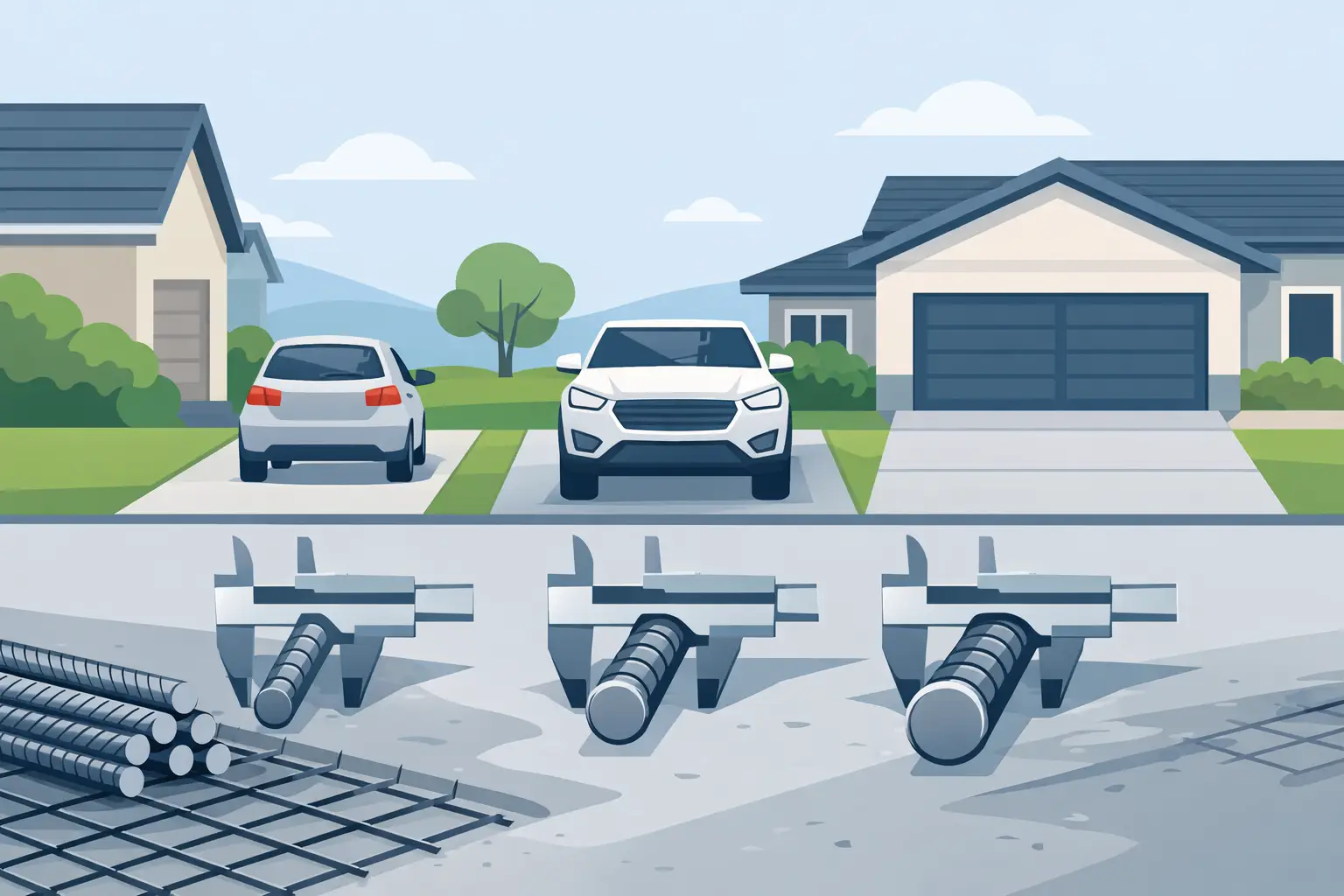
For a standard residential driveway, #3 or #4 rebar is commonly used, depending on the slab design and expected load. A typical light-duty driveway for passenger vehicles may use #3 bar if the slab, base prep, and spacing are designed correctly. Where the driveway will see heavier vehicles, poor soil, wider slab panels, or more demanding site conditions, #4 bar is often the safer call.
That said, there is no one-size-fits-all answer. A 4-inch slab for light residential use is a different job from a 6-inch driveway crossover seeing delivery vans, work utes, or occasional heavier axle loads. If the slab is carrying more than cars and SUVs, bar size should be reviewed as part of the full reinforcement layout, not picked in isolation.
In practical terms, #3 rebar has a nominal diameter of 3/8 inch, while #4 is 1/2 inch. That increase does not sound dramatic, but it changes the steel area and stiffness enough to matter. The trade-off is cost, placement tolerance, and cover. Larger bar can make sense structurally, but it also needs enough slab depth and proper support to sit where it is meant to sit.
Bar size is only part of the driveway design
When people ask what bar size suits driveways, they often mean what steel will stop cracking. Reinforcement does not stop concrete from cracking altogether. Concrete will still shrink, move, and respond to temperature changes. What reinforcement does is help hold cracks tighter, improve load distribution, and reduce the chance that small issues become structural failures.
That means the best rebar size on paper can still underperform if the base is soft, the slab is too thin, the concrete mix is poor, or the bars end up sitting on the ground because they were not supported properly during the pour. On driveways, placement matters just as much as selection. If the steel is not held at the correct height with proper bar chairs or supports, the benefit drops quickly.
For many driveway jobs, the bigger performance gains come from getting four basics right: compacted base, correct slab thickness, proper jointing, and reinforcement placed in the right position with adequate cover. Once those are sorted, bar size can be chosen with more confidence.
Slab thickness changes the answer
A thinner residential slab does not leave much room for heavy bar, especially when you still need proper concrete cover above and below the steel. In a 4-inch driveway slab, using #4 bar may be appropriate in some designs, but placement tolerance becomes tighter. In a 5-inch or 6-inch slab, #4 bar is easier to accommodate correctly and may be better suited to the loads.
If the slab is too thin for the bar size, there is a real risk of poor cover, exposed steel over time, or bars ending up too low in the section. That is one reason oversized rebar is not automatically better. Reinforcement needs to work with the slab dimensions, not fight them.
Vehicle loads matter more than many homeowners expect
A driveway used only by family cars is one thing. A driveway that regularly sees garbage trucks at the edge, delivery vans, trailers, work pickups with loads, or small service trucks is another. Even occasional heavy loading can stress weak sections, especially near entrances, edges, or where the subgrade is variable.
On those jobs, stepping up from #3 to #4 bar may be justified, but so might increasing slab thickness, tightening bar spacing, or improving the base course. If there is a known heavy-use zone, such as the apron near the street or a turning area, reinforcement can also be detailed for that condition rather than treated as a standard residential slab throughout.
Ground conditions can force a heavier approach
A driveway on stable, well-drained, compacted material behaves very differently from one over fill, clay, or moisture-sensitive soil. Expansive or poorly compacted ground increases the risk of differential movement. In those conditions, reinforcement becomes more important, but again, bar size alone does not solve the problem.
Poor subgrade may justify heavier bar, closer spacing, thicker concrete, or all three. It may also require geotechnical input, especially on sloped sites or where previous settlement is already visible. If the soil is doing the wrong thing underneath, even a strong steel layout can only do so much.
Rebar vs mesh for driveways
Many driveway slabs use welded wire mesh rather than loose rebar, and on some jobs that is completely appropriate. Mesh can be quicker to place and works well for shrinkage and crack control when specified correctly. Rebar is often preferred where loads are higher, slabs are thicker, edge strengthening is needed, or the reinforcement layout needs more flexibility.
There is no need to turn this into a mesh-versus-bar argument. The right choice depends on the design. Some driveways use mesh through the slab and additional bars at thickened edges, control joints, or high-stress areas. Others are reinforced primarily with bar because the slab geometry, loading, or engineering detail calls for it.
If you are supplying or ordering steel for a driveway, the useful question is not which product is better in general. It is which product matches the engineer’s detail, expected service conditions, and the install crew’s ability to place it correctly.
Common driveway scenarios
For a basic residential driveway carrying cars and light pickups, #3 bar may suit the slab if thickness, spacing, and support are all in order. For a heavier-duty residential driveway, a steep drive, a crossover, or an area with frequent work vehicle access, #4 bar is often the more common choice.
Once you move into sites with poor ground, retained edges, heavier commercial traffic, or engineered pavement requirements, the answer becomes project-specific. That is where guessing bar size from habit gets risky. A driveway is still a structural element, even if it is a small one.
Spacing affects performance as much as size
A common mistake is focusing on bar diameter while ignoring spacing. Smaller bar at closer centers can provide better crack distribution than larger bar spaced too far apart. The steel area, slab geometry, and crack control objective all need to work together.
That is why two driveways can both be reinforced correctly while using different bar sizes. One may use #3 at tighter spacing for a standard residential slab. Another may use #4 at wider spacing for a thicker slab or a heavier load case. Neither is automatically right or wrong without the rest of the detail.
Placement errors can waste good steel
Even the correct bar size will underperform if the steel is dragged down during the pour, left too close to the surface, or poorly lapped. Driveway reinforcement should be supported on suitable chairs and set to the specified cover. Laps, edge distances, and continuity need to follow the design, not site guesswork.
For trade crews, this is routine work, but it is still where plenty of problems start. If the steel is ordered correctly and then installed badly, the slab will not care what was on the delivery docket.
How to choose the right bar size without overbuilding
The cleanest approach is to start with the driveway use case. Ask what traffic the slab will actually see, not just what it is meant to see. Then look at slab thickness, base prep, drainage, soil behavior, and whether there are any engineered details or local code requirements.
If the driveway is a straightforward residential pour on good ground, #3 bar may be enough. If loads are higher or conditions are less forgiving, #4 bar is often worth the extra material cost. Going beyond that for a typical driveway is usually unnecessary unless the design specifically calls for it.
For buyers and contractors, the practical point is this: do not buy reinforcement by rule of thumb alone. Make sure the bar size suits the slab design, and make sure the supporting products are right as well. Chairs, tie wire, laps, edge thickening, and proper placement all count. A dependable supplier can help confirm you are ordering compliant material that matches the job, whether that is standard driveway bar, mesh, or a combination of both.
If you are still weighing what bar size suits driveways on your next pour, treat the steel as part of the system, not the whole answer. The best driveway slabs are not built with the biggest bar on the rack – they are built with the right reinforcing, placed properly, over ground that has been prepared to carry the load.
Related Posts