
What causes asphalt cracks? Learn how water, traffic, heat, poor drainage, and weak base preparation damage pavement - and how to plan lasting repairs.
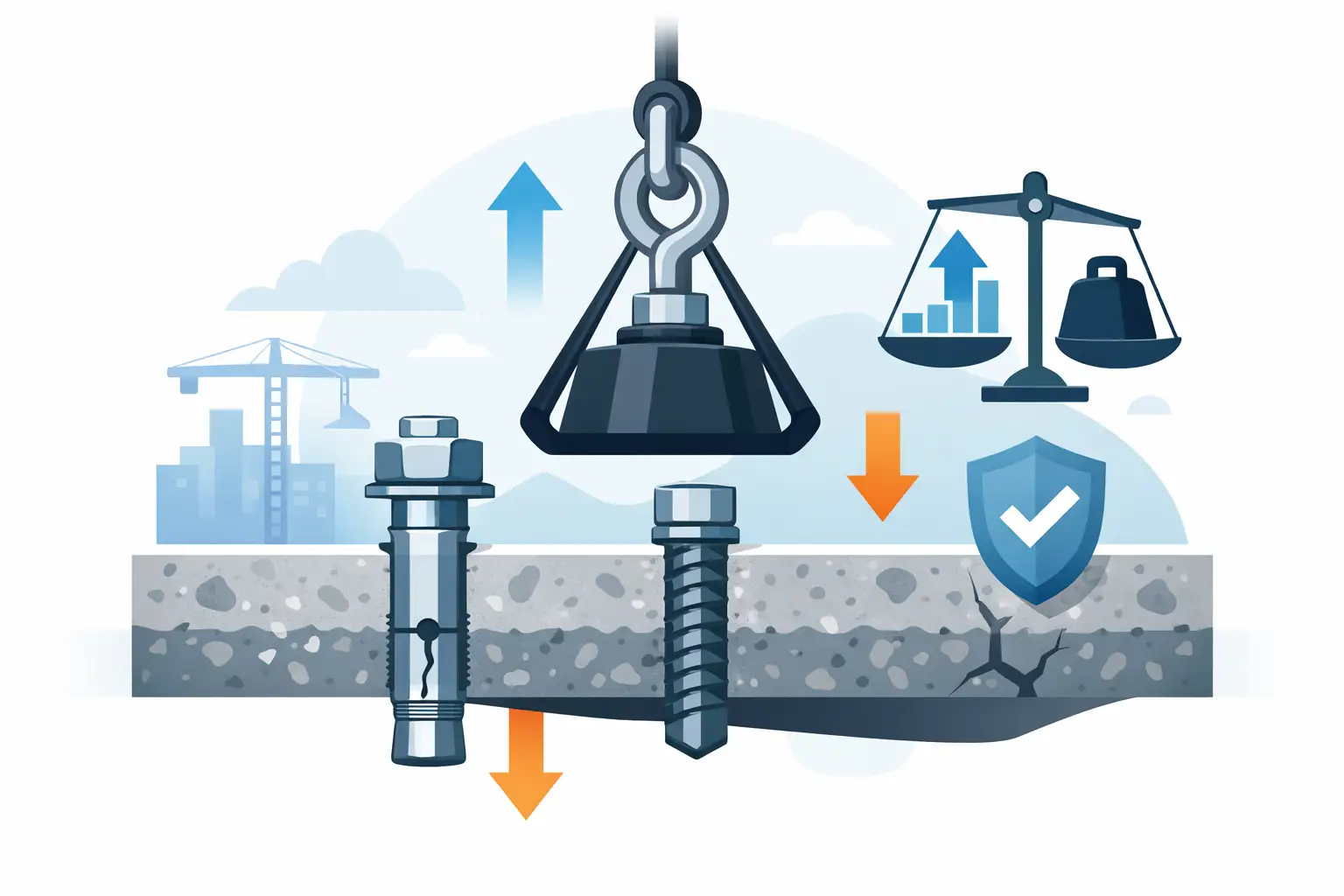
Anchor Load Ratings for Safe Concrete Fixing
A concrete anchor that looks right on the shelf can still be the wrong fixing for the job. Anchor load ratings are only useful when they are read against the actual concrete, the load direction, the edge conditions, and the installation method on site. For structural, safety-critical, or overhead work, guessing from anchor diameter alone is not an option.
The practical question is not, “How much can this anchor hold?” It is, “What load can this installed anchor safely resist in this specific condition?” That distinction protects the structure, the crew, and the project schedule.
What Anchor Load Ratings Actually Mean
An anchor load rating is the stated capacity of an anchor under defined test and design conditions. It may be shown as an allowable working load, a design strength, or an ultimate test load. These are not interchangeable numbers.
An ultimate load is the load at which failure occurred in testing. It is not the load that should be applied in service. A working or allowable load has already had safety factors applied, while design-strength values are used with the load combinations and reduction factors required by the relevant design standard. Always use the rating format specified by the anchor manufacturer and the project engineer.
A published rating may assume a particular concrete strength, minimum slab thickness, embedment depth, edge distance, spacing, and installation torque. Change one of those conditions and the usable capacity may reduce significantly. A rating for uncracked concrete, for example, cannot automatically be used in cracked concrete.
Tension, Shear, and Combined Loading
Anchors are commonly loaded in tension, shear, or both at once. Tension pulls the anchor straight out of the concrete. Shear pushes it sideways, such as a base plate resisting a lateral force. Many real connections experience combined loading, so checking only one rating can leave a critical gap.
A handrail post, for example, can put tension on anchors when a person leans against it, while wind or impact applies shear. A steel bracket supporting pipework may carry sustained tension as well as sideways movement. The anchor selection needs to account for the governing load case, not just the most obvious force.
Where tension and shear act together, the anchor design normally uses an interaction check. As one load approaches its allowable limit, less capacity remains for the other. The calculation method depends on the applicable code and the anchor’s technical data, but the principle is simple: do not treat full tension capacity and full shear capacity as available at the same time.
Conditions That Change Anchor Capacity
The rating printed in a catalog is a starting point. The installed condition determines whether that capacity is achievable. The following factors regularly affect anchor load ratings:
- Concrete condition: Cracked concrete generally provides lower capacity than uncracked concrete. Concrete strength, age, moisture condition, and deterioration also matter.
- Edge distance: Anchors too close to a slab edge can break out a cone of concrete under tension or split the edge under shear.
- Anchor spacing: Closely spaced anchors can overlap their concrete breakout zones. A group of four anchors does not always provide four times the capacity of one anchor.
- Embedment depth: Deeper embedment can improve performance, but only within the manufacturer’s approved installation range and the available slab thickness.
- Load duration and environment: Sustained loads, vibration, seismic demand, corrosion exposure, and elevated temperatures can require a different anchor or a reduced rating.
Base plates are a common example. A contractor may have enough steel in the plate and enough anchor diameter, yet still have a weak connection because the anchors sit too close to the edge of a narrow footing. Increasing the anchor size may not solve a concrete breakout problem. Moving the plate, increasing footing dimensions, or changing the anchoring detail may be the proper fix.
Choose the Anchor Type for the Job
Mechanical expansion anchors, screw anchors, undercut anchors, and adhesive anchors each transfer load into concrete differently. The right option depends on the load, base material, installation access, environmental conditions, and approval requirements.
Mechanical anchors are often fast and practical for repetitive fixing into sound concrete. Their performance can be sensitive to correct hole diameter, cleaning, setting, and torque. Screw anchors can be efficient where removability or reduced edge-distance demands are useful, provided the approved rating supports the application.
Adhesive anchors are commonly used for threaded rod and rebar doweling, particularly where deeper embedment is needed. They demand more installation control. Hole cleaning, resin temperature, concrete temperature, curing time, and proper mixing all affect performance. Loading an adhesive anchor before full cure can turn a compliant product into a failed connection.
For any structural connection, use an anchor with current technical data and approvals applicable to the project. Match the fixing to the approved detail instead of substituting based on availability or a similar-looking product.
Reading an Anchor Data Table
When reviewing an anchor data table, start by confirming the anchor diameter and effective embedment. Then identify whether the listed figures apply to cracked or uncracked concrete, normal-weight or lightweight concrete, and tension or shear loading.
Check the minimum edge distance, minimum spacing, and minimum member thickness beside the rating. These dimensions are often shown in millimeters and can be easy to miss when crews are working from a marked-out base plate. If the anchor layout does not meet those minimums, use the manufacturer’s reduction method or have the connection reviewed by the engineer.
Also look for installation values. Torque-controlled anchors need the stated torque. Over-torquing can damage threads or overstress the concrete; under-torquing can prevent the anchor from setting correctly. Adhesive systems require the specified drill bit size, hole-cleaning sequence, dispensing method, and cure period.
Installation Is Part of the Rating
A quality anchor installed poorly is not a rated anchor. Most fixing failures trace back to a small number of avoidable issues: incorrect hole diameter, shallow drilling, dust left in the hole, damaged threads, missed torque, inadequate cure time, or anchoring into weak and unsupported concrete.
Before drilling, confirm what is inside the slab or wall. Reinforcing bar, post-tensioning tendons, electrical conduits, and services can affect both safety and the approved anchor position. Do not simply shift an anchor hole to avoid steel unless the revised edge distance and spacing still comply with the connection design.
Use the correct drill method for the anchor system and base material. Drill to the required depth, allowing for dust where the installation instructions call for it. Clean the hole exactly as specified. For critical work, record anchor type, lot information where required, embedment, torque or cure time, and installer details. That record is useful when inspections occur or site conditions are questioned later.
When a Published Rating Is Not Enough
Catalog data is suitable only when the connection fits the published conditions. Get engineering input when loads are high, the fixing is structural or overhead, concrete condition is uncertain, anchors are near edges, seismic performance is required, or the detail falls outside the manufacturer’s tables.
This also applies to retrofit work. Existing concrete can contain cracking, corrosion, unknown reinforcement, low strength, or damage from previous drilling. A pull test may be appropriate in some situations, but it does not replace a complete design check unless the engineer specifies that testing approach.
For builders and concrete crews, the best purchasing decision is usually made before the crew reaches site: confirm the anchor type, diameter, embedment, quantity, and approved installation accessories with the detail in hand. Quality Steel Supplies can help keep essential concrete fixing materials moving when the job needs fast supply, but the final anchor selection must match the engineer’s design and the manufacturer’s current data.
Treat anchor capacity as a site-specific design check, not a number to memorize. When the concrete, layout, loading, and installation all match the approved conditions, the fixing does the job it was selected to do.
Related Posts