Rebar fabrication services reduce field cutting, support accurate placement, and help concrete crews keep schedules, inspections, and deliveries on track.

Anchor Bolts for Concrete: Selection and Installation
A base plate can be perfectly fabricated, the steel can arrive on time, and the concrete can meet strength requirements – but the connection still fails if the anchors are wrong. Anchor bolts for concrete transfer load from structural steel, equipment, timber hold-downs, guardrails, and other fixtures into the slab or foundation. They are small compared with the rest of the build, but they are not a minor detail.
For builders and concrete crews, the practical challenge is getting the right anchor type, diameter, embedment, layout, and installation method before the pour or before drilling begins. A quick substitution on site can create expensive rework, failed inspections, cracked concrete, or a connection that does not perform as designed.
What Anchor Bolts Do in Concrete
Anchor bolts, often called anchor rods when used with structural steel base plates, secure an item to hardened or newly placed concrete. The bolt transfers tension, shear, or a combination of both into the concrete mass. Tension tries to pull the anchor out. Shear pushes it sideways. Most real connections see some of each, particularly at column bases, equipment supports, and hold-down locations.
The concrete must resist several possible failure modes. The steel anchor can yield or fracture, but concrete can also break out in a cone around the anchor, split near an edge, or fail under repeated loading. That is why anchor selection is not just a matter of choosing the largest bolt available. Embedment depth, anchor spacing, concrete thickness, edge distance, reinforcement, and the design load all affect capacity.
For structural work, use the project drawings and engineer’s connection schedule as the controlling documents. The anchor specification should identify the anchor type, grade, diameter, length or embedment, location, and any required testing or installation procedure. If those details are unclear, resolve them before materials are ordered or concrete is poured.
Cast-In Anchor Bolts vs. Post-Installed Anchors
The first decision is usually whether anchors will be placed before the concrete pour or installed after the concrete has cured. Both methods have a place on a working jobsite, but they solve different problems.
Cast-in-place anchors
Cast-in-place anchor bolts are set into the formwork before concrete placement. They may be straight rods with a plate, headed anchors, hooked bolts, or threaded rods fitted with nuts and anchor plates. They are common for column base plates, heavy equipment, precast connections, and hold-downs where high loads or reliable placement are required.
Their main advantage is predictable load transfer. Because the anchor is installed as part of the pour, it can achieve substantial embedment without relying on drilled-hole condition or adhesive cure. The trade-off is coordination. Bolt centers must match the base plate, and the anchors need to stay plumb and in position while crews place and vibrate concrete.
A steel or plywood template is the practical answer for multi-bolt layouts. Set the template from survey lines, brace it firmly, and recheck diagonal measurements before the pour. Thread protection is also worth the effort. Damaged threads, concrete buildup, or bent rods can hold up steel erection even when the foundation itself is correct.
Mechanical post-installed anchors
Mechanical anchors are installed in drilled holes after concrete has cured. Depending on the application, these may include wedge anchors, sleeve anchors, drop-in anchors, or screw anchors. Tightening the anchor creates expansion or bearing against the hole wall, allowing the fixture to transfer load into the concrete.
Mechanical anchors suit lighter to medium-duty work, retrofit details, brackets, railings, and site changes where cast-in anchors were not planned. They are fast when the correct hole diameter, embedment, and torque are followed. They can be less suitable near slab edges, in thin concrete, or where high tension loads demand deeper embedment and larger edge distances.
Do not treat torque as a rough guide. Under-tightening can leave an expansion anchor without proper engagement; over-tightening can damage threads or overstress the concrete. Use the manufacturer-specified drill size, hole depth, cleaning method, and torque value for the exact anchor being installed.
Adhesive anchors
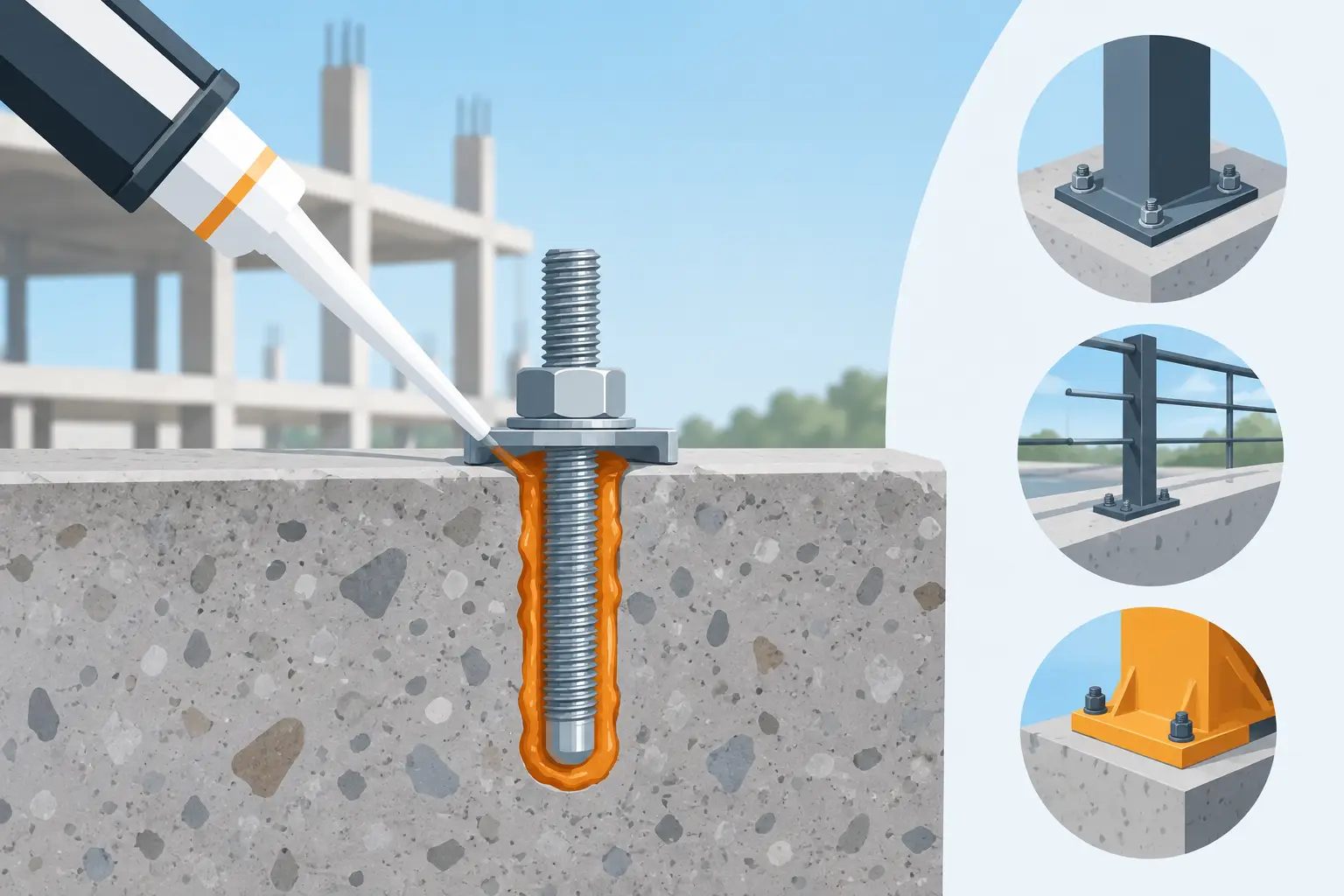
Adhesive anchors use a threaded rod or rebar installed into a drilled hole with an approved chemical adhesive. They are regularly used for structural retrofit connections, doweling, and applications requiring longer embedment or higher tension capacity than a typical expansion anchor can provide.
Installation quality matters more with adhesive anchors than with almost any other concrete fixing. The drilled hole must be the right diameter and depth. Dust must be removed with the specified blow-brush-blow sequence or equivalent method. The adhesive needs to be mixed correctly, injected from the bottom of the hole, and allowed to cure for the actual site temperature before loading.
Cold weather, wet holes, overhead installation, cracked concrete, seismic design, and sustained loads can all change which adhesive system is acceptable. Use an anchor system specifically evaluated for the job conditions. A general-purpose chemical product is not automatically suitable for a structural hold-down or loaded steel connection.
The Dimensions That Control Anchor Performance
Anchor bolts concrete connections are often judged by bolt diameter alone. Diameter matters, but it is only one part of the connection. Four dimensions need attention on every anchor layout: embedment, edge distance, spacing, and concrete thickness.
Embedment is the depth of the anchor within the concrete. Greater embedment can improve tension capacity, but only when the concrete member is thick enough and the anchor is designed for that depth. Drilling deeper than specified is not a fix if it risks hitting reinforcement, penetrating through a slab, or reducing the remaining concrete cover below the anchor.
Edge distance is the distance from the anchor centerline to the nearest free edge. An anchor placed too close to an edge can break out a section of concrete under load. This is especially common with handrails, angles fixed to slab edges, and equipment brackets installed near a foundation perimeter.
Spacing is the center-to-center distance between anchors. When anchors are close together, their concrete breakout zones can overlap and reduce the group capacity. The drawing may show a compact base plate arrangement, but the anchor design still needs to account for the group rather than assuming each bolt delivers its individual published capacity.
Concrete thickness is equally practical. A thin slab may accept a light-duty fixing but not a deep structural anchor. Check the slab depth before drilling, including any topping, void former, or service zone beneath it. For suspended slabs, scanning and approval may be required before drilling to avoid reinforcement and post-tensioning tendons.
Installation Practices That Prevent Rework
The best anchor detail can still go wrong through rushed set-out. Before installing anchors, confirm the latest drawing revision, gridline references, elevations, and fixture dimensions. For base plates, check the actual plate against the bolt pattern rather than assuming the fabrication matches an early shop drawing.
For cast-in anchors, keep the template supported independently from reinforcement where possible. Tying it loosely to rebar can allow movement during placement. Check projection above finished concrete, especially where grout, leveling nuts, washers, and base plate thickness affect the required thread length.
For post-installed anchors, mark the drilling depth on the bit or use a depth stop. Drill perpendicular to the concrete surface unless the engineered detail states otherwise. Clean holes thoroughly, install the correct anchor, and use a calibrated torque wrench where torque is specified. Recording batch numbers, hole depth, torque, and cure time is good practice for critical structural anchors and often required by the project quality plan.
Avoid drilling through reinforcement simply to maintain a bolt location. If a bar is encountered, stop and escalate the issue. Moving the anchor, changing the base plate, or obtaining an engineered alternate may be necessary. Cutting reinforcing steel without approval can compromise the member that the anchor is supposed to rely on.
Common Problems With Concrete Anchors
The most costly failures usually start as small site shortcuts. Misaligned cast-in bolts can prevent a base plate from seating. Insufficient projection can leave no usable thread after leveling. An unclean adhesive hole can sharply reduce bond. Expansion anchors installed in cracked, weak, or green concrete may not achieve their intended capacity.
Another common issue is using a fixing rated for static loads where vibration, fatigue, wind, impact, or seismic loading applies. Equipment anchors, racking supports, and structural hold-downs need the right design basis. If the connection is safety-critical or carries a defined structural load, use the specified anchor product and installation method rather than selecting from a general hardware range.
Corrosion also deserves attention. Indoor dry conditions, exterior exposure, coastal environments, chemically treated timber, and industrial settings may require different corrosion protection. Zinc-plated fasteners are not interchangeable with hot-dip galvanized or stainless options. Match the anchor material and coating to the exposure conditions and the metals in the connected assembly.
Ordering Anchor Bolts for Concrete Work
Order anchors from a clear schedule, not from a rough count. Confirm the required diameter, thread, overall length, embedment, finish, nuts, washers, plates, and any templates or accessories. For post-installed work, confirm drill size, setting tools, adhesive cartridges, mixing nozzles, and cleaning brushes at the same time. An anchor is not useful if the crew has the wrong bit or cannot complete the installation to the approved method.
For large pours, separate anchor assemblies by footing, column line, or pour sequence and label them before delivery. This keeps the correct rods with the correct template and reduces the chance of discovering a missing size when concrete trucks are already on site. Quality Steel Supplies can help contractors source practical concrete fixing and reinforcement essentials with clear product information and fast delivery support when the program is tight.
A concrete connection is only as dependable as its set-out and installation. Give anchor locations the same attention as reinforcement cover and concrete finish, and the steel, equipment, or hold-downs that follow will have a sound place to start.
Related Posts